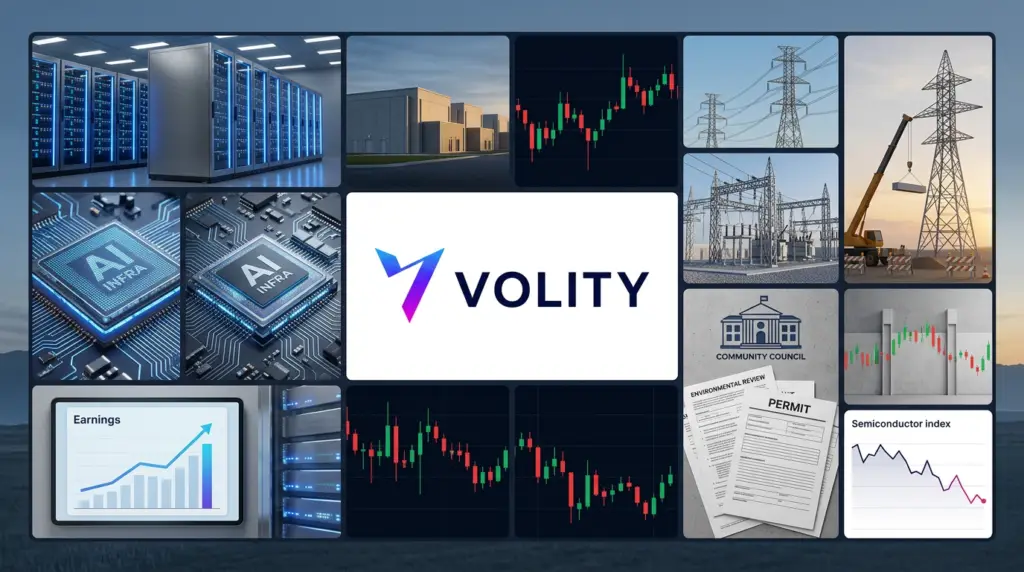
Thursday’s trading exposed a fault line beneath the artificial-intelligence boom. The next limit may not be chips, capital or demand. It may be permission to build.
The wider market held fairly steady after its post-election rally. Technology shares, however, told a more nervous story. The Philadelphia Semiconductor Index fell 3.1%, as Nvidia, Micron and SanDisk shares dropped.
Gold rose above $4,100 an ounce during the session. That move did not establish a new market regime. Still, investors rewarded selected earnings surprises while selling AI’s physical foundations.
Democratic victories in several states with large data-centre plans unsettled investors. They feared tougher permitting, environmental reviews and grid-connection requirements. Chipmakers, power suppliers and specialist infrastructure groups absorbed the first selling.
America has not turned against artificial intelligence. Data-centre construction remains intense, and researchers expect more than 50 gigawatts of new US capacity in 2027.
Yet the buildout faces growing friction. More than 300 local moratoriums have emerged. Projects in Texas, New York and New Mexico have also faced delays over power, permits and community resistance.
A delay is not the same as a cancellation. Still, delays raise financing costs and disrupt construction schedules. They can also test customer commitments and revenue assumptions.
Investors have valued some operators as if announced facilities were already producing cash. That assumption now looks less comfortable. The market will increasingly distinguish between planned capacity and secured capacity.
AI infrastructure meets the real world
The best-positioned companies hold signed customer contracts and reliable power access. They also carry balance sheets that can withstand a longer construction cycle.
Speculative operators face a harsher test. A presentation, a land option and a proposed power agreement no longer look sufficient. Investors will ask who pays, when construction starts and whether electricity actually arrives.
- SOXX: fell 3.1% on Thursday.
- Gold: traded above $4,100 an ounce.
- US data centres: more than 50 gigawatts of capacity expected in 2027.
- Local resistance: more than 300 reported moratoriums on data-centre development.
AppLovin delivers a powerful report
AppLovin gave the market’s clearest positive surprise. Third-quarter revenue reached $2.18 billion, up 55% from a year earlier. Earnings per share came in at $4.30, ahead of roughly $4.03 expected.
The company projected fourth-quarter revenue as high as $2.39 billion. That outlook exceeded expectations and sent APP up more than 20% before and after the opening.
The reaction made sense, although it also created a difficult entry point. APP had fallen about 60% during the year before the report. The earnings jump looked more like a violent repricing than a routine advance.
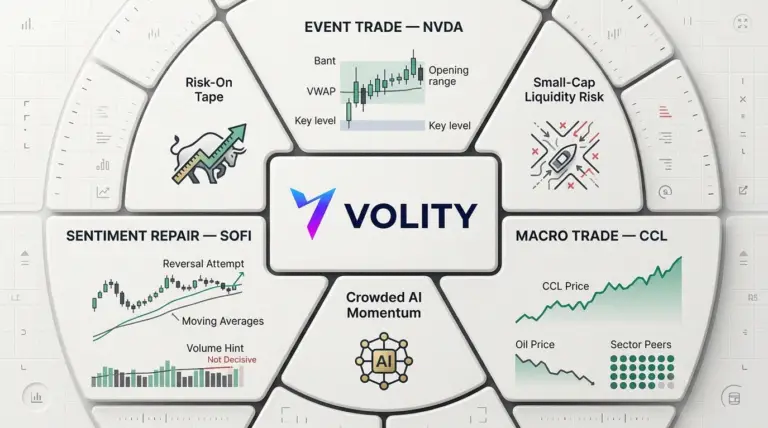
Momentum traders will see an obvious opportunity. They should also recognise the risk of buying the first euphoric candle. Large gaps can attract fast money, then leave late buyers stranded.
A calmer approach watches the opening range and volume. A controlled pullback that holds support could offer a cleaner setup. A break below the early range would suggest that enthusiasm has already faded.
Cloudflare turns earnings into an event-risk trade
Cloudflare was due to report after the bell. Analysts expected about $736.8 million in revenue and earnings per share near $0.34.
NET investors were watching guidance as closely as the quarterly numbers. Enterprise demand, margin direction and the growth outlook matter more than a narrow revenue beat.
A company can beat expectations and still fall. Guidance may disappoint, or investors may decide growth has slowed too much. Strong margins can also fail to impress if future sales look softer.
Options can indicate the expected size of a move. They cannot reliably predict its direction. For most traders, the more disciplined decision comes after the announcement.
The following session’s opening range often carries more information. If NET holds its gap with strong volume, continuation becomes plausible. If it breaks the post-earnings low, the market has delivered a less flattering verdict.
Alphabet remains a thesis, not a trading legend
Alphabet offers exposure to digital advertising, cloud computing and AI development. Its appeal does not depend on tales about early shareholders becoming billionaires.
The useful questions are harder and more immediate. Can Google monetise AI without weakening search economics? Can cloud growth justify rising capital spending? Will infrastructure costs press on margins?
Alternative search tools may also change user behaviour over time. Those questions make GOOGL a long-term investment candidate, not an automatic intraday trade.
Fresh earnings, revised guidance, a valuation reset or a confirmed technical move could change that. Until then, investors should separate a sound business case from a daily trading catalyst.
Semiconductors and energy demand more than labels
SOXX remains a useful temperature check for risk appetite. Weak chip shares can show investors reducing exposure to expensive, economically sensitive technology names.
One weak session does not confirm recession or a lasting bear market. A stronger warning would include weaker breadth, broken support levels, wider credit spreads and poorer economic data.
Energy income requires equal care. A high dividend yield can reflect a falling share price or an unsustainable payout. Investors should examine free-cash-flow coverage, debt, production costs and commodity-price sensitivity.
- Favour AI infrastructure firms with power access, contracts and funding.
- Wait for APP’s trading range before chasing a sharp earnings gap.
- Treat NET as a post-results setup, rather than a pre-results wager.
- Use SOXX as a risk gauge, not a recession forecast.
- Check energy dividends against cash flow, not yield alone.
Thursday did not mark the end of growth investing. It showed that AI ambition must now pass through the grid, permitting office and local council. The boom has met its first serious bottleneck.