Crypto’s trust test after Binance breach
Saturday, 31 October 2026
Crypto markets ended October facing a question larger than Bitcoin’s latest price move.
How much trust can the industry lose before investors demand a safer financial architecture?
Bitcoin fell to a six-week low near $76,368 on Friday after Binance disclosed a $6.3 billion wallet theft.
Ether slipped below $2,200, while BNB lost more than 6% during a broad rush for liquidity.
Leveraged traders absorbed more than $1.5 billion in liquidations, according to market data.
Binance said customer assets remain safe and pledged to absorb losses through corporate resources and emergency reserves.
However, the exchange suspended deposits and withdrawals while engineers examined its systems.
A phased restart will follow security checks, Binance said, although it gave no fixed timetable.
The breach changed the mood
Investigators said attackers moved about $6.36 billion across ten networks in roughly 20 minutes.
The stolen assets included Bitcoin, Ether, stablecoins and tokens running on Tron, Solana and the XRP Ledger.
Early evidence points towards compromised wallet-signing infrastructure, rather than an attack on any underlying blockchain.
That distinction matters because blockchain networks may have worked normally while exchange custody controls failed.
Attackers allegedly gained unauthorised approval for transactions from internet-connected wallets, then moved assets at speed.
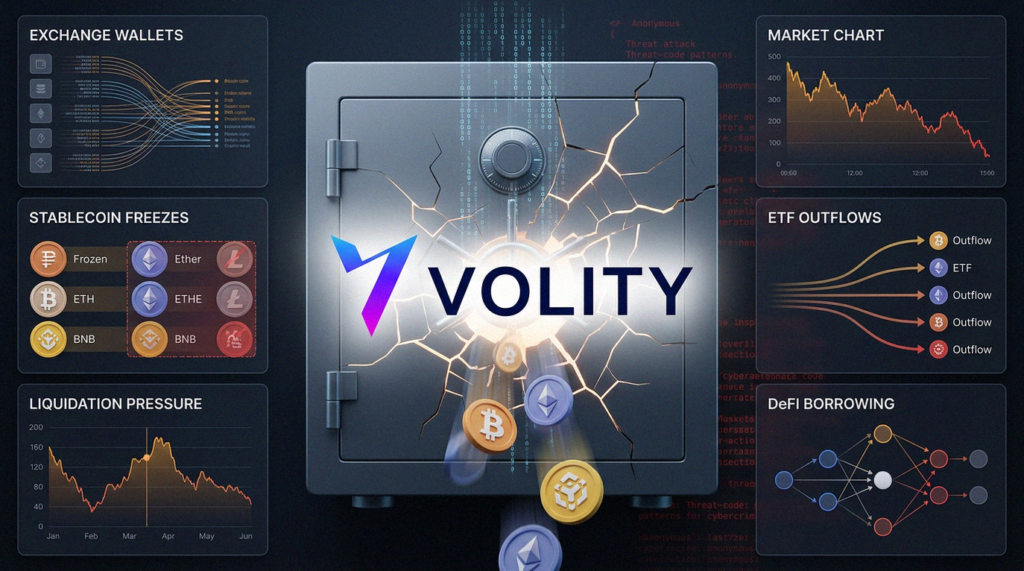
Meanwhile, blockchain partners froze roughly $3 billion of the suspected proceeds.
That total included more than $1.5 billion in Tether and about $800 million in USDC.
Stablecoin freezes limited the thieves’ options, yet they reopened an old argument about crypto’s promise of independence.
Public ledgers can offer open settlement, but major digital dollars still depend on private issuers.
TRM Labs and Chainalysis attributed the operation with high confidence to TraderTraitor, a North Korean-linked group.
The group has featured in several major crypto theft investigations over recent years.
Security failures now carry geopolitical weight, because stolen tokens can support sanctioned state-linked operators.
ETF investors head for the exit
US spot Bitcoin ETFs recorded about $643.33 million in net outflows on 30 October.
The withdrawal ended a four-day inflow streak that had helped stabilise Bitcoin earlier this week.
BlackRock’s iShares Bitcoin Trust accounted for about $234 million of the outflows.
Ethereum funds lost roughly $156 million, extending their run of daily withdrawals to five sessions.
The figures do not prove that institutions have abandoned Bitcoin for good.
Still, they show how swiftly operational shocks can change investor behaviour.
ETFs offer large investors a quick, regulated exit route without moving coins through exchange infrastructure.
That convenience matters most when confidence in a major custodian suddenly weakens.
Bitcoin’s second negative October also arrived during a wider retreat from risk.
Nasdaq shares fell 2.9%, while gold weakened and crypto resumed its uncomfortable correlation with growth stocks.
DeFi finds its own fault lines
The Binance shock spread into decentralised finance, where some Aave markets faced restrictions and temporary freezes.
Aave itself was not hacked, but its response exposed the limits of decentralisation under pressure.
Concerns centred on wallets allegedly linked to the attacker and large loans involving USDT and Ether.
Freezing a market can slow contagion, yet it can also trap users beside collateral they cannot move.
For borrowers, that creates a grim problem when prices fall and liquidation thresholds approach.
The episode shows that decentralised protocols still rely on governance votes, risk teams, price feeds and issuer decisions.
Before supplying collateral, users should understand who can pause a market and under what conditions.
Practical checks for traders
- Check each website address character by character before connecting a wallet.
- Use bookmarked official pages, not advertisements or links from social media.
- Keep trading balances separate from long-term holdings.
- Review token approvals regularly and revoke permissions that no longer serve a purpose.
- Read market pause rules before borrowing against volatile collateral.
The attack surface extends beyond blockchains
Blockaid flagged a DNS attack affecting 12 DeFi websites and linked the activity to Step Drainer malware.
The attackers allegedly redirected visitors from legitimate interfaces towards malicious wallet prompts.
Smart contracts may remain secure while the website in front of them becomes dangerous.
A separate website supplier incident reportedly caused losses for Polymarket users.
Elsewhere, Trezor warned customers about a suspected hardware implant in a CryptoBilis wallet.
Each case points to the same weakness: users reach blockchains through browsers, devices, domains and software updates.
Security, therefore, depends on more than code sitting on a public ledger.
Capital still backs the industry
Funding activity continued despite the sell-off, showing that investors still distinguish between panic and opportunity.
Kalshi reportedly raised $1 billion, while HIVE secured a $129 million loan for its operations.
Coinbase posted third-quarter profit of $719 million, helped by trading activity and prediction-market volumes above $200 million.
Institutional pilots also continued across tokenised assets and round-the-clock settlement systems.
Uber, HSBC and Franklin Templeton tested weekend settlement and yield applications on the Canton blockchain.
Polymarket introduced 15-minute gold and silver markets using Chainlink data.
Meanwhile, Standard Chartered-backed Anchorpoint expanded Hong Kong digital-asset infrastructure through a Solana partnership.
Those projects offer a quieter picture of crypto, focused on settlement, data and financial plumbing.
Yet their value rests on dependable controls, clear rules and systems that survive a difficult Friday.
What investors should watch next
Binance now needs to show exactly how the breach happened and which controls failed.
Its withdrawal restart will provide the first practical test of customer confidence.
Investors should also monitor stablecoin freezes, ETF flows and unusual borrowing rates across major DeFi markets.
Exchange reserves matter, but they cannot erase operational failures or restore confidence overnight.
Bitcoin may recover quickly, as it has after earlier crises.
Still, the market will judge this episode by the evidence Binance provides after prices stop moving.
For traders, patience remains a position rather than a retreat.
When billions move in 20 minutes, protecting capital can offer the clearest edge.