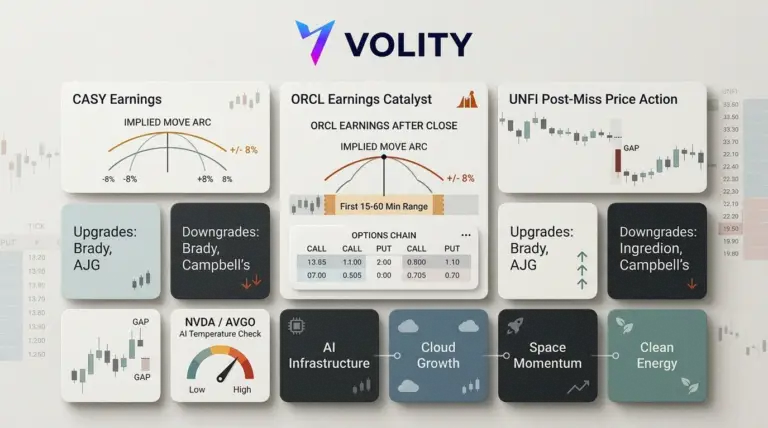
Morning tape: Risk appetite has rules
The market has given traders permission to press risk, but not to daydream.
Indexes are grinding higher, gold and bonds remain firm, and Bitcoin is acting like high-beta equity. That mix supports momentum in technology, semiconductors and post-earnings winners. However, it also argues for hedges, income and clean stop levels.
Today’s better trades have three things in common: a visible catalyst, a defined line, and no need for heroic forecasts. The watchlist becomes less of a menu and more of a script.
By the numbers
- Nokia: Q1 net sales rose 4%, with optical networks up 20%.
- Nokia: AI and cloud-related revenue rose about 49% year on year.
- Nokia: Q2 and half-year results are due on July 23.
- Merck: Wells Fargo’s $150 target keeps the upgrade trade alive.
- SanDisk: the 50-day moving average now matters as support, not resistance.
Single-stock setups
SanDisk (SNDK) has moved into a cleaner technical position. The stock sits comfortably above its 50-day moving average, with rising trend measures backing the move. So the old resistance line has become the first support test.
Dip buyers can look near the 50-day, but only if price firms and volume confirms demand. Conversely, a heavy-volume break below that line flips the trade to avoid, or even short. This name moves quickly, so stale levels are dangerous.
Nokia (NOK) no longer trades like a sleepy telecom relic. Q1 sales rose 4%, optical networks jumped 20%, and AI/cloud revenue climbed roughly 49%. Meanwhile, the Nvidia 6G partnership and Infinera optical scale sharpen the AI infrastructure story.
The trading rule is simple. Buy weakness into prior support while the AI optical narrative holds. However, respect the July 23 earnings date. That report could either confirm the rerating or expose a crowded trade.
GlobalFoundries (GFS) has a sharper catalyst after its SEALSQ pact around post-quantum cryptography. That puts the stock inside the secure-chip story for AI and quantum infrastructure. Volume matters more than opinion here.
Traders should watch the first reaction zone. If GFS holds the gap and builds higher lows, momentum can extend. If it fades back into the gap, the catalyst trade loses its edge.
Plug Power (PLUG) remains one of the clearest short-bias names on the board. The stock sits below its 50-day moving average and still looks structurally weak. Until it reclaims that level, rallies deserve suspicion.
Shorts can lean into failed rallies near the 50-day. However, a strong-volume close back above that line changes the tape. In PLUG, discipline matters more than conviction.
Penguin Solutions (PENG) brings the cleanest post-earnings momentum profile. Record Q3 results, a double beat and raised guidance give buyers a story they can defend. Still, price must do its part.
The key level is the post-earnings gap low, or breakout zone. If PENG consolidates tightly above it, continuation remains live. If the gap fully fills, the thesis weakens fast.
Rivian (RIVN) is less a patient fundamental holding than a volatility machine. Deliveries are improving, but dilution still hangs over the stock. As a result, intraday levels matter more than long spreadsheets.
Range breaks, day-high pushes and day-low failures suit RIVN better than heroic swing calls. Options traders may prefer defined-risk volatility structures. However, directional conviction should wait until the capital overhang clears.
Banks and health care
JPMorgan (JPM) and PNC Financial (PNC) are earnings trades, not personality contests. Before results, implied volatility and sector tone matter. After results, the first reaction matters more.
A beat-and-raise supports buying strength, especially if banks trade well as a group. Conversely, misses or softer guidance create short setups into failed bounces and VWAP fades. The calendar must be checked each morning.
Merck (MRK) has a useful blend of momentum and patience. The $150 target gives the stock room, while the upgrade-day low defines risk. Stay constructive while MRK holds that low and pushes toward prior highs.
If the stock sinks back through the upgrade-day low, the trade loses its clean trigger. However, unlike many momentum names, MRK also offers defensive healthcare exposure.
HCA Healthcare (HCA) is more binary. A downgrade and target cut put pressure on major support. If the stock breaks that floor and cannot reclaim it, sellers keep control.
Still, a volume spike with a reversal candle would change the near-term story. In that case, aggressive traders can look for an oversold bounce. This is not a “sit and hope” chart.
Weak links
Kura Sushi (KRUS) remains a classic earnings-miss short. The gap created the map. As long as price stays below the post-earnings gap high and prints lower highs, sellers have structure.
However, thin or heavily shorted names can snap back violently. A high-volume reversal should be treated as a warning, not background noise.
FuelCell Energy (FCEL) belongs in the tradable, not lovable, bucket. The stock carries high beta, weak structure and pre-market loser risk. Any trade needs tight risk and fast decisions.
Breakdowns below intraday support can work. So can fades of weak bounces. But FCEL is not the place to average down and negotiate with the tape.
Macro hedge
IWM, the Russell 2000 ETF, remains the cleanest small-cap barometer for rate expectations. If traders price earlier or larger Fed cuts, IWM can defend higher lows. If yields push back up, small caps likely lose support.
That makes IWM a useful positioning tool. When single-stock setups feel crowded, traders can express the macro view through small-cap beta. Meanwhile, it can hedge long books heavy in aggressive growth names.
Theme trades
Some of the best opportunities are baskets, not single tickers. Aviation maintenance remains attractive because old fleets need parts, repairs and specialist labour. That theme avoids some airline margin drama.
Quantum and post-quantum security also deserve a slot. The GFS-SEALSQ tie-up gives the theme a tradable anchor, while the timeline remains long. Position sizes should stay realistic.
AI and defence robotics remain multi-year themes, especially where software, autonomy and procurement overlap. However, every entry still needs a technical trigger. A good story without a level is just expensive entertainment.
High-dividend consumer names can also work if volatility rises or rates drift lower. In that setting, reliable income becomes more valuable. Meanwhile, defensive yield can steady portfolios chasing hotter trades elsewhere.
Key takeaways
- Highest-conviction trading lines: PLUG below the 50-day, PENG above its gap zone, and KRUS below its gap high.
- Best catalyst watch: NOK into July 23, with AI optical growth driving the case.
- Best volatility instrument: RIVN, but only for traders using defined levels.
- Best defensive momentum: MRK while it holds the upgrade-day low.
- Best macro pressure gauge: IWM, especially around Fed-cut expectations and rate moves.
The morning plan is straightforward. Freshen the moving averages, confirm earnings dates, mark gap levels, and let price decide. Above the trigger, press. Below the trigger, step aside or fade. That is how a noisy tape becomes tradable.
Related coverage on Volity
- What Is a P/E Ratio and How to Use It
- Fundamental Analysis in Stock Trading: A Working Definition
- Growth Investing vs Value Investing: Which Style Fits You?
- Fractional Shares Explained: How to Start Investing With $50
- How to Start Stock Trading: A 2026 Beginner Guide
- Dividend Investing for Beginners: How to Start