Is forex trading halal? The religious bodies checked for this guide do not give one answer. Those that address plain currency exchange accept it when it is settled on the spot, with possession and no interest. Each one that ruled on leveraged retail forex, from the Muslim World League’s Fiqh Council in 2006 to Jordan’s Iftaa’ Department in 2024, held that form impermissible. Below: who said what, what a swap-free account changes, and what to ask a qualified scholar.
TL;DR: Spot exchange with possession and no riba (interest) is accepted by every body checked that addresses it. Each body here that addressed leveraged retail forex ruled it impermissible. A swap-free account removes overnight interest only; leverage and possession stay open. Get the terms in writing and ask a qualified scholar. Volity offers Islamic (swap-free) accounts.
This guide gives no ruling of its own. It maps what named bodies published, with dates, and quotes their words where an English text exists. A fatwa is a religious opinion from a qualified scholar or a fatwa body. To compare broker accounts, read the companion guide to Islamic forex brokers.
Why people ask whether forex is halal
Currency trading is vast. The Bank for International Settlements (BIS) measured foreign exchange (FX) trading at $9.6 trillion a day in April 2025. The rulings below concern something narrower than changing money for a trip. Retail forex is traded online, often with borrowed buying power, and positions can stay open overnight. Each of those features touches a principle of Islamic finance: interest, uncertainty, possession and lending. So the useful question is whether one product, on its written terms, meets the conditions a body sets.
The points scholars look at: interest, gambling, uncertainty and spot settlement
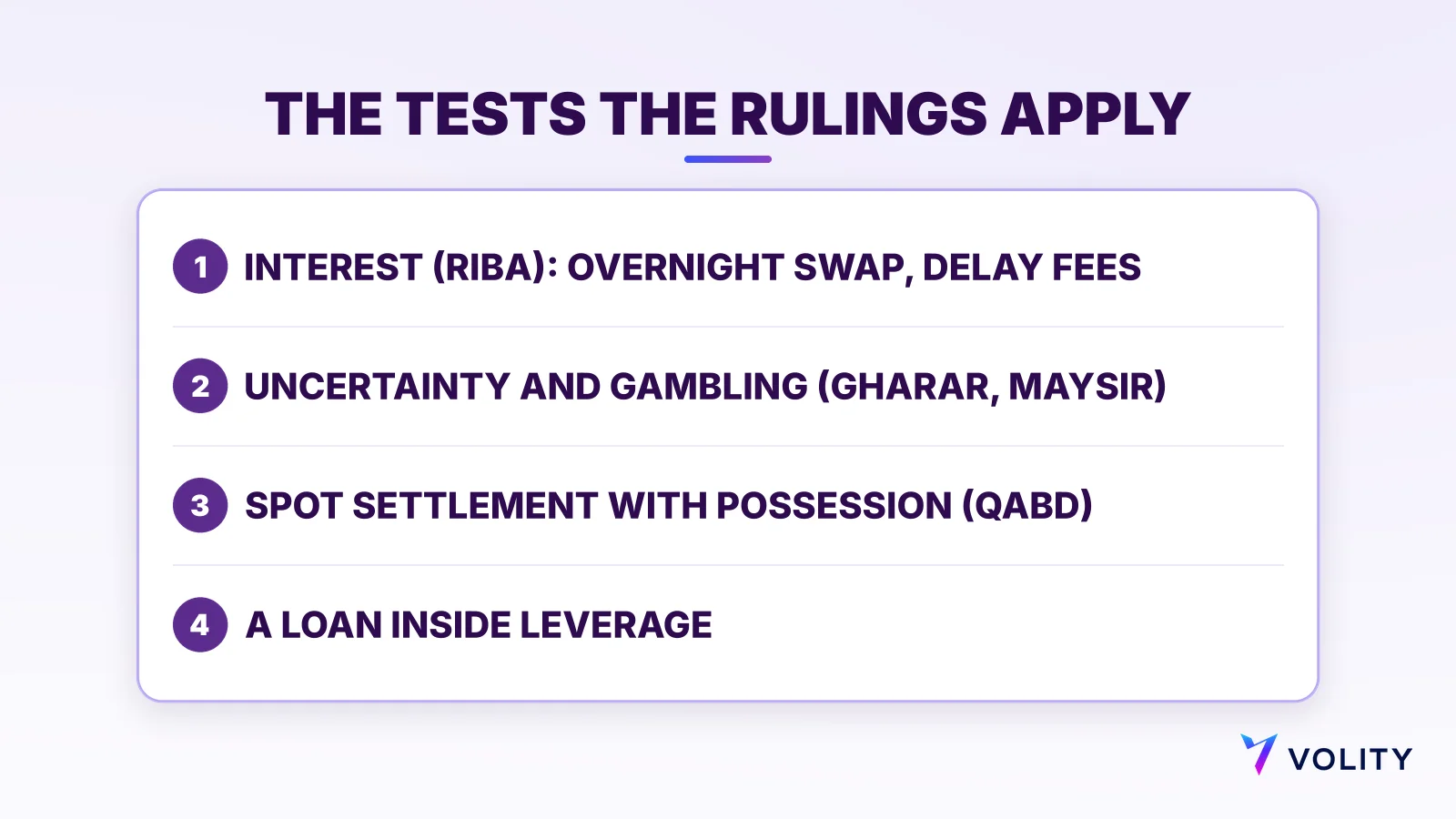
The same four tests recur across the rulings. A product can pass one and fail another, so removing the swap rarely settles the matter alone.
Interest (riba)
Riba means interest, which Islamic finance forbids. In a trading account it appears as the overnight swap. A position open past the daily cut-off is credited or debited an amount based on two interest rates, as the swap and rollover entry explains. The Muslim World League’s Islamic Fiqh Council found riba in “fees for delaying the deal”. Malaysia’s National Fatwa Committee, as reported by the Shariyah Review Bureau, a Shariah advisory firm, named “rollover interest”.
Uncertainty and gambling (gharar and maysir)
Gharar is excessive uncertainty in a contract. Maysir is gambling, gain that depends on chance. Egypt’s Dar al-Ifta al-Misriyyah applied both to margin forex in a 2013 fatwa published in Arabic. In paraphrase, it holds that this form carries more uncertainty than any other modern financial contract, sits closer to gambling, and grows worse with leverage. Malaysia’s committee likewise cited “speculation that involves gambling”.
Spot settlement and possession (qabd)
Qabd means taking possession. In these texts, both sides of a currency exchange must change hands at once, actually or constructively (control in effect, without a physical handover). The International Islamic Fiqh Academy of the OIC (Organisation of Islamic Cooperation) ruled out deferred currency sales in Resolution No. 102 of 1998. Its Resolution No. 53 of 1990 says constructive possession “takes place by leaving the commodity at one’s disposal and enabling him to deal with it as he wills”. It lists “Crediting a sum of money in the customer’s bank account” as one form. During a usual crediting delay, though, the customer “cannot deal in the currency” until the credit takes effect.
The loan inside leverage
Leverage lets you open a position larger than your own money. The deposit behind it is called margin, and the margin and leverage guide shows how both work. Several bodies treat the gap as a loan from the provider. The Muslim World League’s Council objected to a loan combined with a fee. AAOIFI sets standards for Islamic financial institutions. IslamicFinance.com’s summary of its currency standard lists as not permitted trading “for an amount of money exceeding the amount of money he owns, using credit facilities granted by the institution”.
One word causes confusion. A broker’s “swap” is the overnight rollover. In the wholesale market, an FX swap is a contract to exchange currencies now and swap them back later. The BIS survey found FX swaps the most traded instrument, at $4 trillion a day. When Jordan’s Iftaa’ Department forbids “swap contracts”, it means this second kind.
Where scholarly opinion differs
The common ground is clear. Islam Q&A’s own summary, on the page that reproduces the Muslim World League Council’s 2006 statement, says dealing in currencies is permissible “if the deal is done hand to hand and the transaction is free of conditions that stipulate Riba”. Islam Q&A is a scholar-run question-and-answer website. Jordan’s Iftaa’ Department writes: “Trading currencies is permissible under four conditions”. The split comes when those conditions meet an online, leveraged account.
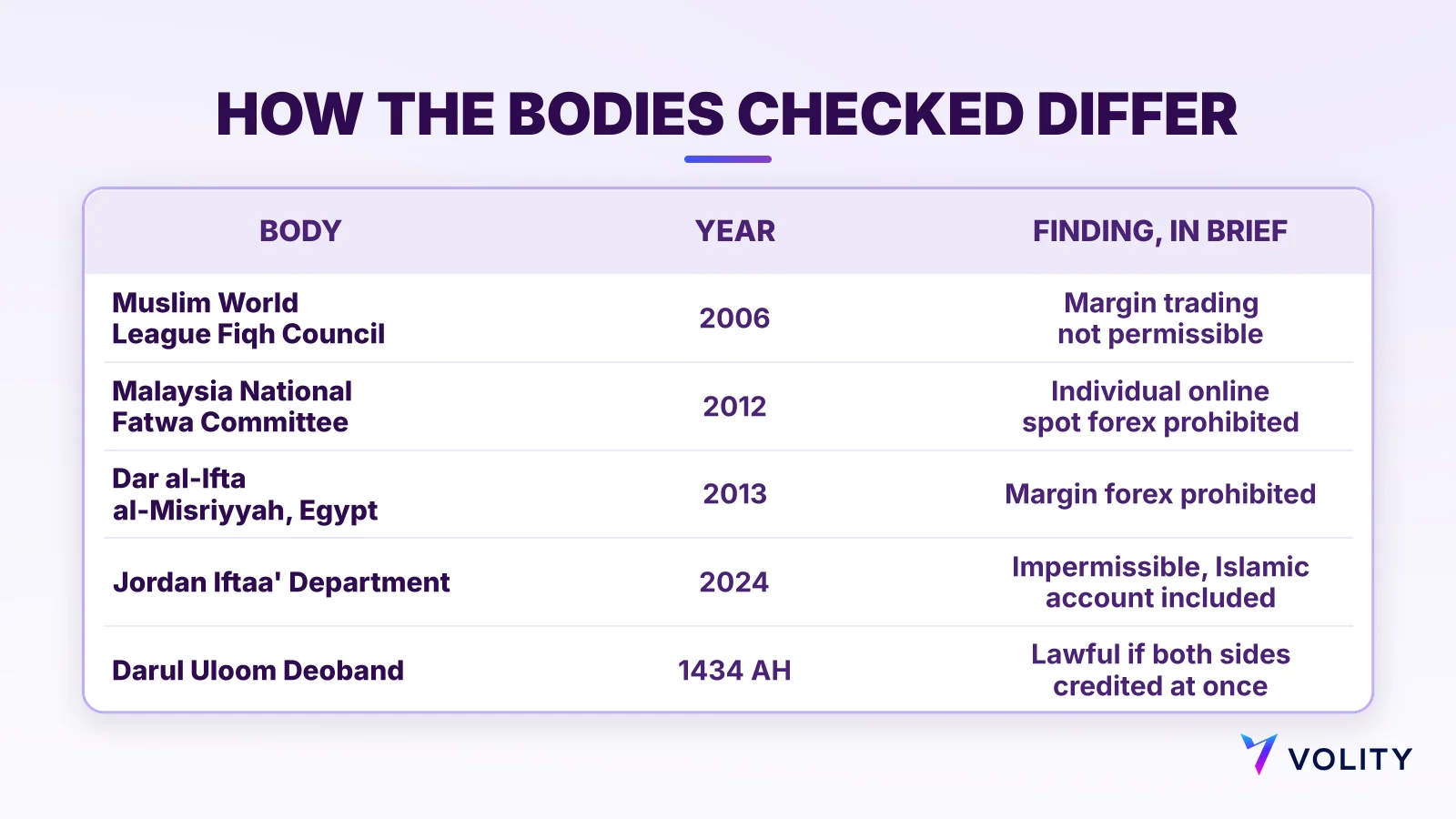
| Body | Date | Finding, in brief |
|---|---|---|
| Islamic Fiqh Council, Muslim World League | 2006 | Margin trading not permissible |
| National Fatwa Committee, Malaysia | 2012 | Individual online spot forex prohibited; money changers and banks not affected |
| Dar al-Ifta al-Misriyyah, Egypt | 2013 | Margin forex prohibited |
| Islamweb fatwa centre | 2014 | Leverage not permissible, even on a no-interest account |
| Iftaa’ Department, Jordan | 2024 | Impermissible, Islamic accounts included |
| Darul Uloom Deoband, India | 1434 AH | Lawful if both sides are credited at once |
| Islam Q&A (website) | Several answers | Not permissible with leverage; own money avoids that objection |
| MuftiOnline, South Africa | Undated | Online forex invalid even without leverage |
What counts as possession
This is the sharpest split. Resolution No. 53 accepts a bank-account credit as constructive possession. Jordan’s Iftaa’ Department, in a December 2024 article by Dr. Hamzah Mash-Shoqah, states: “Possession in the platform’s account is not considered legitimate possession of the currency according to Shari’ah.”
Darul Uloom Deoband answered a questioner who said both currencies are transferred “as soon as the deal is finalised”. Its fatwa, dated 1434 in the Hijri (Islamic) calendar, replied: “If this is the case, then this transaction is lawful as per the Shariah and its profit is halal.” Islam Q&A adds a test in a 2023 answer: “It is not sufficient for the amount to appear in the account, without the ability to withdraw it.”
Whether leverage can be used at all
The Muslim World League Council, Malaysia’s committee, Dar al-Ifta al-Misriyyah, Islamweb and Jordan’s Iftaa’ Department ruled against the leveraged form. Islam Q&A’s answer on Islamic accounts agrees: “it is not permissible to deal with it, so long as it involves leverages, because it is a loan”. A second answer adds: “If you dealt with your money only, and did not use financial leverage, then you have avoided both infractions.”
MuftiOnline, a South African Hanafi fatwa service, goes further. Asked about forex with no leverage, margin or interest, it replied: “since both exchanges are deferred, this transaction is invalid and impermissible in Islam.”
Scope, and the nature of money
Scope matters too. As The Star reported on 16 February 2012, Malaysia’s council chairman said the declaration “only applied to real-time individual spot forex transactions through the electronic medium”. It did not cover money changers or licensed banks. Egypt’s fatwa likewise targets the margin form.
Underneath sits an older question. The Shariyah Review Bureau’s 2018 paper, which calls itself “preliminary Shariah research”, describes two views of paper money. One treats it like gold and silver, so the rules of sarf (currency exchange) apply. The other treats it like fulus (copper coins), where they do not.
Read together, every ruling here on the leveraged retail form went against it, and every permission came with conditions. That describes these sources, not all scholars.
What a swap-free account changes
On a conventional Volity account, a position held past 22:00 GMT may pay or receive an overnight amount. It is based on the interest-rate difference between the two currencies, and the rate for each instrument is shown on the platform. The page on forex swap rates shows the maths. A swap-free account removes that overnight interest, which speaks to the riba point raised about rollover. By itself, it does not touch leverage, possession or Egypt’s gambling concern.
Some bodies looked at the account directly. Jordan’s Iftaa’ Department describes an Islamic Forex account as “free from interest (riba), overnight rollover fees, and swap contracts”. It then finds “two main issues”: “The lack of legitimate possession” and “The use of margin trading”. Its conclusion: “trading through an Islamic Forex account is impermissible.”
Islamweb answered a trader whose broker offered no-interest accounts. Its fatwa kept the objection: “it is not permissible to deal with the money leverage system”. Islam Q&A points to another route: “So if you are not going to use the leverage, you have avoided this infraction.”
A hypothetical example shows how the views part. Two people open the same position on a swap-free account. One uses only their own money; the other uses margin. In Islam Q&A’s terms, the first avoids the loan objection and the second does not. In the Jordan Iftaa’ Department’s terms, both still face the possession question. The example is not a ruling. It shows which question to ask.
Volity offers Islamic (swap-free) accounts. Its full fee schedule is published on the charges and fees page.
Questions to ask before you open an account
Work through these in order. Each answer gives a scholar something concrete to judge.
- Name the exact product: what you will trade, which currency pairs, and whether you will hold positions overnight.
- Decide whether you will use leverage at all. This is where Islam Q&A draws its line.
- Ask what you hold once a trade opens, and whether you can withdraw your balance at once.
- Get the swap-free terms in writing: which instruments they cover and every cost that still applies. The Islamic broker checklist lists the other points.
- Confirm the regulator. Volity holds CySEC licence 186/12 via UBK Markets. Check any licence on the regulator’s own website.
- Take the written terms to a qualified scholar you trust. Ask about that product, not the account’s name.
Leverage is also a financial risk: it magnifies losses as much as gains. The UK Financial Conduct Authority’s PS19/18 (2019) limits leverage on retail contracts for difference (CFDs), which track an asset’s price, “to between 30:1 and 2:1 depending on the volatility of the underlying asset”. ESMA cited national analyses in March 2018 showing that “74-89% of retail accounts typically lose money”. If you are new to currencies, start with forex trading for beginners.
Practise on a free demo before any money moves
A demo uses virtual money, so you learn the platform without risking your own. You see how margin and the overnight cut-off work before you commit, and it carries no religious weight either way. A free demo is available on every Volity account tier. The forex demo account guide explains how to use one.
A live account needs you to be 18 or over and to pass KYC (know-your-customer) checks: ID, proof of address and proof of your source of funds. Islamic (swap-free) accounts are available on Volity, and the Markets account is commission-free.
A swap-free account removes the overnight interest and nothing else. Take the exact product, on paper, to the scholar whose view you follow.
Fact check: International Islamic Fiqh Academy Resolutions No. 53 and No. 102; AAOIFI Shari’ah Standard No. 1 via IslamicFinance.com; the Muslim World League’s Islamic Fiqh Council (2006, via Islam Q&A); Dar al-Ifta al-Misriyyah (2013, Arabic, paraphrased); Malaysia’s National Fatwa Committee (via The Star and the Shariyah Review Bureau); Jordan’s Iftaa’ Department (2024); Darul Uloom Deoband; MuftiOnline; Islamweb; Islam Q&A. Market and risk figures from the BIS, FCA and ESMA; Volity details from volity.io. Checked 10 November 2026.
Frequently asked questions
Do scholars agree on forex trading?
Not fully. Every body checked here that addresses spot exchange with possession and no riba accepts it. They differ on what counts as possession on a platform and on whether leverage can be used. Each one that ruled on leveraged retail forex held it impermissible.
Does a swap-free account make forex trading halal?
No body checked here says removing the swap settles it. An article published by Jordan’s Iftaa’ Department holds trading through an Islamic Forex account impermissible, citing possession and margin. Islamweb kept its leverage objection for a no-interest account.
Is trading with leverage allowed in Islam?
The Muslim World League’s Fiqh Council, Malaysia’s committee, Dar al-Ifta al-Misriyyah, Islamweb and Jordan’s Iftaa’ Department ruled against leveraged forex. Several treat leverage as a loan. Islam Q&A says trading with your own money only avoids that objection.
Is spot forex treated differently from margin trading?
Yes, in the sources checked. AAOIFI’s standard, as IslamicFinance.com summarises it, permits currency trading when both sides take possession, but not with credit beyond your own money. Jordan’s Iftaa’ Department adds that a platform balance is not legitimate possession.
Is the swap in a fatwa the same as the overnight swap?
Not always. A broker’s swap is the overnight rollover. Jordan’s Iftaa’ Department uses “swap contracts” for exchanging currencies now with a condition to exchange them back later, which it forbids as riba.
Can I practise on a demo before opening a swap-free account?
Yes. A free demo is available on every Volity account tier, and Islamic (swap-free) accounts are available on Volity. Take the written terms to a qualified scholar before your first live trade.