Is trading halal? No single answer covers every market, because the bodies that write Islamic finance standards test each asset in its own way. They agree that a business whose main purpose is prohibited is off limits. After that, shares are judged on what a company earns and owes, currencies and gold on spot settlement, and crypto divides the scholars. This guide shows who says what, so you can take precise questions to a qualified scholar.
TL;DR: The bodies quoted here rule asset by asset. Share screens from AAOIFI (as summarised by its Secretary General), MSCI and Malaysia’s Securities Commission cap debt and cash at 30% to 33.33% and prohibited income at 5%. For currencies and gold, the standards require spot exchange with possession. Crypto splits the bodies. A qualified scholar applies all of this to you.
This is a summary of published positions with dated links, and it gives no ruling of its own. The bodies differ in kind. The International Islamic Fiqh Academy is a council of scholars under the Organisation of Islamic Cooperation. AAOIFI (the Accounting and Auditing Organization for Islamic Financial Institutions) sets standards. MSCI is an index provider, and the Securities Commission Malaysia is a regulator.
What halal means for a trader
Halal means permitted under Islamic law, and haram means prohibited. The starting point is shared. In Resolution 63 of May 1992, the Fiqh Academy wrote: “There is no legal disagreement on the prohibition of participating in companies whose main purpose is haram.” Beyond that, the texts return to a short list of tests a trader meets:
- Interest, called riba in the texts, including an interest-based loan from a broker to buy shares.
- Possession: selling something you do not own or do not yet hold.
- Deferment: delaying both sides of an exchange of currencies or gold.
- Gambling-like contracts: the Academy called trading an index “pure gambling”.
Each market meets these tests in its own way. A scholar who knows your situation decides how they apply to you.
Slides presented by AAOIFI’s Secretary General, Dr Hamed Merah, in 2017 quote Shari’ah Standard No. 21 of May 2004: “It is permissible to buy and sell shares of corporations, on a spot or deferred basis in which delay is permissible, if the activity of the corporation is permissible.” The rule also covers dealing “with the intention of benefiting from the difference in prices”, which is what traders do.
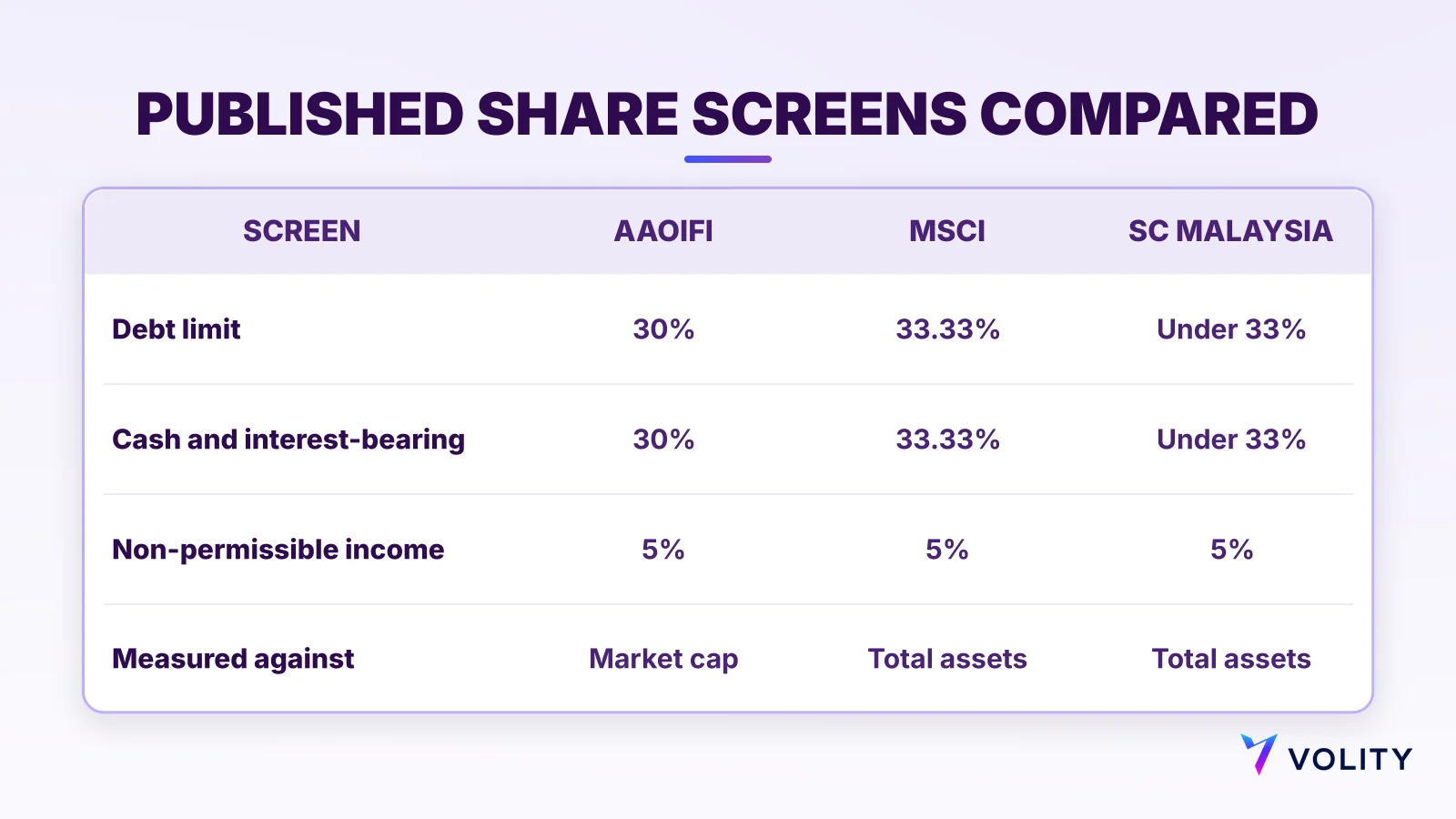
Screens have two layers. The first excludes companies in alcohol, gambling, pork, tobacco or conventional finance. The second caps interest-bearing debt, cash and prohibited income:
| Body and document | Debt limit | Cash and interest-bearing | Prohibited income | Measured against |
|---|---|---|---|---|
| AAOIFI (slides, 2017) | 30% | 30% | 5% | Market capitalisation (per UCL preprint) |
| MSCI Islamic Index Series (July 2025) | 33.33% | 33.33% | 5% | Total assets |
| Securities Commission Malaysia (29 May 2026) | under 33% | under 33% | 5% | Total assets |
The base of each ratio differs. AAOIFI measures against market capitalisation, according to a UCL preprint that compares the rulebooks and is not peer reviewed. MSCI and the Malaysian regulator use total assets, so the same company can pass one screen and fail another. The preprint also reports that S&P Dow Jones Indices cut its debt limit to 30% in September 2026. Check the date on any list you use.
The Fiqh Academy takes a stricter line. Resolution 63 says “Prohibition is the primary judgment” for lawful companies that “may sometimes engage in prohibited transactions such as Ribā-based transactions”. Resolution 77 (1993) and Resolution 87 (1995) postponed the question for more study.
MSCI handles leftover interest income by purification: “this proportion must be deducted from the dividend paid out to shareholders and given to charity”. Take a hypothetical case. A company earns 4% of its income from interest and pays you a dividend of EUR 50. You keep EUR 48 and give EUR 2 to charity.
Volity lets you trade real shares, fractional shares, crypto and CFDs (contracts for difference, which track an asset’s price) from one account. Check each company on a current list before you buy.
Forex turns on spot settlement and swaps
Forex means exchanging one currency for another, and the texts set strict timing. AAOIFI Shari’ah Standard No. 1 of 31 May 2000, as quoted in a summary on islamicfinance.com, says: “Both parties must take possession of the counter values before dispersing, such possession being either actual or constructive.” It adds: “Currency transactions shall not be carried out on the forward or futures market.”
The Fiqh Academy points the same way. Resolution 102 (1998) says “It is not permissible in Shariah to sell currencies by deferred sale”. Resolution 53 (1990), on qabd (taking possession), accepts a credit to your bank account as constructive possession. Resolution 63 permits spot-type deals in organised markets “provided they meet the well-known currency exchange conditions”.
Then comes the swap. On Volity, positions held past 22:00 GMT may pay or receive an overnight (swap) amount. It is based on the interest-rate differential between the two currencies, and the rate for each instrument is shown on the platform. Because that amount is built from interest rates, it touches the riba test directly.
Islamic (swap-free) accounts are available on Volity. The texts also test spot delivery and interest-based credit, so the label alone does not settle the question. The guide to Islamic forex brokers covers what to read in the terms, and the companion guide on whether forex trading is halal goes deeper.
Crypto is where opinions differ most
The Fiqh Academy has not ruled on crypto. Resolution 237 (Dubai, November 2019) named bitcoin, ethereum and ripple and recommended “pursuing research and studies on issues affecting its ruling”. A Jeddah symposium in November 2021 gathered 15 papers and postponed its recommendations. Other bodies split:
| Body | Date | Position, as reported |
|---|---|---|
| Dar al-Ifta, Egypt | Dec 2017 | Against bitcoin, likened to gambling |
| Diyanet, Turkey | Nov 2017 | “not compatible with religion at this time” |
| Securities Commission Malaysia, Shariah Advisory Council | Jul 2020 | Permissible on SC-registered exchanges |
| Indonesian Ulema Council (MUI) | Nov 2021 | Unlawful for trading |
| UAE Higher Shari’ah Authority | 2025 | Bitcoin dealing permissible, per Fitch |
The reasons differ too. Egypt’s fatwa cited, as reported by The Times of Israel, “direct responsibility in financial ruin for individuals”. Turkey’s Diyanet, per Euronews, pointed to speculation, money laundering and no state audit. Asrorun Niam Sholeh, who heads fatwas at Indonesia’s council, told AFP crypto has “elements of uncertainty, wagering and harm”.
Malaysia’s 2020 resolution classes a coin with no underlying asset as urudh, a tradable good, so currency-exchange rules do not apply. Its permission covers only SC-registered exchanges. Fitch, reported by the New Straits Times in September 2026, summed up: “Sharia views on cryptocurrencies are mixed.”
On Volity, crypto trades 24/7. Which position applies to you is for your scholar to decide.
Gold and silver: the settlement rule
AAOIFI Shari’ah Standard No. 57 (November 2016), developed with the World Gold Council, an industry body, sets the rule in clause 3/2/1: “In case of sale of gold for gold, or silver or currencies, the two counter-values must be delivered during the contracting session, physically or constructively.” Clause 3/2/3 rules out deferring both sides, “as in the case of forward or futures contracts”.
Constructive possession, in clause 3/4, means a specific ingot allocated to you, or a certificate for an identified ingot issued on the trade date (T+0, the same day). Unallocated gold is a claim on a pool of metal. For gold ingots sold for currency, the standard says: “it is not permissible to sell an unspecified ingot (technically known in the market as unallocated ingot) without physical possession.”
Clause 3/2/1 also names silver as a counter-value for gold. The Fiqh Academy’s Resolution 84 (1995) allows buying gold and silver by certified cheque “provided that the exchange should be held in a majlis”, with both parties present. The World Gold Council’s launch statement reads the standard as showing “that investment in gold is permissible provided that all the relevant Shari’ah rulings are satisfied”.
Spot gold on Volity is traded as a CFD on XAU/USD and XAU/EUR, long or short. The standard’s wording turns on delivery or allocation, so ask how any gold product settles and take that answer to a scholar. The gold trading platform page explains the product.
Leverage and short selling
Leverage lets you open a position larger than the money you put down, which is called margin. At 1:500, each unit of margin controls up to 500 units of position. It magnifies losses as well as gains.
The texts address the financing behind a position. Resolution 63 says: “It is not permissible to purchase a share with an interest-based loan offered to the purchaser by the broker or any other party against pawning of the share”. The AAOIFI currency summary rules out trading beyond the money you own “using credit facilities granted by the institution which handles the currency trading”.
Short selling means selling what you do not own, hoping to buy it back cheaper. Resolution 63 says it is “not permissible to sell a share that the seller does not possess”, and calls index trading “pure gambling”.
On Volity, leverage goes up to 1:500. By market, forex, metals, index CFDs and commodities go up to 1:500, crypto CFDs up to 1:50 and stock CFDs up to 1:20. Take the product terms to a scholar. The guides to how leverage works and day trading for beginners show the mechanics, and companion guides cover day trading and CFD trading from the halal angle.
How to check an account for yourself
Work through these checks in order, with your own instrument in mind.
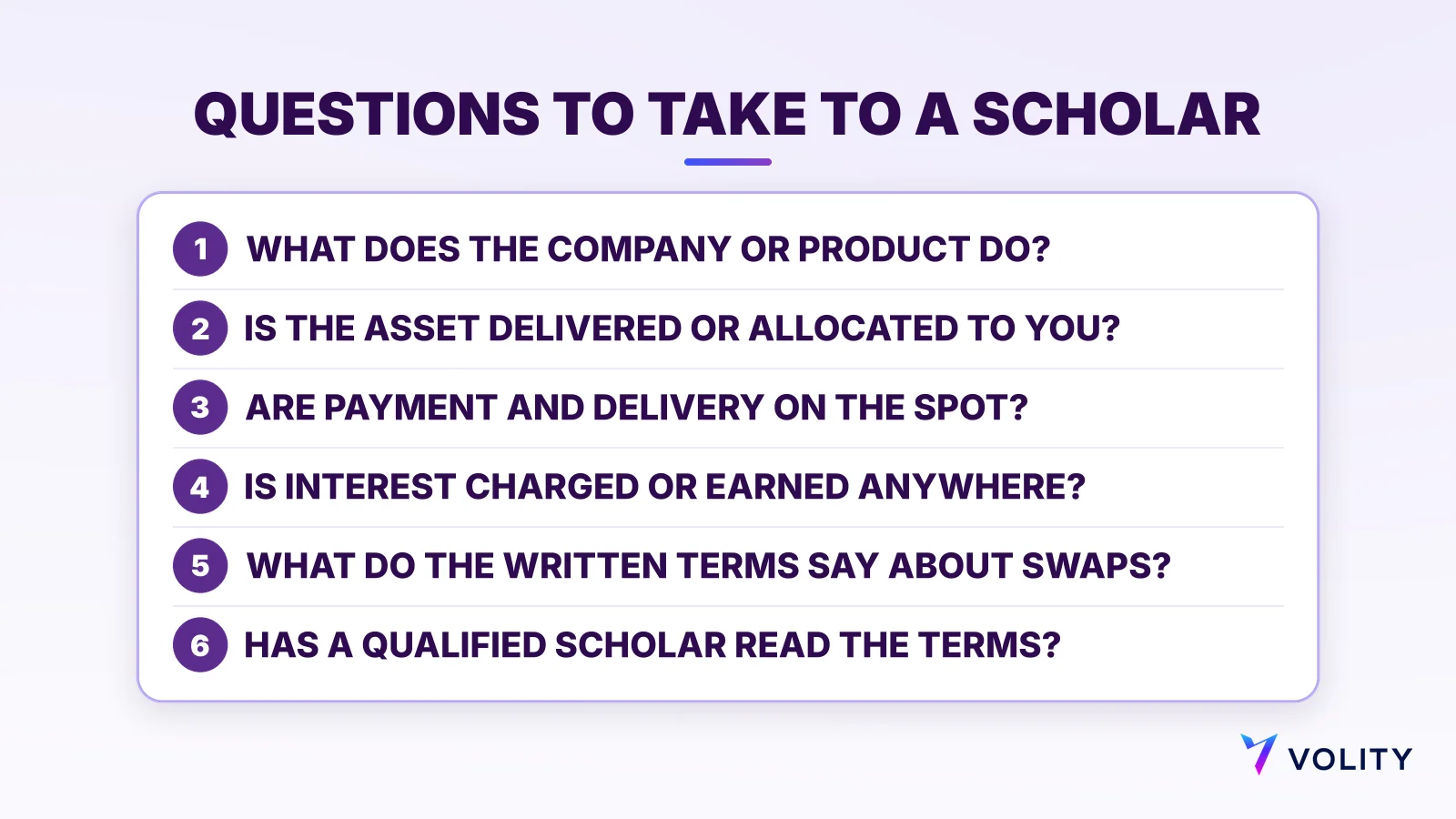
- Name what you will trade, and what you own once the trade is open.
- For a share, check a current published list and its date. The Securities Commission Malaysia list is updated each May and November.
- Ask whether the asset is delivered or allocated, and whether payment and delivery are on the spot.
- Ask whether interest is charged or earned anywhere, such as an overnight swap or a funding loan.
- Read the written terms on swaps and other charges. The full schedule is on the charges and fees page.
- Open a free demo and watch a position overnight before you commit money.
- Take the terms and your notes to a qualified scholar you trust, and decide.
A free demo is available on every Volity account tier, with no money at risk.
Fact check: Fiqh Academy resolutions 53, 63, 77, 84, 87, 102 and 237; AAOIFI Standard No. 57 and the Secretary General’s 2017 slides; islamicfinance.com on AAOIFI Standard No. 1; MSCI methodology (July 2025); Securities Commission Malaysia (29 May 2026 list, 2020 resolution); Fitch via the New Straits Times; The Times of Israel, Euronews and The Jakarta Post. As of 10 November 2026. This is a summary of published positions, not a ruling.
Frequently asked questions
Is trading halal in Islam?
The bodies quoted here rule asset by asset. The Fiqh Academy says investing in companies whose main purpose is haram is prohibited, then tests interest, possession and deferment. A qualified scholar decides how this applies to you.
Is stock trading halal?
AAOIFI’s Standard No. 21, quoted in its Secretary General’s slides, permits share dealing if the company’s activity is permissible, with debt, cash and income screens on top. The Fiqh Academy is stricter on mixed companies. Ask a qualified scholar.
Is crypto halal to trade?
Views are split. The Fiqh Academy has not ruled. Bodies in Egypt, Turkey and Indonesia said no, while Malaysia’s SC council (2020) allowed trading on SC-registered exchanges and, per Fitch, a UAE authority deemed dealing in bitcoin permissible in 2025. Ask a qualified scholar.
Is gold trading halal?
AAOIFI’s Standard No. 57 requires same-session delivery, physical or constructive, and rules out forward deferment and selling unallocated gold without physical possession. Check how your product settles and ask a qualified scholar.
Is leverage haram?
The Fiqh Academy says buying shares with an interest-based loan is not permissible, and AAOIFI’s currency standard, as summarised, rules out trading on credit beyond your own money. Ask a qualified scholar about a specific product.
What is an Islamic trading account?
It is the industry name for a swap-free account, and Islamic (swap-free) accounts are available on Volity. Fiqh Academy and AAOIFI texts also test possession and deferment, so read the terms and ask a qualified scholar.