Saving for a home is less about luck and more about arithmetic plus a habit you do not have to think about. If you want to know how to save for a house deposit without it ruling your life, the plan is simple: fix a target, work out the monthly number, then automate the saving so it leaves your account before you can spend it. This guide walks each step and is honest about the thing most articles skip. Money you need within a few years should not sit in a volatile market.
TL;DR / Quick insight: To save a house deposit, first set a realistic target, then divide it by the months you have to reach the monthly amount you must put aside. Automate that transfer so it happens on payday, before anything else. Keep a deposit you need soon in cash-like savings, not invested in markets that can drop right when you need to buy. Once the deposit is banked, your longer-term money can do more, and a Volity account holds savings, shares and a $0 wallet in one place for that next stage.
Nothing here is personal advice, and saving and investing both carry risk.
Set the target, how much deposit you actually need
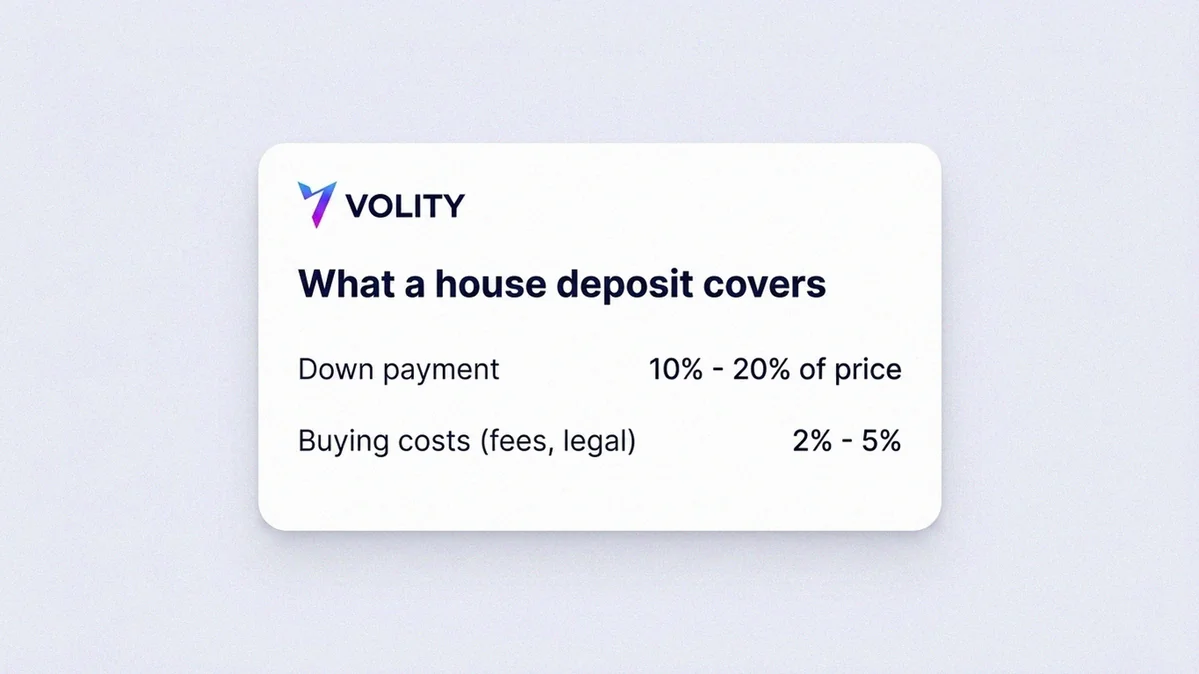
The deposit is the slice of a home’s price you pay up front, with the rest covered by a mortgage. So the first number you need is the property price you are aiming at and the share you intend to put down. A larger deposit usually unlocks better mortgage rates and a smaller loan, so the size is a real trade-off.
One trap catches almost everyone. The deposit is not the only cash you need on completion. Add the buying costs: legal and conveyancing fees, a survey, any transfer tax, moving costs, and a small buffer for the first weeks. Treat the deposit plus those costs as your true target.
Set the timeline and the monthly number
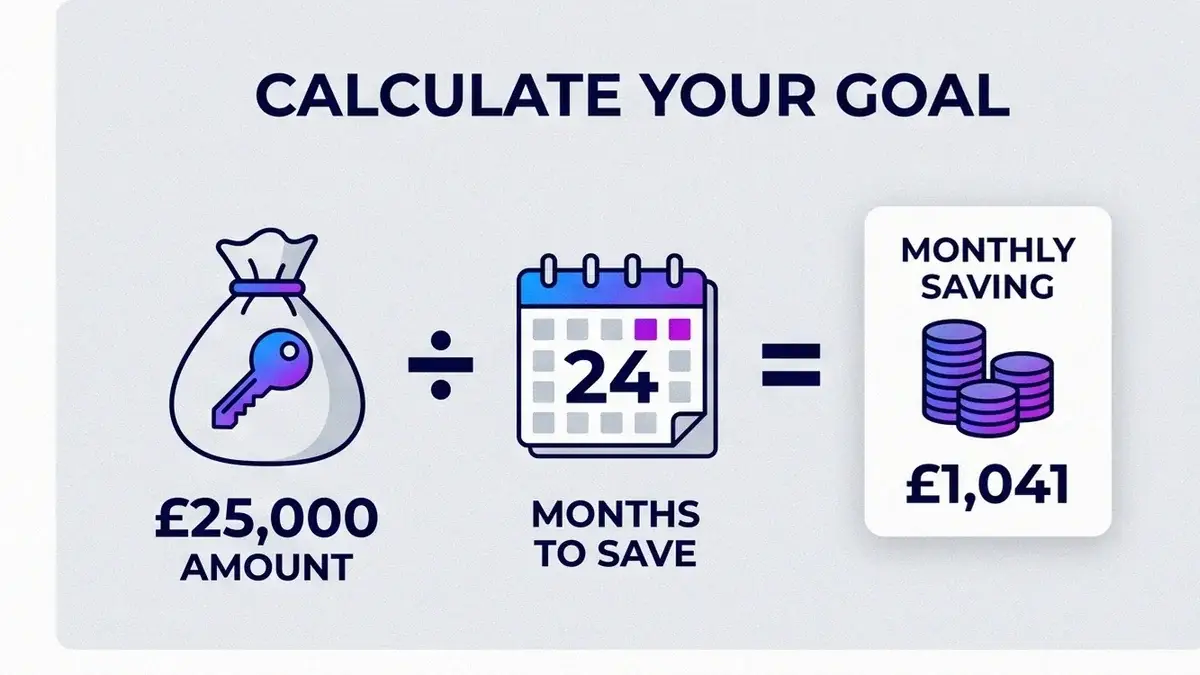
Once you have a target, the maths is what makes a deposit feel achievable. Pick a date to buy by, count the months until then, divide the target by that number, and you have the amount to save each month.
Here is an illustration with invented, round figures. Say your target is 30,000 in your local currency and you want to buy in three years. That is 36 months, so 30,000 divided by 36 is about 833 a month. If that feels too steep, you have three levers and only three: lower the target, lengthen the timeline, or save more each month.
Run the same sum with your own figures. If the monthly amount is painful, push the date out and watch it fall: the same 30,000 over four years is 48 months, about 625 a month. The timeline is the gentlest lever to pull. Treat the monthly figure as a bill you owe yourself.
Automate the saving so it happens first
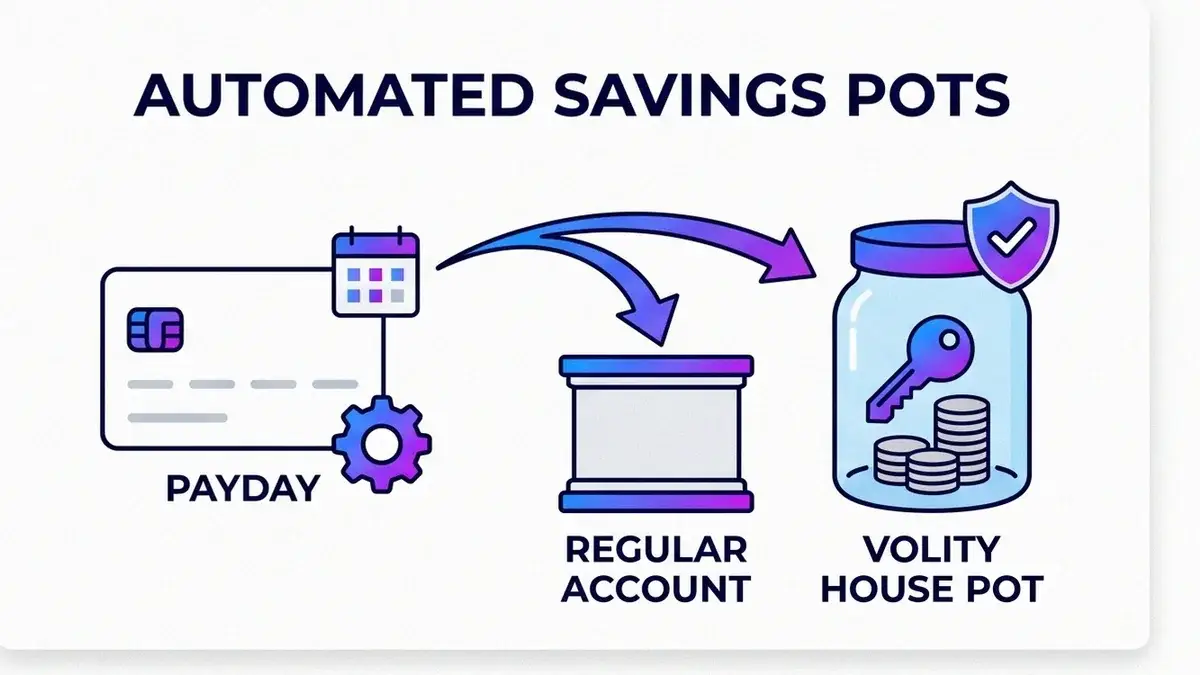
The biggest predictor of whether people hit a savings goal is not income. It is whether the saving happens automatically. Willpower is finite, and budgets that lean on it tend to leak.
So pay yourself first. Set up a standing transfer that moves your monthly amount into a separate pot just after payday, before it is available to spend. You never see it in your balance, so you never miss it.
Keep the deposit pot separate from your current account and your emergency fund. Three jobs, three places, which makes it harder to raid for a holiday or a gadget. If your income is irregular, set the transfer at a level you can always manage, then top it up by hand in stronger months. Set the standing order today, even small, and raise it once it feels routine.
Where to keep a house deposit safely
This is where a lot of well-meaning savers go wrong. A deposit you will spend within a few years belongs in cash-like, capital-stable savings. The aim is not growth. It is being certain the full amount is there on the day you need it.
Good homes for a near-term deposit share a few traits: capital does not move with markets, the money is available on completion day, and any interest is a bonus. A separate savings pot, a notice account, or a short fixed-term product can all fit.
| Where the money sits | What matters for a deposit |
|---|---|
| Cash-like savings | Capital stays stable and is there on completion day. The right home for money you need within a few years. |
| Volatile markets | Value can swing, and can be down exactly when you need to buy. Wrong tool for soon-spent money. |
A $0 multi-currency wallet helps here for a specific reason. If you are buying in a different currency from the one you earn, you can hold and convert without a custody charge, and FX on the Volity wallet is free. Then pick the savings home that matches your buying date and leave the pot alone.
Should you invest a deposit you need soon?
The honest answer for most people saving over a few years is no. Investing suits money you can leave alone for the long haul, because markets reward patience but punish bad timing. A deposit has a deadline, which is exactly what volatile assets dislike.
Picture the risk plainly. You invest your deposit, the market dips in the months before you buy, and now your pot is smaller than your target with no time to recover. You delay or buy with less. That is what cash-like saving exists to prevent.
Investing has its place, and a powerful one, just not for cash already promised to a deadline within a few years. Decide your buying horizon first, and let that pick the tool. Soon means save; far and flexible means you can consider investing.
Speed it up without risking the pot
The fastest way to save for a deposit is rarely chasing returns. It is widening the gap between what you earn and what you spend, then sending the difference to the pot.
- Raise the automatic transfer. A small increase, repeated monthly, adds up to real money over a few years.
- Send windfalls straight in. Bonuses, refunds, gifts and tax rebates go to the pot before they touch your balance.
- Trim a few recurring costs. One or two forgotten subscriptions can quietly fund part of the monthly target.
- Add income where you can. Extra hours or a side project, with the proceeds ring-fenced, shorten things.
- Cut the fee drag. On Volity, deposits and withdrawals via card or crypto are instant; withdrawals and crypto deposits are free and card deposits carry a 2.99% fee, so more of each contribution survives.
None of these touches the safety of the pot, because none put your capital at the mercy of a market. They simply move more money into stable savings. Pick two to start this week.
Your house-deposit plan at a glance
Run this list when you set the plan up, then glance at it at each review.
- Have I set a true target, deposit plus buying costs, for the price I am aiming at?
- Do I know my buying date and the months until then?
- Have I divided target by months to get a clear monthly number?
- Is that amount realistic, or do I need to lengthen the timeline?
- Is an automatic transfer set up to save on payday, before I can spend it?
- Is the deposit pot separate from my current account and emergency fund?
- Is the money in cash-like savings, not exposed to volatile markets?
- Am I keeping fees low so more of every contribution survives?
- Do windfalls and any pay rise go straight to the pot?
- Have I a plan for the longer-term money once the deposit is banked?
If any line gets a no, fix that before the next contribution. The list catches leaks you miss while busy.
What to do next
Set your target, work out the monthly number, and switch on an automatic transfer this week, keeping the deposit in stable, cash-like savings until completion day. Once it is banked and you turn to longer-term money, that is where markets earn their place. OPEN A VOLITY ACCOUNT to hold savings, shares and a $0 multi-currency wallet in one login, or browse the trader education hub first. You can rehearse on the free demo before committing a penny. SEE FEES AND ACCOUNT TYPES.
Reviewed by: A. Bennett, Volity editorial desk.
Data integrity: every product figure here ($0 multi-currency wallet, free FX, free and instant crypto deposits and withdrawals, 2.99% on card deposits, one account for savings and shares, free demo) is verified against Volity’s published fee docs.
Related Volity guides
- How much money do you need to start trading?
- Dollar-cost averaging explained
- How to diversify a small portfolio
Related coverage on Volity
- How Much Should Your Emergency Fund Be? A Simple Way to Decide
- The 50/30/20 Budgeting Rule, Explained With Examples
- Ways to Save Money That Actually Work: A Practical Guide
- Dollar-Cost Averaging Explained: A Beginner Guide
- ETF vs Index Fund: The Difference and Which to Pick
Frequently asked questions
How long does it take to save for a house deposit?
It depends on your target, how much you save each month, and how disciplined you are about windfalls. Divide your target by your monthly saving to estimate the months. A 30,000 target at 833 a month takes about 36 months. Raise the monthly amount to get there sooner.
Should I invest my house deposit?
For most people buying within a few years, no. A deposit has a deadline, and volatile markets can fall exactly when you need the money, leaving you short with no time to recover. Keep a near-term deposit in cash-like savings. Investing suits longer-term money you can leave alone.
How much deposit do I need for a house?
There is no single figure, and it varies by country, lender and property price. A larger deposit usually means a better mortgage rate and a smaller loan. Decide the share you can realistically reach, then add buying costs like legal fees and transfer tax to get your true target.
Where is the safest place to save a house deposit?
Cash-like, capital-stable savings where the amount does not swing with markets and is available on completion day. A separate savings pot, a notice account or a short fixed-term product can all work, chosen by how soon you will buy. Keep it apart from your current account and emergency fund.
What is the fastest way to save for a deposit?
Widen the gap between income and spending, then automate sending the difference to the pot before you can spend it. Raise the transfer, funnel windfalls straight in, trim a few recurring costs, and keep fees low. None of this risks the pot, since the money stays in stable savings.
Sources
The guidance above draws on the following public sources.
- GOV.UK – government-backed first home saving
- GOV.UK – transfer tax on completion
- Office for National Statistics – current average property prices
- Financial Conduct Authority – money you need soon stays in cash
- Citizens Advice – the costs of buying a home
- Citizens Advice – find your monthly saving capacity
- Corporate Finance Institute – loan-to-value and your rate
- Corporate Finance Institute – how a mortgage is structured
- Investor.gov – target divided by months
- Bank of England – how rates affect borrowing costs