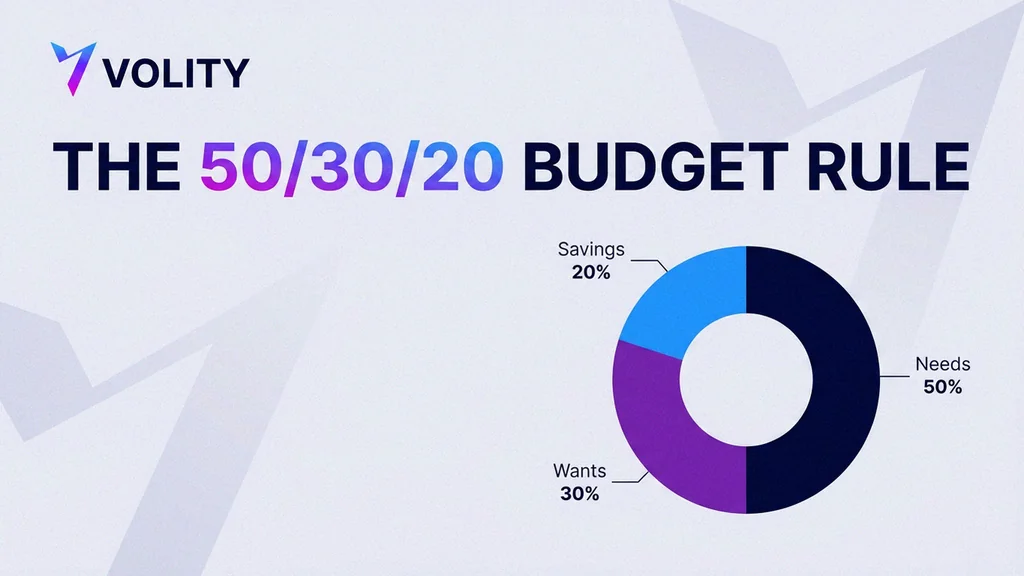
Most budgeting advice collapses under its own complexity. The 50/30/20 budgeting rule is the opposite: three buckets, no spreadsheet gymnastics. Half your take-home pay covers needs, three-tenths covers wants, and a fifth goes to savings and debt. This guide covers what counts where, a worked example, how to set it up, and when high rent or a low income means it has to bend.
TL;DR / Quick insight: The 50/30/20 rule splits your monthly take-home pay into 50 percent needs, 30 percent wants and 20 percent savings or debt repayment. It is a starting frame, not a law, so adjust the slices if your rent is high or your income is tight. The real win is the 20 percent slice: park it, then put part of it to work. With Volity you can hold that slice in a $0 multi-currency wallet and invest it commission-free from the same account.
Nothing here is personal advice – budgeting and investing both carry risk, and your numbers will differ from the example.
What the 50/30/20 rule is
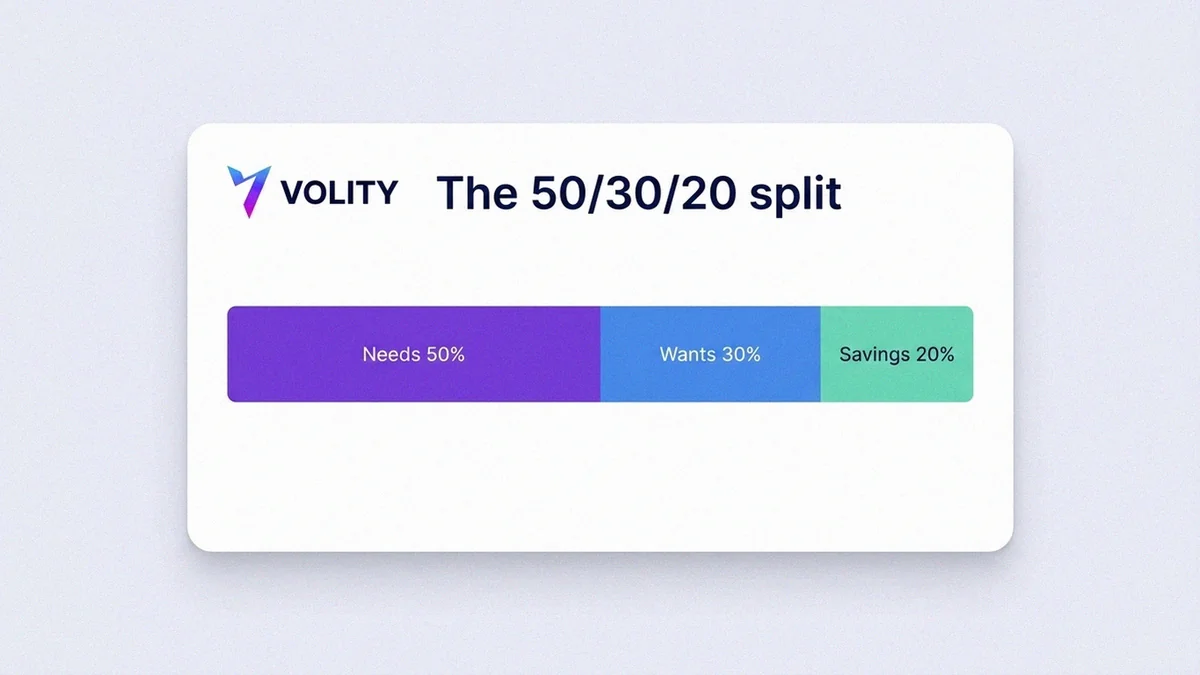
The 50/30/20 rule divides the money that lands in your account each month. You take your income after tax, then split it three ways: 50 percent to needs, 30 percent to wants, and 20 percent to savings and debt.
The figure you start from matters. This is take-home pay, after tax and compulsory deductions, not your headline salary. Budget off the bigger pre-tax number and every slice ends up too large, so the plan fails in week three.
What makes the rule stick is that it is easy to carry in your head: three percentages and one take-home figure, sketched on the back of a receipt. The trade-off is precision, since it gives a sensible default rather than a tailored plan, which is why it works when you are starting out.
Needs, wants and savings, and what counts where
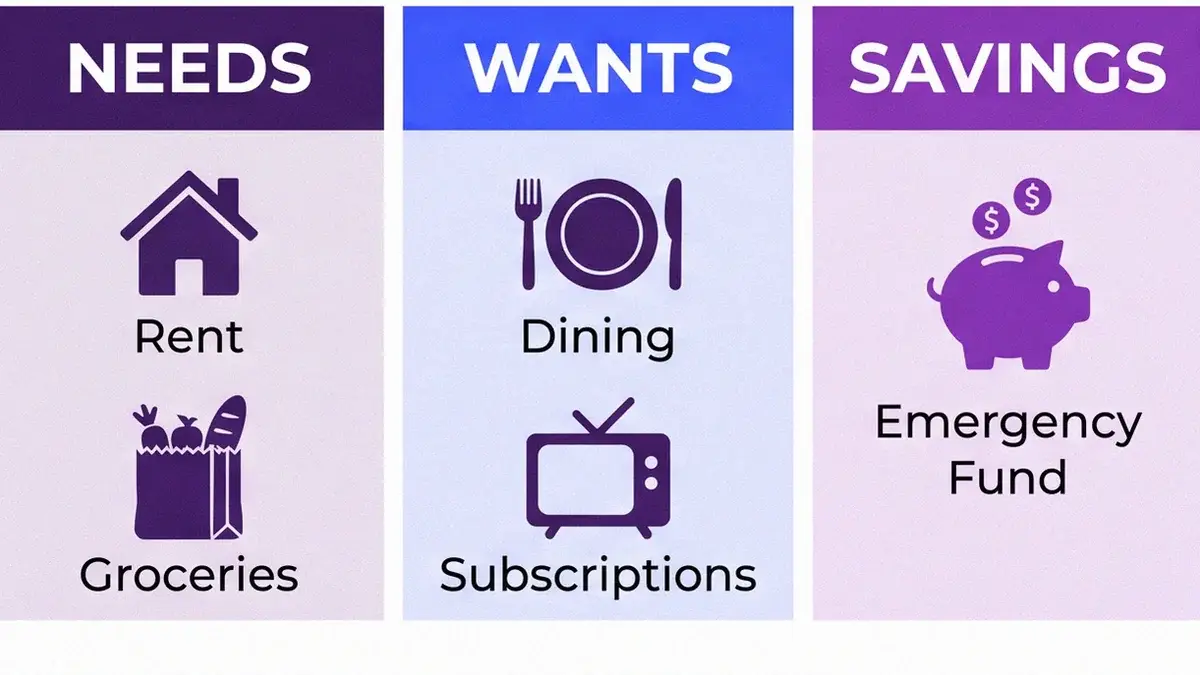
The confusion is sorting items into the right bucket. The plain version:
| Bucket | What it covers | Easy test |
|---|---|---|
| Needs (50%) | Rent or mortgage, utilities, groceries, transport to work, insurance, minimum debt payments. | Stop paying it and life breaks. |
| Wants (30%) | Eating out, streaming, holidays, hobbies, the nicer phone, anything optional. | Nice to have, survivable without. |
| Savings (20%) | Emergency fund, investing, and extra debt repayment beyond the minimum. | It builds your future, not today. |
Two grey areas trip people up. A phone contract is a need; the top-tier handset is mostly a want. Groceries are a need; the weekly restaurant habit sits in wants. When something could go either way, put it in wants, which keeps your needs slice lean. Minimum debt payments live in needs; anything above the minimum belongs in savings.
A worked example on a real take-home figure
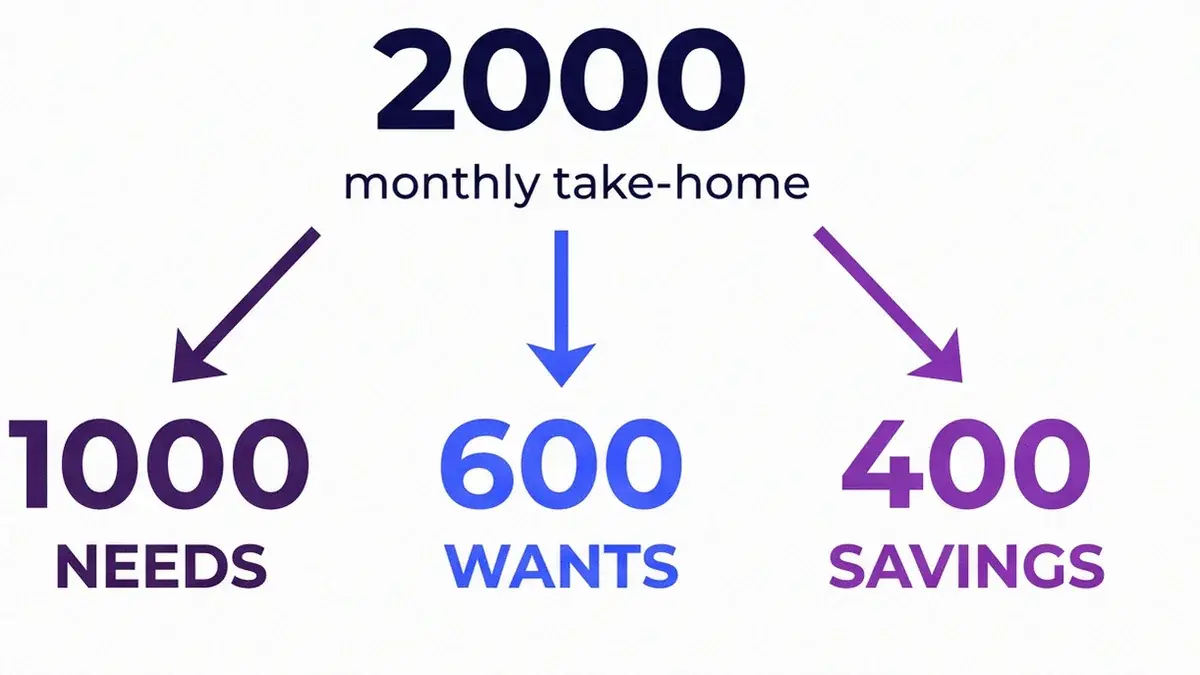
Take an example take-home pay of 2,000 a month after tax; the currency does not matter, as the maths is the same in euros or pounds. Split it by the rule:
- Needs: 50 percent of 2,000 = 1,000. Rent, utilities, food, transport, insurance and minimum debt payments.
- Wants: 30 percent of 2,000 = 600. Eating out, subscriptions, hobbies and the occasional treat.
- Savings: 20 percent of 2,000 = 400. Emergency fund, investing and any extra debt repayment.
So on a 2,000 take-home month, you put 400 toward your future, or 4,800 over a year, and the figures scale cleanly: on 3,000 it becomes 1,500 / 900 / 600. If your real needs come to more than half your take-home, you have found the rule’s pressure point, not a personal failure. We deal with that next.
How to set it up in three steps
You can have this running before the end of the week. It is three moves, and the free demo is a safe place to rehearse investing later.
- Find your real take-home figure. Look at what arrives in your account in a normal month, after tax. If pay varies, use a cautious average.
- Apply the three percentages. Multiply that figure by 0.5, 0.3 and 0.2, then write the amounts somewhere you will see them.
- Separate the money on payday. Move the savings slice out of your spending account the moment you get paid, so you never see it as spendable. A separate wallet does the work.
That third step is where the rule lives or dies. Budgets fail when the savings slice sits in the same pot as the groceries and gets eaten. A $0 multi-currency wallet on Volity holds that slice with no custody fee.
When to bend the rule (high rent, debt, low income)
The 50/30/20 split assumes a fairly typical cost of living. For many people it is not realistic as written, so bend it on purpose. If your rent alone swallows much of your pay, your needs slice runs past 50 percent. That is common in expensive cities and it is fine. Run a 60/25/15 or even 70/20/10 split for now, protect whatever savings percentage you can defend, and treat moving needs down as a goal.
When you carry expensive debt, flip the priority of the savings slice. Build a small emergency buffer first so one surprise does not send you back to borrowing, then aim most of the 20 percent at the costliest balance. Once it is gone, that money shifts toward investing.
On a tight income, the percentages can feel impossible because needs are close to all of it. Start with a 5 percent savings slice rather than zero, then raise it as your income grows. A small habit beats a perfect plan that never starts. The rule is a target you move toward, not a gate.
Turn the 20 percent into investing
Saving and investing are different jobs. The first chunk of your 20 percent should build an emergency fund, cash you can reach quickly, usually a few months of needs. Once that buffer exists, idle cash just lets inflation thin it out, so the rest becomes the natural candidate for investing. You do not need a large sum to begin.
Volity lets the same account that holds your $0 wallet also buy real shares, fractional shares, crypto and CFDs, so the savings slice flows straight from cash into investments. Markets trading is commission-free, which matters when you invest small, regular amounts, since per-trade charges hit them hardest. The Markets account opens from a $1 entry minimum, and every tier comes with a free demo so you can rehearse with zero risk. Fractional shares mean a 400 monthly slice can touch several companies. The Volity trader education hub goes deeper. Prices move both ways, so only money you can leave invested belongs here.
Start a 50/30/20 budget this month
Run this once to set up, then glance at it on payday.
- Do I know my real take-home figure, after tax, in a normal month?
- Have I worked out my three amounts (take-home times 0.5, 0.3, 0.2)?
- Have I sorted my regular costs honestly into needs and wants?
- Are minimum debt payments counted as needs, extra repayment as savings?
- Does the savings slice leave my spending account on payday?
- If my needs run past 50 percent, have I set a realistic split?
- Do I have an emergency fund building before I invest anything?
- Is the investing part going somewhere commission-free?
- Have I rehearsed buying on a free demo before committing money?
- Have I set a date to revisit the percentages as income changes?
If any line gets a no, fix that before the next payday. The budget works when the savings slice leaves first.
What to do next
Split your take-home figure 50/30/20 and move the savings slice out on payday so it is never spendable. Build the emergency fund first, then put the rest to work – rehearse on the free demo, hold cash in a $0 multi-currency wallet, and invest commission-free from one account that holds shares, fractional shares, crypto and CFDs. OPEN A VOLITY ACCOUNT to turn your 20 percent into investing, or browse the trader education hub. SEE FEES AND ACCOUNT TYPES.
Reviewed by: A. Bennett, Volity editorial desk.
Data integrity: every product figure here (Markets $1 entry minimum, commission-free trading, $0 multi-currency wallet, free demo on every tier, one account for shares, fractional shares, crypto and CFDs) is verified against Volity’s published account and fee docs. The splits and the 2,000 example are plain arithmetic.
Related Volity guides
- Ways to save money that actually work
- Dollar-cost averaging explained
- How to diversify a small portfolio
Related coverage on Volity
- Ways to Save Money That Actually Work: A Practical Guide
- How Much Should Your Emergency Fund Be? A Simple Way to Decide
- How to Save for a House Deposit: A Step-by-Step Plan
- How Much Money Do You Need to Start Trading? A Realistic Guide
- Dollar-Cost Averaging Explained: A Beginner Guide
Frequently asked questions
Is the 50/30/20 rule realistic?
For many people, yes, but not for everyone. It assumes a fairly typical cost of living. If your rent or essential costs run past half your take-home pay, the 50 percent needs slice is unrealistic, and you should bend the split. Treat it as a sensible default you adjust, not a fixed law.
What counts as a need in the 50/30/20 budget?
A need is something life breaks without: rent or mortgage, utilities, groceries, transport to work, insurance and minimum debt payments. The test is whether skipping it causes real consequences. If you would only miss the item, like eating out or streaming, it belongs in wants.
Can I change the percentages?
Absolutely, and you often should. The rule is a starting frame. High earners might push the savings slice well above 20 percent, while someone with high rent might run 60/25/15. The three-bucket structure is what matters; the exact numbers should fit your income and costs.
What should the 20 percent go to?
Build an emergency fund first, a few months of needs in cash you can reach quickly. After that buffer exists, the rest is the natural candidate for investing and for clearing expensive debt. On Volity you can hold the cash in a $0 wallet and invest it commission-free from the same account.
How does the 50/30/20 budget work with an irregular income?
Use a cautious average of your recent months rather than your best one, and apply the percentages to that. In strong months, bank the surplus into savings to smooth out the lean ones. The structure still holds; you let savings absorb the swings.
Sources
The guidance above draws on the following public sources.
- Citizens Advice – start from real take-home pay
- Citizens Advice – minimum payments versus extra repayment
- Consumer.gov (FTC) – sorting needs from wants
- Corporate Finance Institute – a simple monthly budget structure
- Corporate Finance Institute – building the savings slice into a plan
- Office for National Statistics – what households actually spend
- Office for National Statistics – rising costs for renters
- Investor.gov – turn the 20 percent into a goal
- Federal Reserve Board – households facing an unexpected expense
- Bank of England – why idle cash thins out