Most people do not have a saving problem so much as a system problem. The willpower runs out long before the month does. This guide skips the lectures and shows you ways to save money that survive a busy life: automate before you spend, attack the few costs that move the needle, and put what you keep somewhere it works for you. It ends where saving leads, when your money is ready to start earning.
TL;DR / Quick insight: The reliable ways to save money are mechanical, not heroic. Move a fixed amount to savings the day you get paid, before you can spend it. Cut the three big costs (housing, transport, regular subscriptions) instead of policing small treats. Park the cash somewhere it keeps its value, then once you have a buffer, let the surplus start earning. With Volity you hold that cash in a $0 multi-currency wallet and step into investing from one account.
Nothing here is personal advice, and investing carries risk. The point is to build habits that run on their own, so saving stops depending on a good mood.
Why most saving advice fails, and what works instead
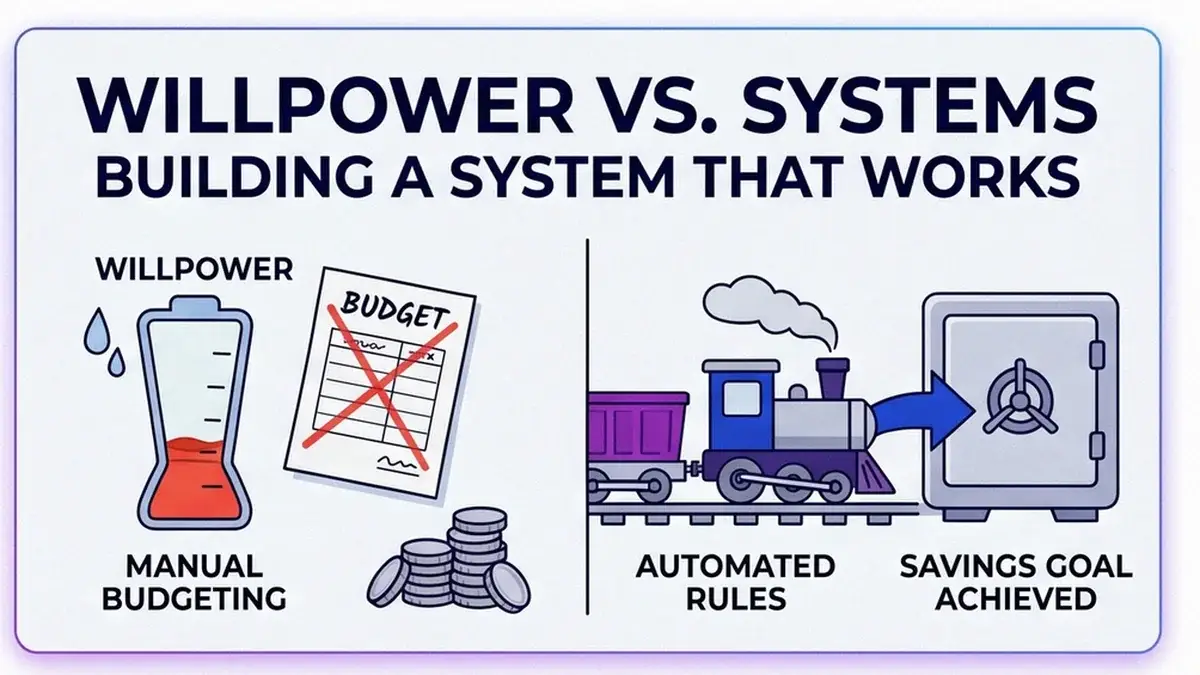
The usual advice tells you to track every coffee and feel guilty when you slip. It fails because it leans on willpower, which drains across a hard week.
What works is the opposite of effort. You set up the saving once, then let a rule do the work while you get on with life. Money you never see in your current account is money you do not miss. The real question is how to build a setup where saving happens by default.
Pay yourself first and automate before you spend
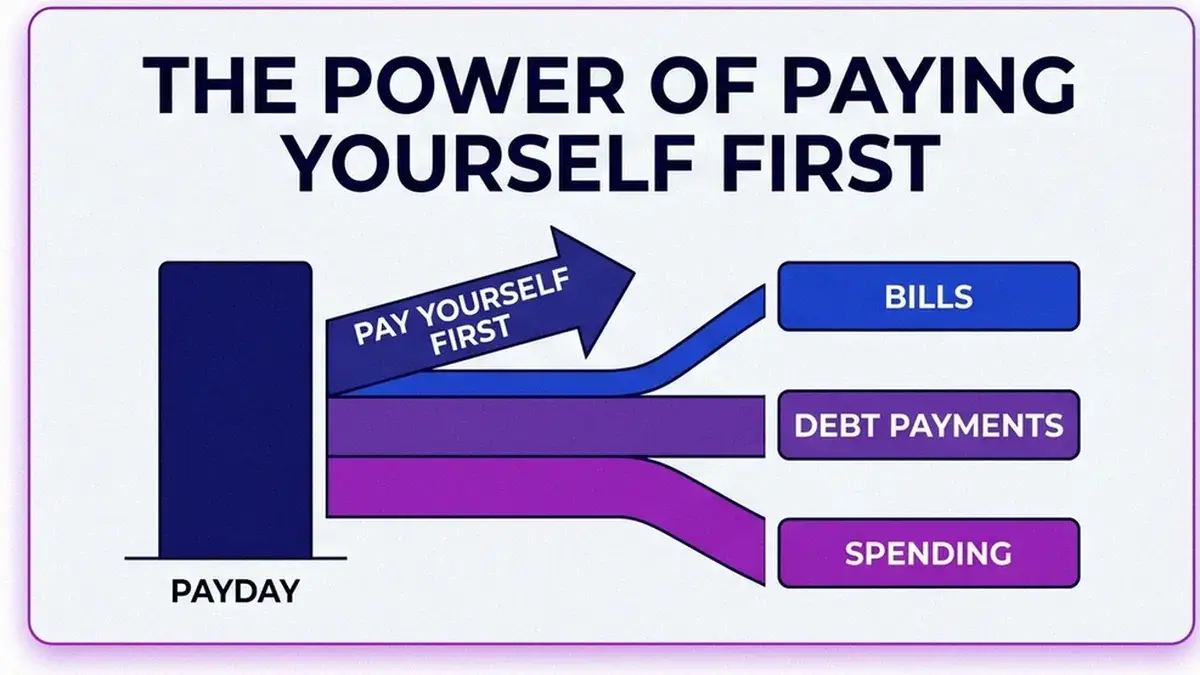
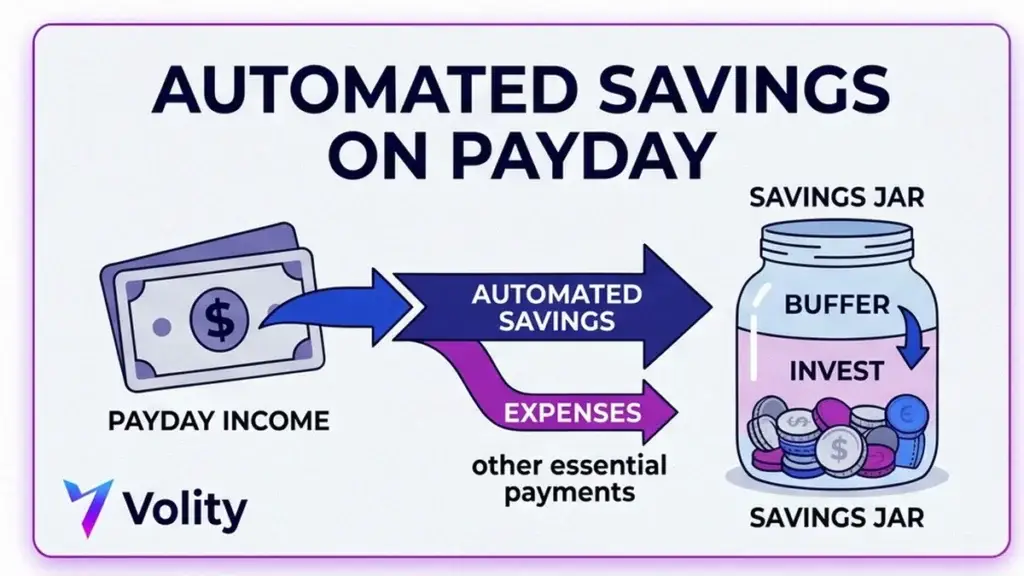
Pay yourself first means treating saving like a bill that comes out the moment you are paid, ahead of everything else. Most people save whatever is left at month end, and nothing is ever left. Flip the order.
Set up a standing transfer for the day after payday. A fixed sum leaves your current account automatically into a separate savings pot, and you budget on what remains, which feels normal within a week or two. The amount matters less than the automation; a small transfer that never stops beats a big one you cancel.
Start with a figure that does not hurt, then raise it the next time your income goes up. A quick example: move 10 out of every 100 the day you are paid, and that is 120 saved a year from a habit you set once and forgot.
Keep the pot slightly out of reach. A separate account, or a wallet you do not carry a card for, adds enough friction to stop casual raids. A Volity $0 multi-currency wallet holds the buffer in the currency you earn in, with no custody fee eating it.
Cut the big three, not the small treats
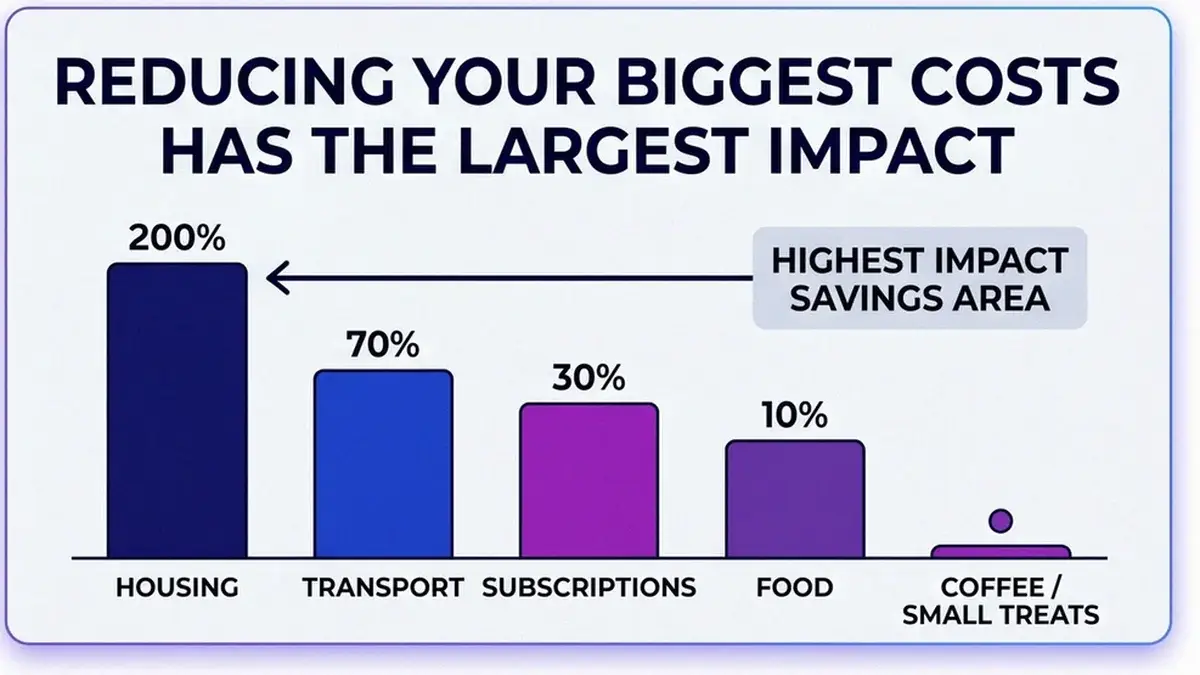
Cancelling your morning coffee saves loose change. Renegotiating the three costs that dominate your budget saves real money, once.
| Cost | Why it dominates | One move that helps |
|---|---|---|
| Housing | Usually the single largest line in any budget. | Review rent or mortgage terms; one move dwarfs years of small cuts. |
| Transport | Fuel, insurance and finance stack up quietly every month. | Compare insurance at renewal; question whether a cheaper option covers the same need. |
| Recurring subscriptions | Small individually, but they multiply and renew unnoticed. | List every recurring charge, then cancel the ones you forgot you had. |
The subscription audit is the fastest win. Most people pay for at least one thing they stopped using months ago, so scan your statement and cut the charges you cannot justify out loud. The small treats can stay: a joyless budget is one you abandon by February, so protect the few things you enjoy and cut hard everywhere else.
Sinking funds for predictable costs
A sinking fund is a small pot you fill gradually for a cost you know is coming. The annual insurance bill, the car service, the festive season; none are surprises, yet they wreck budgets every year because we pretend they are.
The fix is plain arithmetic. Take the yearly cost, divide by twelve, and set that aside each month. A 600 annual bill becomes 50 a month you barely notice, instead of a 600 shock that drives debt.
- List your once-a-year costs and their rough amounts.
- Divide each by the months until it is due.
- Add those monthly slices to your payday transfer.
- Keep each fund labelled so you do not spend it by accident.
Sinking funds turn every “unexpected” expense into a line you already planned.
Where to keep savings so they do not lose value
Cash sitting still quietly loses purchasing power as prices rise. That does not mean gambling your emergency fund; it means the place you keep money should match its job.
Split your savings by time horizon. Money you might need this month belongs somewhere instant and safe. Money you will not touch for a year can sit somewhere that keeps pace with prices. Money you will not need for years can start working harder, which is the next section.
Currency matters too if you earn or spend across borders, because holding value in a currency you do not use means paying to convert it every time. A multi-currency wallet keeps value in the right currency until you need it. On Volity, same-currency internal transfers are free, crypto deposits are free and instant, card deposits carry a 2.99% fee, and the minimum to move money is just EUR 10.
Turn saving into investing once the buffer is set
Saving and investing are two different jobs. Saving protects you; investing grows you. You do the first until you have a cushion, then the surplus graduates to the second. Get the order wrong and a market dip can force a sale at a bad moment.
The rule of thumb is to build an emergency buffer first, a few months of essential costs in instant-access cash. Once it is full, the same payday habit that built it can fund small, regular contributions into investments, and doing it from one account keeps it simple. Volity holds real shares, fractional shares, crypto and CFDs in a single login, and the commission-free Markets account starts from a $1 entry minimum, so small regular buys are not eaten by per-trade charges. Rehearse it on a free demo first, with no money at risk.
Your first month of saving
Run this once to set the system up. After that it runs itself; revisit only when your income changes.
- Pick a fixed amount to save, small enough that it does not hurt.
- Set a standing transfer for the day after payday so it leaves before you spend.
- Open a separate savings pot or wallet, slightly out of easy reach.
- Audit your statement and cancel every subscription you no longer use.
- Review the big three: housing, transport, insurance at next renewal.
- List your once-a-year costs and add monthly sinking-fund slices.
- Match each pot to its time horizon; keep short-term money instant and safe.
- Set a target for your emergency buffer in months of essential costs.
- Decide what happens to the surplus once the buffer is full, and try the step on a free demo first.
If any line is a “no”, fix that one before moving on.
What to do next
Set your payday transfer this week, run the subscription audit tonight, and pick a buffer target you can hit. When the buffer is full, you can move from saving to investing in the same place, real shares, fractional shares, crypto and CFDs, plus a $0 wallet for ready cash. OPEN A VOLITY ACCOUNT to take that step commission-free on the Markets tier, or browse the trader education hub first. Want the numbers before you commit? SEE FEES AND ACCOUNT TYPES.
Reviewed by: A. Bennett, Volity editorial desk.
Data integrity: every product figure here ($0 multi-currency wallet, free same-currency transfers, free instant crypto deposits, 2.99% on card deposits, EUR 10 minimum, commission-free Markets trading from a $1 entry minimum, free demo, one account for shares, fractional shares, crypto and CFDs) is verified against Volity’s published account and fee docs.
Related Volity guides
- How much money do you need to start trading?
- How to diversify a small portfolio
- Dollar-cost averaging explained
Related coverage on Volity
- How Much Should Your Emergency Fund Be? A Simple Way to Decide
- The 50/30/20 Budgeting Rule, Explained With Examples
- How Much Money Do You Need to Start Trading? A Realistic Guide
- Dollar-Cost Averaging Explained: A Beginner Guide
- How to Avoid Currency Conversion Fees: A Practical Guide
Frequently asked questions
What is the fastest way to save money?
Of all the ways to save money, the fastest is to automate it before you can spend it. Set a standing transfer for the day after payday so a fixed amount leaves your current account into a separate pot. Pair that with a one-off subscription audit to cancel charges you no longer use. Those two moves free up cash this month.
How much should I save each month?
There is no single right number, and treat anyone who states one as a hard rule with caution. A practical start is a fixed amount small enough that you do not feel it, then raise it whenever your income goes up. Early on, the habit of saving something automatically matters far more than the exact percentage.
Where should I keep my savings?
Match the place to the job. Money you might need this month belongs somewhere instant and safe. Money you will not touch for a year can sit somewhere that keeps pace with prices. If you earn or spend in more than one currency, a multi-currency wallet avoids repeated conversion costs. Keep the emergency buffer liquid, not locked away.
How do I save when money is tight?
Start absurdly small, even a token amount, so the habit forms without strain. Then look at the big costs rather than the treats: housing, transport and recurring subscriptions are where tight budgets find real room. Cancel one forgotten subscription tonight and redirect that amount into savings. Tiny and automatic beats large and rare.
When should saving turn into investing?
Build an emergency buffer first, a few months of essential costs in instant-access cash. Once that is full, the money you keep adding each payday no longer needs to sit idle and can fund small, regular investments instead. Doing both from one account keeps it simple, and a free demo lets you rehearse first.
Sources
The guidance above draws on the following public sources.
- Citizens Advice – work out your budget first
- Citizens Advice – reducing your regular outgoings
- Consumer.gov (FTC) – making a simple monthly budget
- Corporate Finance Institute – income, spending, saving and investing
- Corporate Finance Institute – build a cash buffer first
- Bank of England – why idle cash loses value
- Office for National Statistics – housing and transport dominate spending
- Office for National Statistics – household costs by tenure
- Investor.gov – set a savings target and timeline
- GOV.UK – tax-efficient places to hold savings