The difference between a prediction market and a fixed-odds bet is structural, and it sits in who is on the other side of you. A fixed-odds operator quotes a price and takes the position facing the customer. A prediction market matches you against another trader on an order book, and the venue itself takes no side. Polymarket’s own introduction puts it in one line: instead of betting against a house, you trade shares with other users in an open, peer-to-peer market. Everything else that feels different follows from that one design choice.
TL;DR / Quick insight: A fixed-odds operator sets the price you get and is your counterparty. A prediction market is an order book where the price comes from other traders, so it moves continuously, you can sell before the event finishes, and the venue’s charge is a visible fee rather than a margin folded into the quoted odds. Both cap what you can lose at what you committed. Neither removes the risk of losing all of it.
Nothing here is personal advice, and none of it is a view on which product suits you. An event contract can settle at zero, which means losing everything you paid for it. Whether these contracts are treated as financial instruments or as something else differs by country, so check the rules that apply where you live before you do anything.
An exchange rather than a bookmaker
Academic work on betting markets separates the two structures cleanly. In the fixed-odds model, as Franck, Verbeek and Nuesch describe it in the International Journal of Forecasting, the operator “acts as a dealer announcing the odds against which the bettor can place his bets”. They call this a quote-driven market, borrowing the term from finance. The price exists because a firm published it, and it is the same price for everyone who accepts it.
The exchange model works the opposite way round. The same paper notes that prices there “are determined by a multitude of individuals trading the bets among themselves”, with the platform providing the matching rather than the quote. Polymarket’s documentation describes exactly that machinery: a central limit order book in which prices are not set by Polymarket but emerge from supply and demand as users trade with each other.
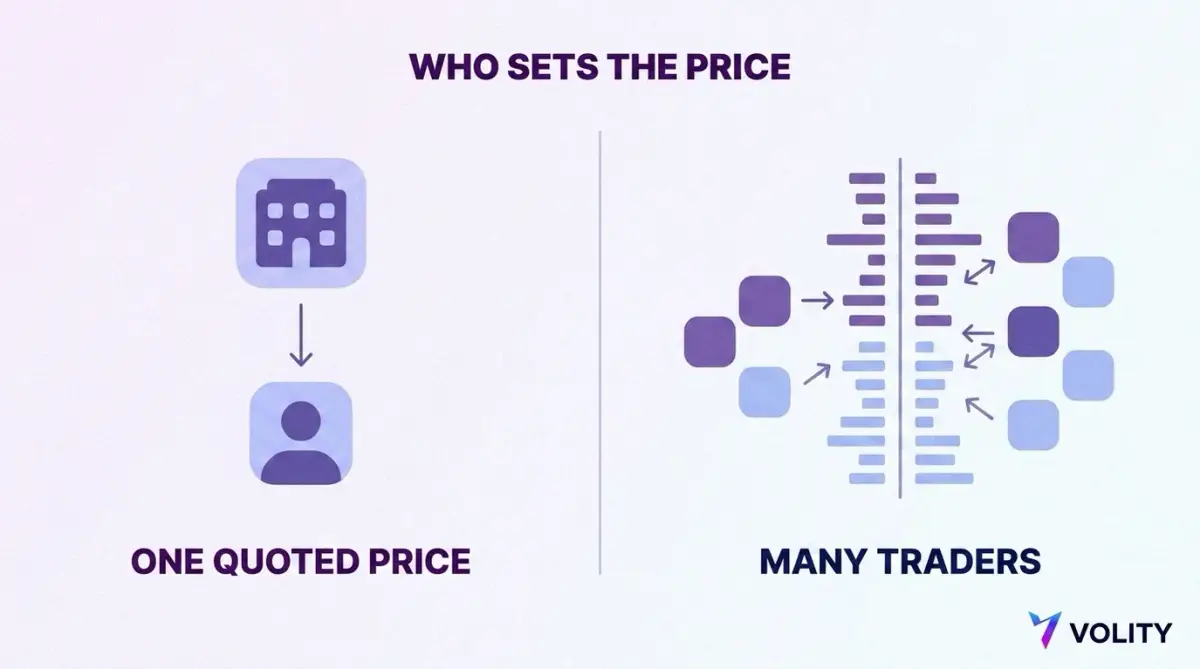
Set side by side, the two structures differ on almost every mechanical question.
| Question | Fixed-odds operator | Prediction market |
|---|---|---|
| Who sets the price? | The operator, in advance | Buyers and sellers, continuously |
| Who is your counterparty? | The operator | Another trader |
| How is the price expressed? | Decimal or fractional odds | A share price between $0.00 and $1.00 |
| Can you change your mind? | The odds are struck when you place the bet | Sell the position at the current bid |
| Where is the venue’s charge? | Built into the quoted odds | A separate fee on the trade |
| What decides the result? | Settlement rules published by the operator | Resolution rules published with the market |
No house on the other side, and why that changes the price
When a firm quotes both sides of a question, the quote carries that firm’s view, its risk appetite and its commercial margin. When thousands of people bid and offer against each other, the price is whatever the marginal buyer and the marginal seller can agree on, and it updates the moment either of them changes their mind. That is why a share price on a prediction market reads directly as a probability, with $0.25 meaning a 25% chance and $0.75 meaning 75%. Our guide to prediction market odds works through the conversions in detail.
Whether the traded price is a better forecast than the quoted one has been tested rather than assumed. Franck and his co-authors compared a betting exchange against bookmaker odds across every match in the top divisions of England, France, Germany, Italy and Spain over three seasons, 5,478 games in total, and found the exchange outperformed every single bookmaker in the sample on forecasting accuracy. Smith, Paton and Vaughan Williams, writing in Economica, matched exchange and fixed-odds data on UK horse racing and measured a favourite-longshot bias of 0.9% in the exchange data against 1.19% to 2.17% in traditional fixed odds, which they attribute to the exchange’s lower trading costs.
The wider literature points the same way without overclaiming. Wolfers and Zitzewitz argued in the Journal of Economic Perspectives that market-generated forecasts beat most moderately sophisticated benchmarks, and Berg, Nelson and Rietz found the Iowa Electronic Markets closer to the eventual result than 964 polls in 74% of comparisons. A traded price is a well-informed estimate. It is not a settled fact, and it is wrong often enough that you should never treat it as one.
Why what you can lose is what you paid
An event contract cannot be worth less than nothing. Each market has two outcome tokens, and every Yes and No pair in existence is backed by exactly $1 of collateral, so a share redeems for $1.00 or for nothing at all. Buy 100 Yes shares at $0.35 and the arithmetic has only two endings.
| Outcome | Redemption per share | Total on 100 shares | Cost | Result |
|---|---|---|---|---|
| Yes resolves | $1.00 | $100.00 | $35.00 | +$65.00 |
| No resolves | $0.00 | $0.00 | $35.00 | -$35.00 |
Read that second row carefully, because bounded is not the same word as safe. The resolution documentation is blunt about it: winning tokens redeem for $1 each and losing tokens become worthless. A total loss is the ordinary outcome for one side of every market that settles, not an unusual accident.
A fixed-odds bet also caps the downside at the stake, so this is not the dividing line people often assume it is. What differs is what happens in between. A staked bet has no market price until the event decides it, while a share sitting between $0.00 and $1.00 has a live value the whole time, which is what makes the next section possible.
You can exit before the event resolves
Because the position is a token on an order book, you can sell it at any time before resolution. Suppose those 100 shares bought at $0.35 drift to $0.55 after a squad announcement. Selling into the book turns a paper gain into $20.00 realised, and the event can then go whichever way it likes. If instead the price slides to $0.20, selling crystallises a $15.00 loss and keeps $20.00 back rather than risking the last of it on the result.
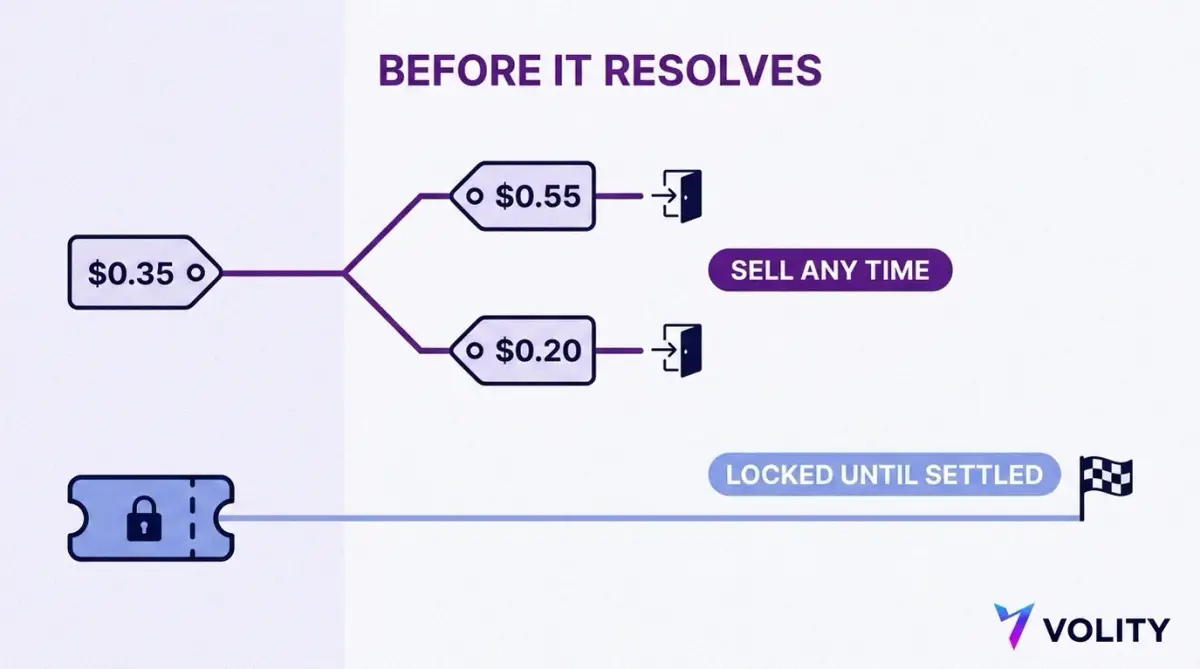
A fixed-odds bet behaves differently by construction. The odds are struck when the bet is placed, which is what the word fixed is doing in the name, and the return is locked at that moment. Where an operator offers an early settlement figure, it is another quote from the same firm rather than a price discovered between traders, so it inherits the structure described above.
The exit route on an exchange is only as good as the book behind it. Thin markets have wide spreads, and the displayed price is the midpoint of the bid and the ask, not the price you will get. If the book shows a bid of $0.18 and an ask of $0.22, the screen says $0.20 and your sale fills at $0.18.
Where the cost actually sits
In the fixed-odds model the charge is inside the number you are looking at. Franck and his co-authors define the mechanism precisely: the implied probabilities across all outcomes sum to more than one, and that excess, the overround, is the transaction cost. Two-way odds of 1.90 on each side imply 52.6% for each outcome and 105.3% in total, so 5.3 percentage points of the price is the operator’s margin. It is not itemised, and the customer never sees it as a line.
On a prediction market the charge is a separate number you can look up before you trade. Polymarket publishes the formula as fee = shares x fee rate x price x (1 – price), which peaks at a 50 cent price and falls away towards both ends. As of 2 August 2026 its published fee schedule sets the sports taker rate at 0.05, geopolitics markets at zero, and charges makers nothing at all. Fee schedules change, so read the current one rather than this paragraph.
| Trade (sports market, as of 2 Aug 2026) | Cost |
|---|---|
| 100 shares at $0.50 | $50.00 |
| Taker fee on that trade | $1.25 |
| Same order as a resting limit order | No fee |
| Spread cost if the book is $0.48 bid and $0.52 ask | $2.00 against the midpoint |
Adding the spread to the fee is the honest way to compare, and on an illiquid market the spread is the larger of the two. Franck’s paper observes that an exchange commission is “typically lower than the bookmaker’s overround”, but the useful takeaway is not a league table of costs. It is that one structure shows you the charge and the other embeds it, so only one of them can be checked before you commit.
How each one treats a market that moves against you
Consider a contract bought at $0.60 that drops to $0.30 on news. On an exchange that move is visible and actionable in the same instant. You can hold, sell into the bid and take the loss, or add at the lower price, and your account shows the position marked at the current price rather than at what you paid. That is a genuine advantage only if you use it deliberately, because a live price also invites the two classic mistakes: selling a good position on a wobble, and averaging into a position that is falling for a reason.
A fixed-odds bet does not re-price for the customer. The stake is committed and the outcome decides it, which removes the temptation to churn and equally removes any ability to respond to information that arrives after the bet is placed. Neither treatment is better in the abstract. They suit different temperaments and different reasons for being there.
What both share is that the rules text decides the result, not your reading of the event. On a prediction market those rules are published with the market before trading opens, and settlement follows them mechanically. Our walkthrough of how prediction markets resolve covers the ambiguous cases and the dispute path.
Which one answers which question
Work through these before you decide the format suits what you are actually trying to do.
- Are you after a probability you can trade, or a fixed return on a stated outcome? The first is an event contract, the second is a fixed-odds bet.
- Do you need the ability to change your mind after new information? Only a tradable contract gives you that.
- Can you see what the venue charges? Look for the published fee schedule, then add the spread on the specific market you want.
- Is the market liquid enough to leave? Check the depth on both sides of the book, not just the headline price.
- Have you read the resolution rules rather than the title? The title summarises; the rules are the contract.
- Are you comfortable losing the whole amount? Both formats can and regularly do return nothing.
- Do the rules where you live permit what you are considering? Treatment varies by country and it is on you to check.
If the mechanics of the contract itself are still fuzzy, start with what prediction markets are, then browse the rest of our trader guides for the wider market-structure context.
The format has grown quickly enough that most readers will meet it soon whether they seek it out or not. TRM Labs reported in March 2026 that monthly volume across prediction markets rose from about $1.2 billion in early 2025 to over $20 billion in January 2026, and Pew Research Center tracked combined volume at the two largest venues reaching roughly $24 billion in April 2026.
Where Volity fits
The Markets screen in your Volity dashboard connects an external platform to your Volity wallet. You connect or create the account at the venue, fund it from your Volity USD wallet, and trade on the venue itself while the balance shows up alongside the rest of your money. Dollars leave the wallet and arrive as a dollar stablecoin balance, which is the unit these contracts are collateralised in.
Your position lives at the venue, not with us. Balances and positions are held on the external platform, and trading, availability and withdrawals are subject to that platform’s own terms. Volity does not place or manage orders on your behalf.
Are prediction markets the same as gambling?
They work differently at the level of market structure. A fixed-odds operator quotes a price and is your counterparty, while a prediction market matches you against other traders and the venue takes no side, so the price moves with supply and demand and you can trade out of a position before the event ends. How the contracts are treated in law differs by country and is not settled everywhere, so the sensible step is to check the rules that apply where you live.
Can I cash out early on a prediction market?
You can sell the position at any time while the market is open, which is closer to selling a share than to asking for an early settlement figure. The price you get is whatever the best bid in the order book is at that moment, so a liquid market lets you leave near the displayed price and a thin one does not. There is no separate cash-out product and no quote to accept or decline.
Who sets the odds if there is no bookmaker?
Nobody sets them. Prices are the result of buy and sell orders meeting on the book, so a share trading at $0.62 means the last people to agree on a price settled at 62 cents, implying a 62% chance. When new information arrives, traders move their orders and the price moves with them, sometimes within seconds. The venue publishes the market and the rules, and it does not quote the price.
Is the payout better on a prediction market?
That is the wrong comparison, because the payout on an event contract is always $1.00 per share and your return depends entirely on what you paid. The meaningful difference is where the venue’s charge sits: an exchange fee is published separately and can be checked before you trade, while a fixed-odds margin is folded into the quoted odds. Neither structure changes the fact that you can lose everything you commit.
What is the equivalent of the margin in the odds?
On a prediction market it is the taker fee plus the bid-ask spread. The fee follows a published formula and is largest around a 50 cent price, and the spread is the gap between the best bid and the best ask on the specific market you are trading. Add the two together for the real cost of entering and leaving. In fixed odds the equivalent is the overround, which is the amount by which the implied probabilities across all outcomes exceed 100%.