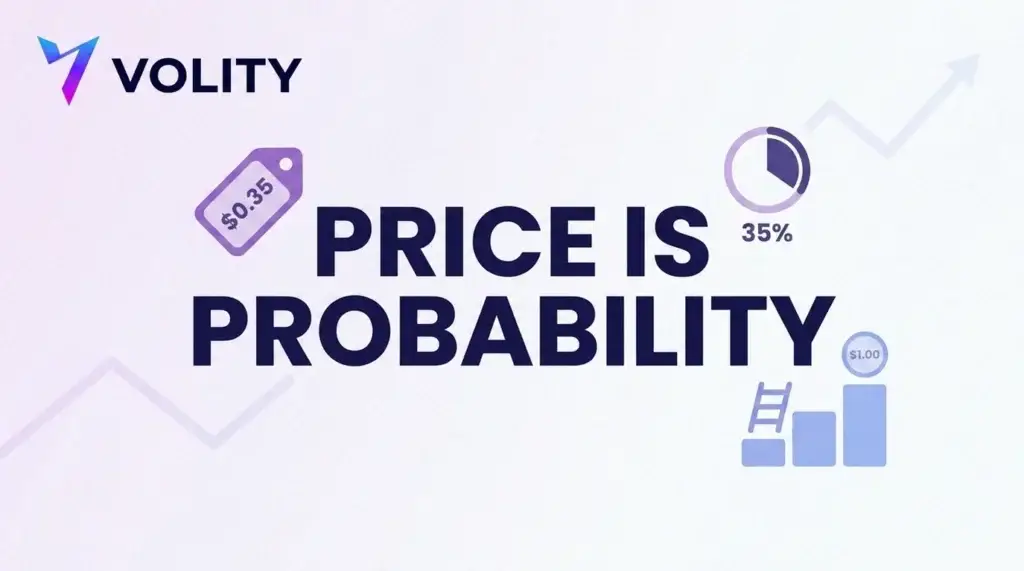
A prediction market does not quote odds. It quotes a price, and the price already carries the answer most people are hunting for. A share that costs $0.35 is the market saying there is roughly a 35% chance, because every share pays exactly $1.00 if the outcome happens and nothing if it does not. Learning how to read prediction market odds is mostly learning that one sentence and then doing the arithmetic that follows from it. Wolfers and Zitzewitz set out the theory behind that shortcut in Interpreting Prediction Market Prices as Probabilities, showing that across a broad class of models the price sits close to the mean belief of the traders in the market.
TL;DR / Quick insight: Price is probability. A share at $0.35 implies about 35%, costs $0.35, and pays $1.00 or $0.00. Your profit if it wins is $1.00 minus what you paid, so the return on cost is (1 – price) / price. YES at $0.35 and NO at $0.65 are two views of one market, and the pair always sums to $1.00. In the formats you already use, $0.35 is decimal 2.86 and fractional 13/7.
Nothing here is personal advice. An event contract can settle at zero, which means losing the whole amount you paid for it.
Why the price is the probability
The link between price and probability is not an interpretation anyone bolted on afterwards. It falls out of the payout. Because a winning share redeems for a fixed $1.00 and a losing share for nothing, the price has nowhere to sit except somewhere between those two numbers. Polymarket’s documentation puts it directly: every share is priced between $0.00 and $1.00 and the price represents the market’s belief in the probability of that outcome. A regulator’s public explainer describes the same instrument from the legal side, defining an event contract as a derivative built on a yes-no scenario with a fixed payout and an expiration.
Kalshi, a separate venue running the same structure, describes the arithmetic from the other end. If the Yes price is 70 cents and the No price is 30 cents, the two buyers together contribute exactly $1. That dollar is the thing being fought over. One of the two shares it creates will be worth the full dollar and the other will be worth nothing, so the split between them is a statement about how likely each side looks right now.
Reading probability out of a traded price is ordinary practice in mainstream finance too. The Bank of England has published work on option-implied probability distributions for future inflation, extracting a full distribution of expected outcomes from the prices of traded contracts. An event contract does the same job with far less machinery, because the payout is already a clean yes or no.
The idea has been tested in public for decades. The Iowa Electronic Markets have run small real-money markets at the University of Iowa since the late 1980s precisely so researchers could check whether a price forecasts an outcome. Wolfers and Zitzewitz summarise the wider evidence in Prediction Markets in Theory and Practice, where the prices are treated as market-aggregated forecasts rather than opinions.
Turning cents into a percentage, and back
The conversion is the easiest arithmetic in trading, which is why it catches people out so rarely and costs them so much when it does. Multiply the price in dollars by 100 and you have the implied probability in percent. Divide the percentage by 100 and you have the price. Every cent of price is one percentage point.
| Share price | Implied probability | Price of the other side | Its implied probability |
|---|---|---|---|
| $0.05 | 5% | $0.95 | 95% |
| $0.25 | 25% | $0.75 | 75% |
| $0.35 | 35% | $0.65 | 65% |
| $0.50 | 50% | $0.50 | 50% |
| $0.72 | 72% | $0.28 | 28% |
| $0.90 | 90% | $0.10 | 10% |
Polymarket publishes the same mapping in its own reference table, listing $0.25 as a 25% chance, $0.50 as 50% and $0.75 as 75%. Nothing in that conversion depends on the venue, the asset or the question being asked. It depends only on the fixed $1.00 payout.
One detail on the screen deserves attention before you trade against it. The single price a market shows you is usually a midpoint, not something you can transact at. Polymarket’s documentation gives the worked case: if the best bid is $0.34 and the best ask is $0.40, the displayed price is $0.37, and you will pay the ask of $0.40 when buying or receive the bid of $0.34 when selling. So the headline 37% is a fair reading of where the market sits, while 40% is the probability you would have to beat to make buying worthwhile.
What your payout looks like at any entry price
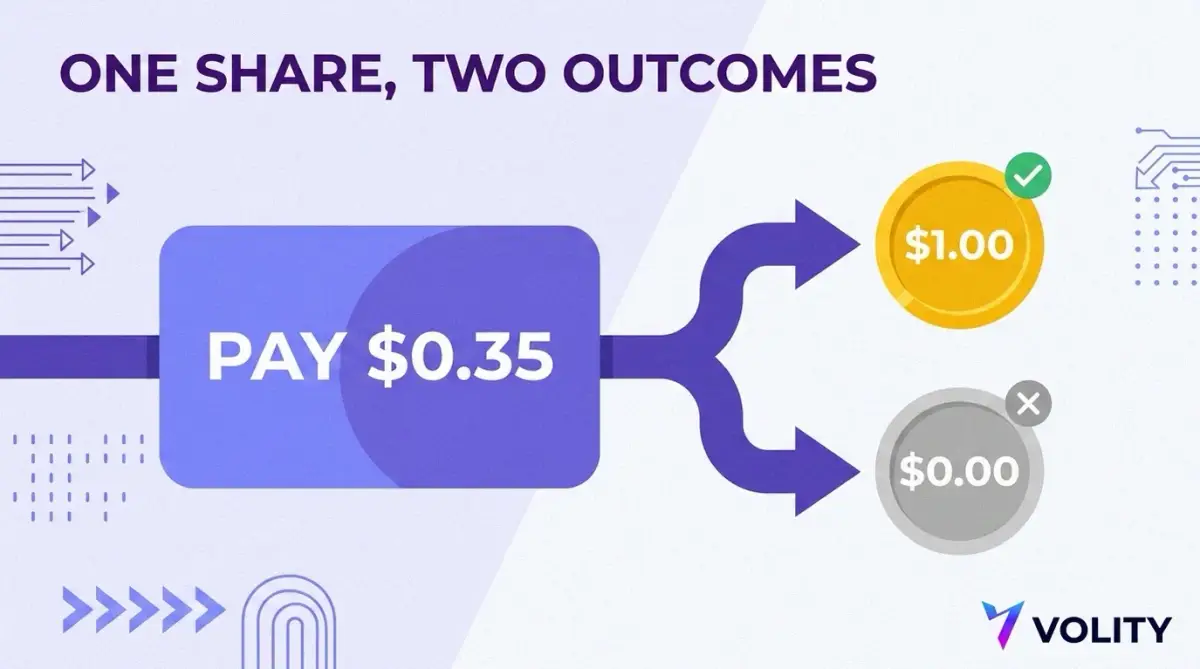
Every position you will ever hold in one of these markets is described by what you pay and what you collect. You pay the price. You receive $1.00 per share if you are right and $0.00 per share if you are wrong. Everything else is division.
Start with the shares. A stake of S dollars at a price of p dollars buys S divided by p shares. If it resolves your way, those shares redeem for $1.00 each, so the payout is S divided by p. The profit is that payout minus the stake, and the return on cost is (1 – p) divided by p. Polymarket’s resolution documentation states the redemption side plainly: holders of winning tokens redeem them for $1 each and losing tokens become worthless.
Here is the same $100 stake placed at six different prices.
| Entry price | Shares for $100 | Payout if it happens | Profit if it happens | Return on cost | Loss if it does not |
|---|---|---|---|---|---|
| $0.10 | 1,000.00 | $1,000.00 | +$900.00 | 900% | -$100.00 |
| $0.25 | 400.00 | $400.00 | +$300.00 | 300% | -$100.00 |
| $0.35 | 285.71 | $285.71 | +$185.71 | 185.7% | -$100.00 |
| $0.50 | 200.00 | $200.00 | +$100.00 | 100% | -$100.00 |
| $0.65 | 153.85 | $153.85 | +$53.85 | 53.8% | -$100.00 |
| $0.90 | 111.11 | $111.11 | +$11.11 | 11.1% | -$100.00 |
Read the last two columns together. The $0.90 row offers 11.1% and the $0.10 row offers 900%, and the downside in both is the same $100. What changes is how often each one is supposed to come good. If the $0.90 price is honest, that row loses everything about one time in ten. Run it ten times and nine wins of $11.11 come to $99.99, which the single $100 loss erases with a penny to spare. A fairly priced contract has an expected value of zero before costs, whichever row you pick.
Costs do exist, and on Polymarket they land on the taker side of the trade. The published formula is fee = C x feeRate x p x (1 – p), where C is the number of shares and p is the price, with makers never charged and geopolitics markets fee-free (rates as published on 1 August 2026, and they change). On a politics market at a 0.04 rate, 100 shares bought at $0.35 costs 100 x 0.04 x 0.35 x 0.65, which is $0.91. That turns your effective entry into $0.3591 per share and pushes your breakeven probability from 35% to about 35.9%. The same formula gives $0.91 at $0.65 and $1.00 at $0.50, so the charge peaks in the middle and shrinks toward the extremes.
YES at $0.35 and NO at $0.65 are the same market
New traders often scan a page looking for the cheap side, as though $0.35 were a bargain and $0.65 an expensive one. They are the same market described twice. On Polymarket a market is a single binary question with Yes and No outcomes, and the two shares are created together: one dollar of collateral creates one Yes share and one No share, exactly one of which will be worth $1.00.
Line the two trades up and the symmetry is complete.
| Per share | Buy YES at $0.35 | Buy NO at $0.65 |
|---|---|---|
| Cost per share | $0.35 | $0.65 |
| Implied probability | 35% | 65% |
| Profit per share if it happens | +$0.65 | -$0.65 |
| Profit per share if it does not | -$0.35 | +$0.35 |
| Return on cost when right | 185.7% | 53.8% |
| Most you can lose per share | $0.35 | $0.65 |
The YES buyer risks 35 cents to win 65. The NO buyer risks 65 cents to win 35. Add the two risks and you get the $1.00 that one of them will collect. Neither side is cheap or dear on its own, and the only question worth asking is whether 35% is too low or too high for the event in front of you.
That symmetry also explains something that looks like two different products. Buying a YES share at $0.35 and selling a NO share at $0.65 leave you in an identical position: 65 cents up if the event happens, 35 cents down if it does not. Interfaces label these differently, and traders coming from a fixed-odds background often read one as backing and the other as laying. In an order book they are one exposure.
Converting to the odds formats you already know
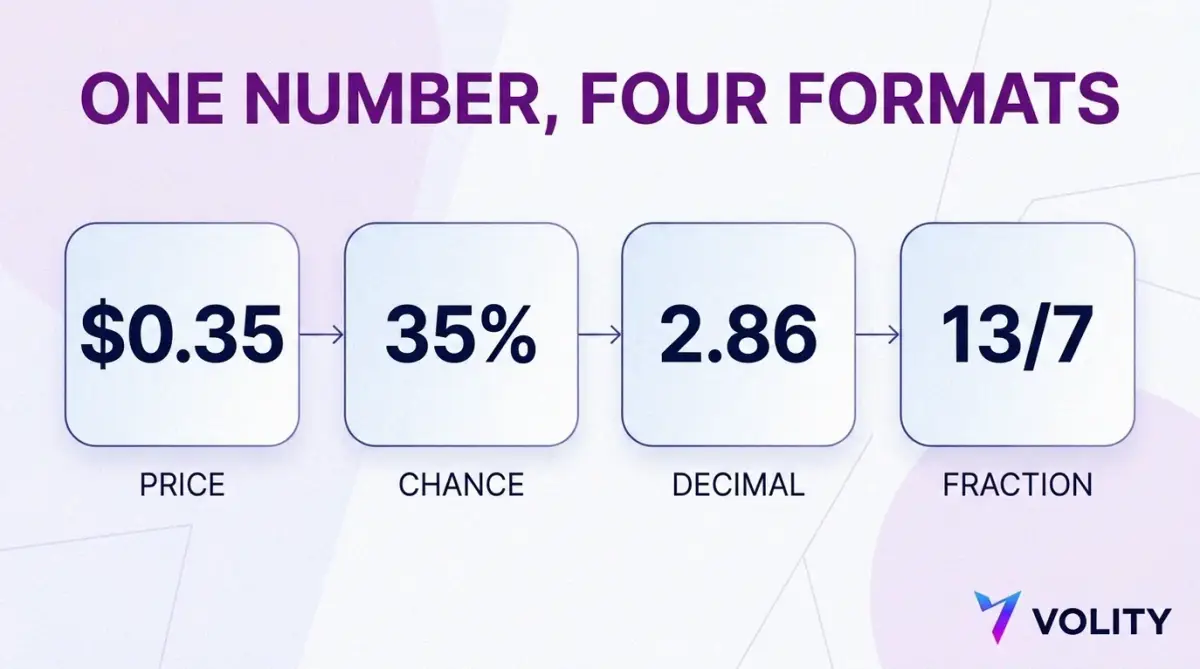
If you have spent time around sportsbooks in Britain, Ireland, Australia or South Africa, a price in cents will feel like the wrong unit at first. The translation runs on short formulas.
- Decimal odds are the total return on one unit staked, including the stake, so decimal = 1 divided by the price. A share at $0.35 is 1 / 0.35 = 2.86.
- Fractional odds are the profit per unit staked, so fractional = (1 – price) divided by the price. A share at $0.35 is 0.65 / 0.35 = 13/7, which a bookmaker would round to something near 15/8.
Both run backwards just as easily. From decimal odds, price = 1 / decimal, so 4.00 is $0.25. From fractional odds a/b, price = b / (a + b), so 3/1 is 1 / 4 = $0.25 and 5/2 is 2 / 7 = $0.29.
| Share price | Implied probability | Decimal odds | Fractional odds |
|---|---|---|---|
| $0.10 | 10% | 10.00 | 9/1 |
| $0.20 | 20% | 5.00 | 4/1 |
| $0.25 | 25% | 4.00 | 3/1 |
| $0.35 | 35% | 2.86 | 13/7 (about 15/8) |
| $0.50 | 50% | 2.00 | 1/1 (evens) |
| $0.65 | 65% | 1.54 | 7/13 (about 8/15) |
| $0.80 | 80% | 1.25 | 1/4 |
| $0.90 | 90% | 1.11 | 1/9 |
One difference survives the conversion, and it is the one worth knowing. A fixed-odds price has a margin baked into it. Researchers working with betting data describe the standard correction: implied winning probabilities are derived by dividing the inverse odds by the booksum, the sum of the inverse odds, so that the implied probabilities add up to 1. They need that step because the raw numbers sum to more than 1. Quote 1.80 and 2.10 on a two-way question and the implied probabilities are 55.56% and 47.62%, a total of 103.17%, and the 3.17 points of excess is the margin.
An order book does not work that way, because the two sides are two halves of one dollar. The cost of crossing shows up in the spread instead. If the best ask on YES is $0.53 and the best ask on NO is $0.49, buying both would cost $1.02 to guarantee $1.00 back, a round-trip cost of two cents. The corresponding bids, $0.51 and $0.47, mirror each other exactly, and the midpoints add to precisely $1.00. Same friction, different place, and it is visible rather than embedded.
Why the price moves before anything happens
A price that quietly drifts from $0.42 to $0.47 with no headline attached confuses people who expect a probability to sit still until news arrives. Prices move because the market is a live auction, not a published forecast. Polymarket describes its order book as the mechanism where prices are not set by the platform but emerge from supply and demand as users trade with each other. Somebody wanting size right now lifts the offers, and the price is wherever the last willing seller stood.
Time itself moves prices too. A contract on something that resolves in eleven months and one that resolves on Thursday can carry the same 60% price and behave nothing alike, because as the deadline approaches the range of things that could still change the answer narrows. Prices tend to drift toward $1.00 or $0.00 as the window closes, and a position that was quiet for months can move several cents a day in the final week.
Liquidity moves prices as well, and gets discussed least. In a thin market a single large order can walk the book several cents, and the printed price afterwards reflects one trader’s urgency rather than any change in the world. Checking the depth on both sides before you read a move as information is a habit worth building.
Common misreadings that cost money
Most expensive mistakes in this instrument are reading errors rather than forecasting errors. These are the ones that keep recurring.
- Treating the displayed price as your fill. The screen shows a midpoint. You buy at the ask and sell at the bid, and on a wide market the gap between the two can be worth more than your edge.
- Reading $0.90 as certainty. It is a claim that roughly one in ten of these fail, and the whole $100 goes when one does.
- Confusing price movement with probability movement. A move from $0.05 to $0.10 doubles your money and adds five percentage points of probability. The two figures describe different things and only one of them is your return.
- Hunting for the cheap side. Every YES has a NO at one dollar minus the price, so there is no cheap side, only a side you think is mispriced.
- Assuming you can always exit at the quoted price. Selling before resolution is allowed on these venues, but a thin book may not take your size anywhere near the midpoint.
- Skipping the resolution rules. The title asks the question and the rules decide it, including how a delay, a cancellation or an ambiguous outcome is treated. Reading them takes two minutes and settles arguments before they cost anything.
Before you buy, write down the probability you would put on the event yourself, then compare it with the ask rather than the midpoint. If you think an event is a 45% chance and the ask is $0.35, the gap is where the trade lives: 0.45 x $1.00 minus $0.35 is 10 cents of expected value per share on a 35 cent outlay. If the gap is one or two cents, fees and spread will eat it.
For the wider picture, our guide to what prediction markets are covers the instrument itself, how these markets resolve covers the rules that decide your payout, and prediction markets compared with betting handles the structural differences. The mechanics of one venue are set out in how Polymarket works, and the rest of our trader guides cover the surrounding ground.
Where Volity fits
The Markets screen in your Volity dashboard lets you connect a Polymarket account, fund it from your Volity USD wallet and watch the balance from the same place you manage the rest of your money. Dollars leave the wallet and arrive at the venue as a dollar stablecoin balance, which is the unit these contracts are collateralised in.
Your position lives at the venue, not with us. Balances and positions are held on the external platform, and trading, availability and withdrawals are subject to that platform’s own terms. Volity does not place or manage orders on your behalf. What you get on our side is one funding route and one view of the balance, so the arithmetic on this page is the only thing you need to do yourself.
What does a 35 cent contract mean?
It means the market is pricing roughly a 35% chance of that outcome. You pay $0.35 per share now and each share pays $1.00 if the outcome happens or $0.00 if it does not. In the odds formats used across the UK, Ireland and Australia that is 2.86 decimal or 13/7 fractional. Bear in mind the 35 cents on screen is normally a midpoint, so your actual entry will be a cent or two higher.
How do I calculate my return on a prediction market trade?
Divide your stake by the price to get the number of shares, then multiply by $1.00 for the winning payout. A $100 stake at $0.35 buys 285.71 shares, which redeem for $285.71, a profit of $185.71. The shortcut for the percentage is (1 – price) divided by price, so 0.65 / 0.35 is 185.7%. If the outcome goes the other way you lose the full $100.
Does a 90 cent price mean it is certain?
No. It means about a one in ten chance of the outcome failing, and if it fails you lose everything you paid. The payoff reflects that: $100 at $0.90 returns $111.11, a profit of $11.11. Nine of those wins add up to $99.99, which a single $100 loss wipes out entirely. High prices are small returns attached to small but real risks.
How do prediction market odds compare to bookmaker odds?
The arithmetic is identical and the margin sits in a different place. A fixed-odds market has the operator’s margin priced in, which is why the implied probabilities across the outcomes add up to more than 100%. On an order book the two sides always sum to exactly $1.00, and the cost of trading appears as the spread you cross plus any taker fee, both of which you can see before you commit.
Why did the price move without news?
Order flow and time both move prices. A large order in a thin market can push the price several cents without anything happening in the world, and prices naturally drift toward $1.00 or $0.00 as the resolution date approaches and fewer things can still change the answer. Check the depth on both sides of the book before reading a move as information.