Polymarket is a prediction market where you buy and sell shares in the outcome of a real event, and the price of a share reads as the market’s estimate of how likely that outcome is. What makes it unusual is the plumbing. Your order is matched by an operator away from the blockchain, then settled on Polygon by smart contract, and the money backing your position never sits in a company account. This guide follows one dollar through the whole path, from the order book to the moment a winning share is redeemed.
The Crypto Trading Starter Kit
A plain-English PDF: what to check before you trade, how orders and risk really work, and the mistakes to skip. Get it free.
TL;DR / Quick insight: Polymarket runs a central limit order book where an operator matches signed orders off-chain and every matched trade settles on-chain on Polygon. Collateral is a dollar stablecoin held in a wallet you control, and one dollar of it backs exactly one Yes share plus one No share. Nobody takes the other side of your trade, so the cost sits in the spread and an explicit taker fee rather than in a bookmaker’s margin. Winning shares redeem at $1.00 once an outside oracle settles the market.
Nothing here is personal advice. An event contract can settle at zero, which means losing the full amount you paid for it.
What Polymarket is in one paragraph
Polymarket lists questions about real events and turns each answer into a tradable share. Buy the side you think is right, and if you are right, each share pays a fixed $1.00. The platform’s own documentation describes trading shares with other users in an open, peer-to-peer market rather than betting against a house, with every share priced between $0.00 and $1.00 so the price doubles as an implied probability. Yes at $0.65 reads as roughly a 65% chance. If that pricing logic is new to you, our explainer on what prediction markets are covers the instrument itself before the venue mechanics.
Scale is worth a sentence, because a market only works if someone is on the other side of your order. Polymarket’s public data API showed global open interest of about $328 million on 1 August 2026, and CNBC reported that Polymarket volume hit a record high of $10.8 billion in June 2026. Polymarket runs that international exchange alongside a separately operated US-regulated venue, whose volumes press reports count separately.
How orders match off the chain and settle on it
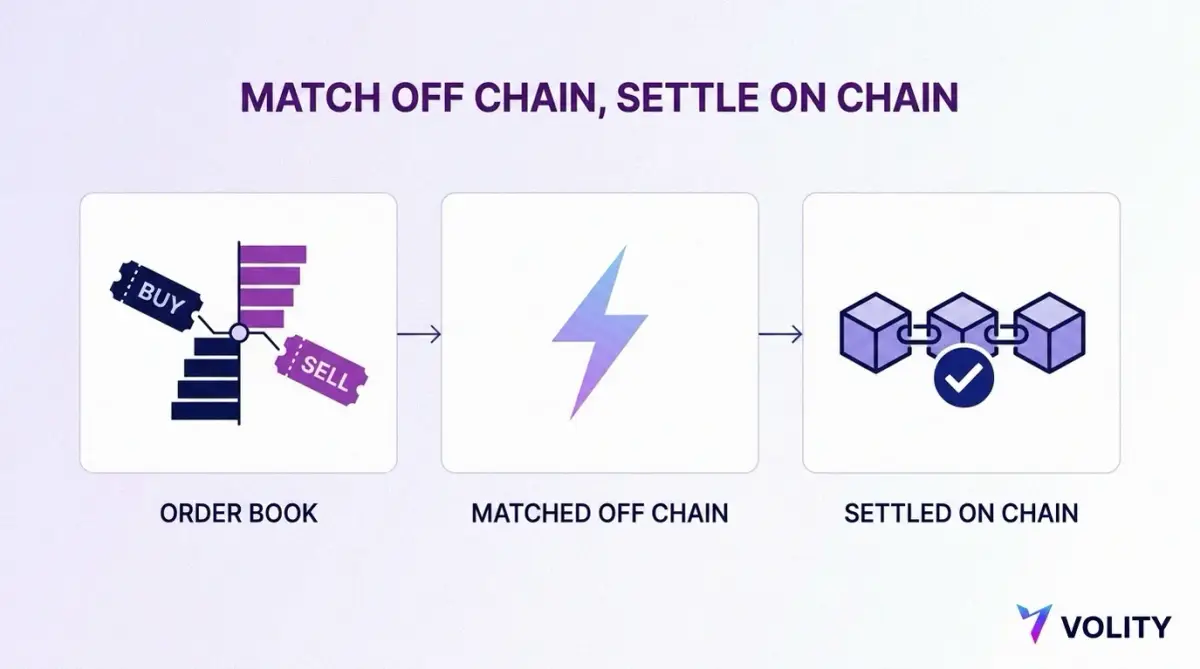
The order book is what Polymarket calls hybrid-decentralised: an operator matches compatible orders away from the blockchain, and every matched trade then settles on-chain through smart contracts. Matching off-chain is what makes the book fast and free to quote. Settling on-chain is what makes the result verifiable by anyone.
You never hand over your money to make this work. An order is a structured message you sign with your own key under EIP-712, the Ethereum standard for signing readable, typed data. That signature authorises the exchange contract to execute the trade without ever taking custody of your funds. The limit on the operator’s power is set out in the documentation and it is the sentence worth remembering: the operator can match orders and enforce their ordering, but cannot set prices or execute trades that users did not authorize. The contract that does the settling is public, and its repository describes it as facilitating atomic swaps between conditional-token assets and an ERC-20 collateral asset in exactly this operator-matched, non-custodial pattern.
That design shows up in the details. Every order is technically a limit order, and what looks like a market order is simply a limit order priced to execute immediately against what is already resting on the book. A trade then moves through visible stages once it is matched, from matched to mined to confirmed, which is the seam between the fast off-chain book and the slower chain underneath it.
Why the collateral is a dollar stablecoin on Polygon
Every Polymarket contract is deployed on Polygon mainnet, and the unit of account is a dollar stablecoin rather than a volatile token. That choice removes a second price risk: a share priced at $0.35 should move because the odds moved, not because the collateral underneath it repriced overnight.
The token doing the work changed in 2026. Since the exchange upgrade of 28 April 2026, the collateral that moves through the order book is pUSD, described in the docs as an ERC-20 token on Polygon backed by USDC with the backing enforced onchain, with no algorithmic peg and no fractional reserve. USDC remains the thing underneath, since deposits, withdrawals and protocol settlement run in it. Day to day the reader sees a dollar balance and trades against it.
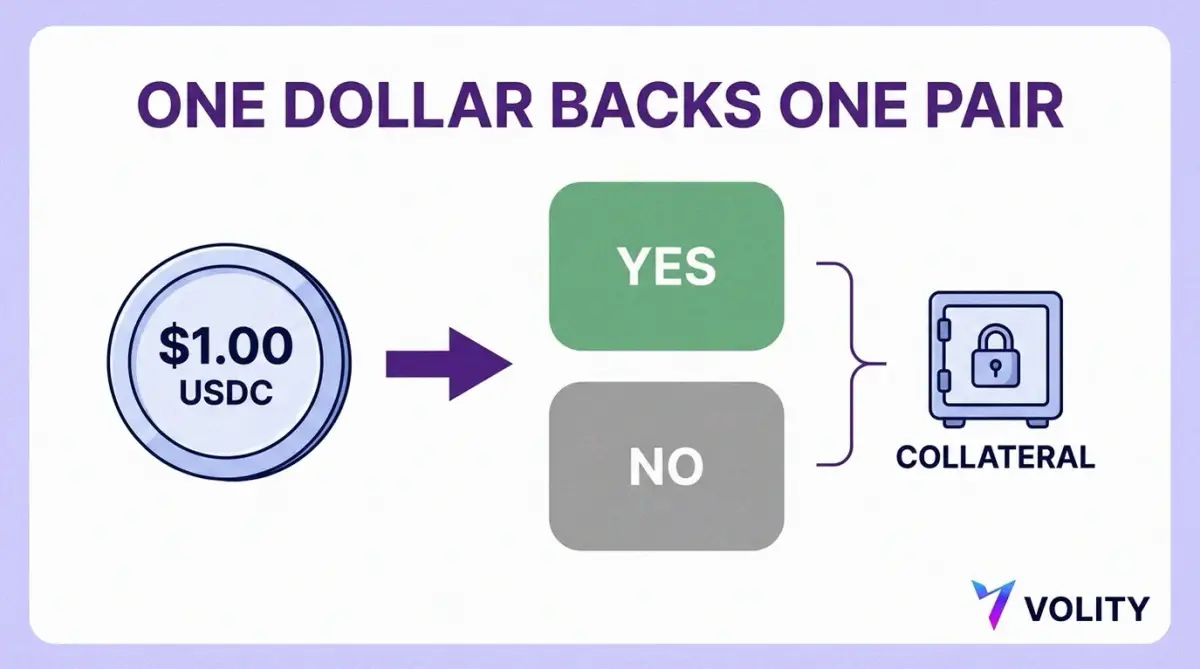
Now the part that makes the whole market add up. Outcome shares are issued through the Gnosis Conditional Token Framework as ERC-1155 tokens, the multi-token standard that lets one contract manage thousands of token types. One dollar of collateral splits into one Yes token and one No token, and a complete set can be merged back into a dollar at any time. That is why a Yes share and its matching No share always sum to $1.00: one of them will redeem for a dollar and the other for nothing, and the collateral for both is already locked up.
Why your funds stay in your own wallet
Polymarket states the custody position plainly in its documentation: assets sit in your wallet, secured by your key, and Polymarket never takes possession of your funds. Trades execute through audited contracts and every position is recorded on-chain, so a third party can check the record without asking anyone’s permission.
The piece most explainers skip is the approval step. Before you can trade, your wallet grants the exchange contracts permission to move your collateral and your outcome tokens when an order you signed is matched. Polymarket’s wallets and authentication documentation lists four such approvals, two on the collateral token and two on the conditional tokens, covering both the standard and the negative-risk exchange. They are submitted as gasless transactions through a relayer, which is why a new account does not need to hold a network token to get started.
An allowance is permission for a named contract to move a named asset, granted by you and revocable by you. It is not a deposit into a company balance sheet. That distinction is the entire practical difference between this model and an exchange that holds your money for you, and it is worth understanding before you approve anything, on any platform.
What no house on the other side changes for you
Polymarket’s help centre answers the question directly under the heading “Is Polymarket The House?”, stating that the platform is a marketplace of traders on both sides of any given market, so you always trade with other users rather than against a central entity. Prices are not quoted by the platform. They come out of supply and demand, the same way a share price does on a stock exchange.
Removing the house removes the bookmaker’s built-in margin, and the cost moves somewhere visible instead. First, the spread. The price you see displayed is normally the midpoint between the best bid and the best ask, so a market showing 37% might be 34 cents bid and 40 cents ask, and you transact at the edge rather than the middle. Second, an explicit taker fee. The old line that Polymarket charges nothing to trade no longer holds: makers are never charged, takers pay a published rate that varies by category, and the fee is applied at the moment your order is matched. The fee peaks at a 50-50 price and shrinks towards both ends of the scale, so the cheapest trades in fee terms are the long shots and the near-certainties.
| Market category | Maker fee | Highest taker fee per 100 shares |
|---|---|---|
| Crypto | None | $1.75 |
| Sport, economics, culture, weather | None | $1.25 |
| Finance, politics, tech | None | $1.00 |
| Geopolitics and world events | None | $0.00 |
Those peak figures apply at a share price of $0.50 and fall away as the price moves towards $0.00 or $1.00, per the fee tables published in the documentation on 1 August 2026. Polymarket charges nothing of its own to deposit or withdraw, though any intermediary you route through may.
How a position moves before it resolves
A share you hold is marked at the current price, so 100 Yes tokens quoted at $0.75 is a position worth $75. You can sell at any time while the market is open, and the documentation is careful to add the qualifier that matters: you can sell before resolution provided there is a willing buyer of your shares. Buy Yes at $0.40 and the three endings are simple. The event happens and the token returns $1.00, up 150%. It does not and the token returns nothing, down 100%. Or you sell at $0.70 beforehand and take $0.30 a share, having removed the resolution risk entirely.
Liquidity is where the theory meets the book, and the long tail is thin. CNBC’s analysis of Polymarket’s own market data found that about 70% of closed markets saw under $10,000 in reported volume between 2021 and the end of May 2026, with more than 45,000 markets recording no volume at all. In the same piece, Constantin Bürgi of University College Dublin notes that thin markets mean small trades can move the price a long way, and Eric Zitzewitz of Dartmouth College points out that spreads in low-volume markets can widen enough to make trading expensive. Read the depth on the book, not only the headline percentage. The conversion drills for reading those percentages sit in our guide to prediction market odds.
Settlement itself is handed to an outside oracle rather than decided by the platform. Markets resolve through UMA’s optimistic oracle, where a proposer posts a bond, a challenge window opens, and an unchallenged proposal simply stands. On Polymarket that window is two hours, with a disputed market taking four to six days once a debate period and a token-holder vote are added. A dispute needs a matching bond, usually $750, and once UMA has finalised an outcome Polymarket cannot alter or reverse it. Our walkthrough of how prediction markets resolve takes the disputed path apart in full.
Connecting Polymarket from the Volity Markets screen
The Markets section of your Volity dashboard lets you connect a Polymarket account, fund it from your Volity USD wallet and track the balance from the same screen you use for everything else. Connect or create your account at the venue, deposit from your wallet, then trade on the venue itself. Funding is described in-product as funded in USD from your Volity wallet and delivered as USDC, and from there the venue’s own wrapper turns it into the dollar stablecoin balance your positions are collateralised in.
Your position lives at the venue, not with us. Balances and positions are held on the external platform, and trading, availability and withdrawals are subject to that platform’s own terms. Volity does not place or manage orders on your behalf. The step-by-step version is in our guide to funding a Polymarket account, the wider pattern is covered in connecting external trading platforms to your wallet, and the rest of our crypto guides fill in the background.
Is Polymarket non-custodial?
Yes. Polymarket’s documentation states that the platform never takes possession of your funds. Collateral and outcome tokens sit in a wallet you control, and trading works by granting named exchange contracts permission to move those assets when an order you have signed is matched. That permission is revocable, and it is not the same as depositing money into a company account.
What blockchain does Polymarket use?
Polygon. Every Polymarket contract, including the exchange, the conditional tokens and the collateral token, is deployed on Polygon mainnet. Orders are matched off-chain for speed, then each matched trade settles on Polygon, which is what makes positions publicly verifiable.
Does Polymarket take the other side of my trade?
No. You trade against other users on an order book, and the platform does not quote prices or hold a position against you. Prices come from supply and demand. The cost of trading shows up in the bid-ask spread and in a published taker fee applied when your order matches, rather than in a bookmaker’s margin built into the odds.
What currency is Polymarket in?
Everything is denominated in dollars. Since the April 2026 exchange upgrade the token that moves through the order book is pUSD, an ERC-20 on Polygon backed one for one by USDC with the backing enforced on-chain. In practice you deposit and withdraw in USDC and see a dollar balance, and each share trades between $0.00 and $1.00.
Can I track my Polymarket balance somewhere else?
You can. Connecting Polymarket from the Markets screen in your Volity dashboard lets you fund the account from your Volity USD wallet and see the balance alongside the rest of your money. The funds themselves remain held at the external platform under its own terms, and Volity does not place or manage orders for you.