Crypto’s stress test: bitcoin fights for footing as institutions, hackers and regulators reshape the market
Tuesday, November 17, 2026. Crypto traders are trying to regain their balance after another hard week. Bitcoin traded near $64,800 after briefly falling towards $62,000. Ether changed hands around $1,820.
The selling has damaged confidence without yet becoming full panic. The Crypto Fear and Greed Index stood at 10, its weakest reading since June. That leaves the market deeply oversold, but oversold markets can remain weak.
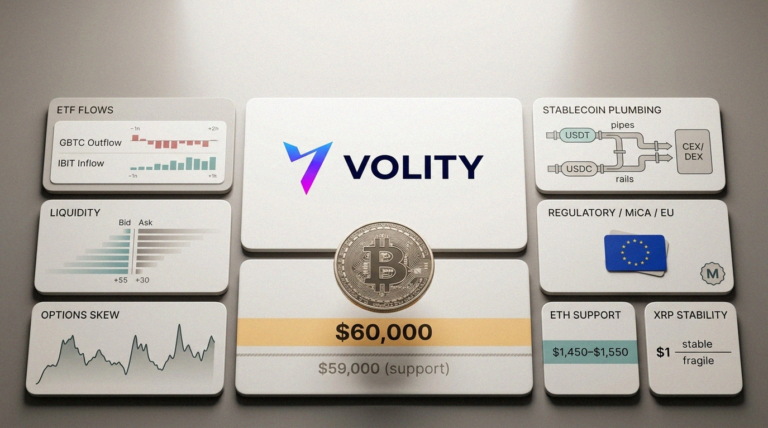
US spot Bitcoin exchange-traded funds remain the clearest source of pressure. They recorded about $1.07 billion in net withdrawals during the week ending November 13. Seven consecutive sessions have now produced roughly $1.91 billion of outflows.
Ether ETFs lost nearly $399 million last week. Solana-linked products also faced redemptions, extending a broad retreat from listed crypto vehicles. Investors appear less willing to pay for volatility while rates remain high.
Monday brought a sliver of relief. BlackRock’s iShares Bitcoin Trust, ticker IBIT, took in $76.5 million. That ended an 11-session withdrawal streak worth about $2.35 billion.
The wider Bitcoin ETF group recorded a modest $7.9 million net inflow. However, one positive day barely offsets weeks of redemptions. Traders want sustained demand across several funds before calling a durable bottom.
The $62,000 question
Bitcoin now sits between two powerful forces. ETF holders have sold into falling prices, while large wallets have accumulated coins. Whale addresses reportedly added more than 270,000 Bitcoin over two weeks.
At current prices, that buying represents roughly $16.7 billion. It has helped Bitcoin defend the weekend low. Still, concentrated private buying cannot automatically replace steady institutional fund flows.
The distinction matters during a correction. ETF investors can sell swiftly when bond yields rise or risk appetite evaporates. Long-term holders often buy weakness, but they may not support every failed rally.
Some chart watchers see $62,000 as a pause rather than a confirmed floor. Bitcoin has declined for six consecutive weeks. A move above $68,000 would do more to repair the short-term structure.
- $62,000: Weekend low and immediate support zone.
- $65,000: First level where buyers need to hold ground.
- $68,000: A break above could force short sellers to cover.
- $1.91bn: Bitcoin ETF outflows across seven sessions.
Until fund inflows broaden, sharp rebounds may resemble short-covering rather than genuine new demand. That does not rule out a rally. It does mean traders should watch volume and ETF data closely.
Institutions have not vanished
Quarterly filings show a less dramatic picture than daily flow figures. Harvard held 3.04 million IBIT shares at September’s end. The position was worth about $144.1 million at that point.
Dartmouth reported 201,531 IBIT shares, valued near $9.5 million. Neither university changed its holding during the quarter. Their holdings gained value as Bitcoin rose before this month’s sell-off.
Goldman Sachs reported roughly $1.28 billion in Bitcoin ETF exposure. It also increased its reported Ether exposure. Wells Fargo disclosed a 103% increase in its IBIT position to about $2.35 billion.
Those filings show that large financial groups still see crypto as an investable asset class. Yet they also look backwards. Form 13F reports reveal September holdings, not November trading decisions.
That time lag matters now. The filings describe a more confident market than today’s tape. Traders should resist reading old portfolio snapshots as a live signal.
Security becomes a market risk
Price is not the only concern confronting crypto investors. A supply-chain attack involving compromised website scripts reportedly reached 178 organisations. Affected properties reportedly included Ledger, Salesforce and BBC-linked websites.
The malicious code could replace copied wallet addresses with attacker-controlled destinations. It could also capture card details entered into infected payment forms. Such attacks exploit routine habits rather than exotic technical flaws.
Wallet users should confirm addresses on the device receiving funds. They should also distrust sudden browser prompts, unsolicited support calls and unfamiliar approval requests. A familiar logo offers no protection against a compromised page.
Separate incidents added to the unease. Aster reportedly suffered losses of $4.56 million after an API wallet leak. Safe said its contracts were unaffected by a wallet theft estimated at $6.45 million.
Meanwhile, a dormant BUSD market on Kava Lend was exploited for roughly $3.76 million. Each event involved different code and controls. Yet investors face the same lesson: every link in the trading chain needs scrutiny.
Regulation starts shaping the plumbing
Governments are also deciding how crypto fits inside traditional finance. Russia is opening access to Bitcoin, Ether and USDT for retail investors under new rules. Taiwan is considering stablecoin rules centred on bank issuers.
Revolut plans four blockchain-based funds designed to improve private-market liquidity. Tokenisation could make traditionally locked-up assets easier to transfer. However, easier trading does not erase valuation or credit risk.
Privacy remains a harder political issue. Ethereum co-founder Vitalik Buterin has urged Canadians to oppose Bill C-22. He argues that the proposal threatens encryption and digital privacy.
Monero highlights the practical tension. Private transactions protect users from surveillance. They can also complicate tax records, compliance checks and proof that a payment occurred.
Altcoins wait for a spark
Ether has found occasional support from large buyers. Persistent ETF withdrawals have still restrained sentiment. Solana has slipped to a four-month low as its listed products face continuing outflows.
Some institutions are increasing XRP and Solana ETF exposure. That suggests rotation rather than a total exit from crypto. The market’s appetite has simply narrowed towards assets with clearer liquidity.
Pump.fun is expanding beyond memecoins through prediction-market features linked to Polymarket. Cardano’s foundation seeks 25 million ADA for 2027 events, despite a reported $1.2 million funding gap.
Both developments depend on attention and available capital. Right now, liquidity is tightening. Projects with weak demand may discover that a compelling narrative cannot substitute for buyers.
Bitcoin’s defence of the low $60,000s could still produce a forceful rebound. A lasting recovery needs more than a green candle and one ETF inflow. It needs investors to return before the next wave of sellers does.
Related coverage on Volity
- How to Avoid Crypto Scams: A Beginner Safety Checklist
- How to Choose a Trading Platform: A 10-Point Checklist
- Demo vs Live Trading Account: A 7-Step Checklist Before You Go Live
- How to Size a Trade: Position Sizing and Risk Per Trade for Beginners
- Risk-Reward Ratio Explained: How to Set It and Why It Matters
- ETF vs Index Fund: The Difference and Which to Pick