Crypto turns defensive as regulation, liquidity and leverage collide
Crypto has moved from swagger to self-protection, and the shift is showing up across the tape.
Bitcoin is fighting to hold a major round number. Ether is testing a support band that once looked distant. Meanwhile, altcoins are moving less like independent projects and more like leveraged claims on market liquidity.
That matters because this drawdown is not only about price. It is about who still has balance sheet, where the deepest order books sit, and how fast regulators can alter the routes money uses.
For traders, the central question is blunt. If liquidity leaves the riskiest corners, does it hide in Bitcoin, stablecoins, tokenised cash products, or outside crypto entirely?
Bitcoin becomes the market’s stress gauge
Bitcoin remains crypto’s gravity well, even when the mood is sour. Recent sessions have exposed crowded long positioning, weaker spot demand and nervous ETF flows.
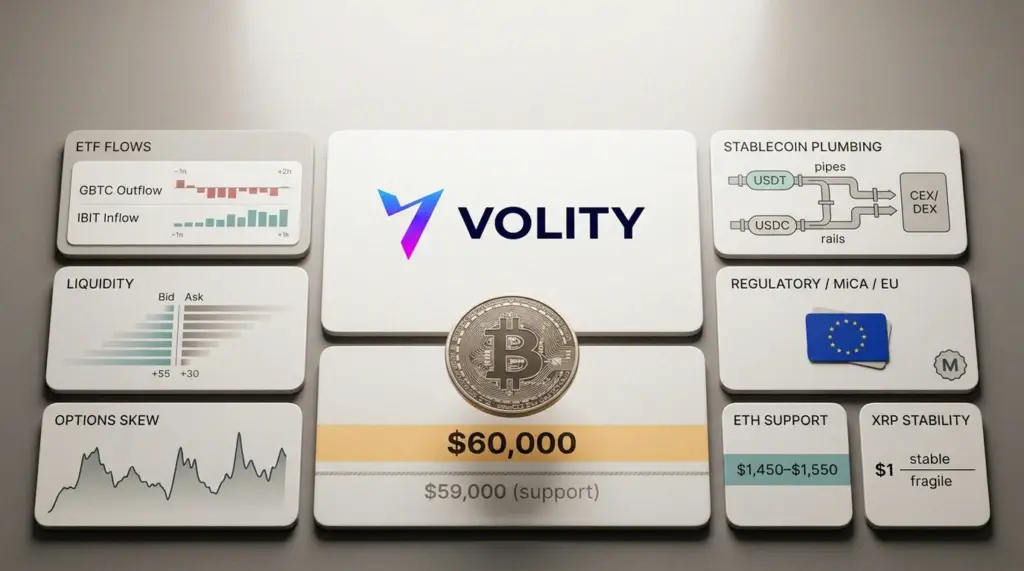
The $60,000 area now carries more weight than a neat chart line. It is where macro fear, ETF redemption risk and forced selling meet.
Below that level, leveraged accounts face a nastier market. Perpetual futures can accelerate declines, especially when funding flips and liquidity thins. However, a hard defence of that zone would tell a different story.
It would suggest long-only buyers still want exposure, but only after speculative froth clears. The next few closes matter more than the intraday wicks.
Bitcoin has survived worse technical damage before. Still, the current pressure feels different because ETF flows have created a visible daily scorecard. Traders can now watch institutional appetite almost in real time.
Ether tests faith as well as support
Ether’s problem is more awkward. The token is no longer judged only as a gateway to decentralised finance. It must also defend its premium against faster chains, cheaper settlement layers and thinner fee revenue.
The $1,450 to $1,550 band has become the level to watch. Previously, buyers treated that zone as a major accumulation area. Now, it looks like a test of patience.
ETF-related selling has added pressure. Meanwhile, large holders have less room for elegant theories when losses grow on their screens.
If Ether loses that support cleanly, options desks will likely reprice downside protection quickly. In that case, implied volatility could rise before spot traders fully react.
However, a stabilisation there would help more than Ether alone. It would ease pressure on layer-2 tokens, DeFi governance coins and staking-linked plays.
Xrp moves from courtroom trade to infrastructure bet
XRP remains one of the more revealing assets in this market. Once treated mainly as a courtroom proxy, it now trades like a payments-infrastructure wager.
Spot prices around $1.03 to $1.05 put the $1 level in clear focus. Parity is both a psychological marker and a likely stop-loss zone.
Below it, short-term traders will expect faster air pockets. Above it, bulls can argue that the market still assigns value to Ripple’s banking links.
Yet the more interesting catalyst may sit outside the chart. Cross-border payments are becoming a serious blockchain battleground. Banks want faster settlement, longer operating hours and cleaner audit trails.
That shift helps XRP’s narrative, although it does not guarantee upside. Regulation can turn a growth story into a compliance grind. Still, Ripple’s evolution looks increasingly institutional, not rebellious.
Speculation around exchange-traded XRP products has also moved closer to mainstream discussion. If such products arrive, they would change access, custody and portfolio treatment for some investors.
Stablecoins become the quiet centre of the market
While traders stare at red candles, stablecoins keep handling the plumbing. USDT and USDC remain the working cash of exchanges, market makers and offshore desks.
Their role has grown well beyond parking money between trades. They now serve as collateral, settlement rails and the base layer for tokenised funds.
Meanwhile, traditional finance has noticed the dull profitable bit. Reserve funds, tokenised Treasury products and regulated cash-like instruments are pulling attention from meme-led speculation.
This is where crypto is becoming most ordinary, and perhaps most durable. Investors who want yield, transparency and daily liquidity may prefer boring instruments to violent tokens.
That does not make stablecoins risk-free. Reserve quality, issuer rules and redemption mechanics still matter. However, their market role looks stronger after every volatility shock.
Europe’s rules change the liquidity map
Regulation now moves prices because it moves access. Europe’s MiCA framework forces exchanges and issuers to choose licensing, restriction or retreat.
For large platforms, the issue is not just legal paperwork. It is market depth, euro rails, stablecoin listings and regional client access.
If a major venue loses part of its European reach, smaller tokens could feel it first. Spreads would widen, slippage would worsen and market makers would demand more compensation.
Binance remains central to that conversation because its order books still shape altcoin liquidity. Any regulatory disruption around the venue carries market consequences beyond one company.
However, MiCA also gives institutions something they have long demanded. It offers clearer rules on reserves, consumer protections, disclosures and operational standards.
That clarity may reduce wild west risk. Yet it can also drain liquidity from tokens and venues that cannot meet the new standard.
By the numbers
- $60,000 – the Bitcoin zone traders are treating as a broad risk signal.
- $1,450 to $1,550 – the Ether support band now carrying wider market importance.
- $1 – the key XRP line separating orderly trading from likely stop-driven selling.
- 24/7 – the settlement standard banks increasingly want from blockchain payment rails.
- MiCA – the European rulebook reshaping exchange access and stablecoin issuance.
Institutions buy differently now
Retail traders often ask whether this is another bear market. Institutional desks ask a colder question: which exposure offers the best risk-adjusted entry?
Some managers have used weakness to add listed crypto plays, including exchanges, brokers and infrastructure stocks. That route offers liquidity, disclosure and easier risk limits.
Others prefer hedged exposure through futures, options and structured notes. In practice, they want upside without accepting every liquidation cascade in the token market.
This split shows how much the asset class has changed. Crypto no longer trades as one giant coin with different logos.
Bitcoin, Ether, stablecoins, tokenised funds, miners, exchanges and payments tokens now react differently. Relative-value trades matter more than heroic all-in bets.
What traders should watch next
- ETF flows: persistent outflows would keep pressure on spot support, especially in Bitcoin and Ether.
- Order-book depth: thin books near round numbers can turn routine breaks into sharp liquidation moves.
- Stablecoin supply: rising balances can signal dry powder, while shrinking supply often warns of risk withdrawal.
- European access: MiCA-related changes may alter liquidity in altcoins faster than fundamentals do.
- Options skew: growing demand for puts would show that desks are paying up for crash protection.
The trade now demands less romance and more map reading. Liquidity, regulation and leverage are pulling crypto in different directions.
For disciplined investors, that creates opportunity. For the overextended, it creates the kind of market that checks accounts before it checks opinions.