Investing in financial products involves risk. Losses may exceed the value of your original investment.
Bitcoin iran solana is a core topic for traders in 2026. The complete guide follows.
Crypto markets reel as Iran threats meet a Solana shock
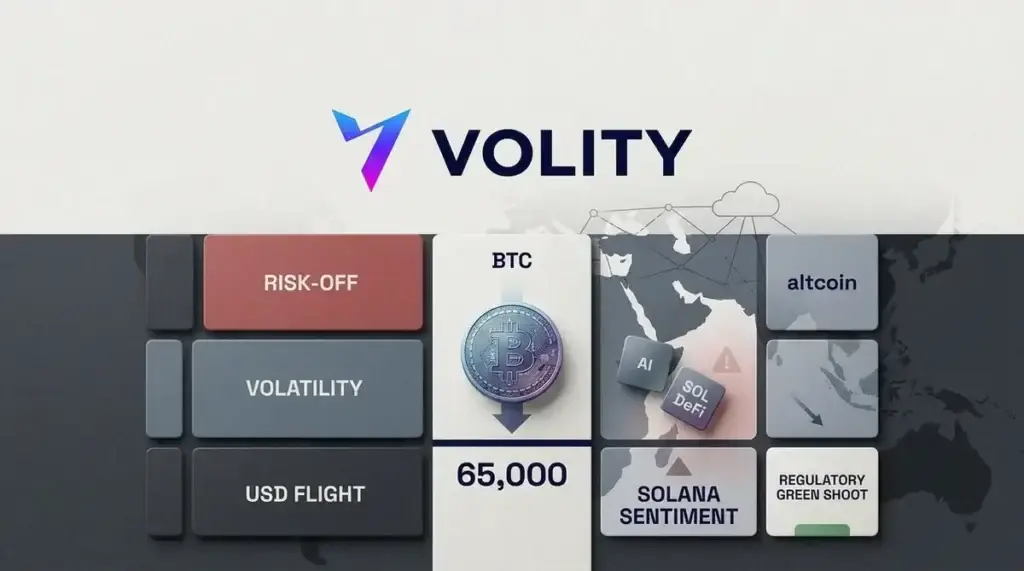
Crypto sold off on Thursday, and not for the usual internal squabbles. Traders pointed to a sharp rise in Middle East risk, while a large exploit on Solana added a second jolt. Bitcoin slid towards $65,000 in early dealing, and high beta tokens moved like a trapdoor. Meanwhile, AI linked names such as Bittensor’s TAO and NEAR fell 4% to 6% as the market trimmed anything that looked like “growth”.
However, the day’s mood came from outside the charts. Iran’s Islamic Revolutionary Guard Corps said 18 US firms were “legitimate targets” in retaliation for the assassinations of Iranian leaders. The list read like a Nasdaq 100 factsheet: Alphabet, Apple, Microsoft, Meta, Nvidia and Intel, alongside Boeing and JPMorgan. The risk off move leaked from equities into crypto, as it often does when volatility spikes and liquidity thins.
Meta sank 13% on the day, while Microsoft fell 8% and Nvidia dropped 6%. Those moves mattered for crypto flows because they sit in the same “risk bucket” for many hedge funds and retail accounts. Meanwhile, Donald Trump warned of “hitting hard” and floated a $200 billion request tied to potential strikes. Traders chased dollars, trimmed leverage, and sold the most crowded longs.
Reports of drone attacks disrupting AWS data centres in parts of the Middle East amplified the anxiety. Cloud dependent services faltered, and Anthropic’s Claude reportedly went offline for some users. That sort of operational fragility lands badly in a market already nervous about central points of failure. Bitcoin futures slipped as the session opened, and the spot market followed.
Solana takes a hit after a big Drift exploit
Then came the crypto specific bruise. Drift Protocol, a Solana based DeFi venue, suffered an exploit valued at about $285 million. The draft points to social engineering, with attackers tricking insiders and draining funds. Whatever the precise method, the result was the same: a confidence shock in an ecosystem that thrives on speed and composability.
Solana’s SOL weakened after the news, and technical traders talked about bearish momentum returning. However, the more immediate issue was contagion risk. If market makers pull back from Solana DeFi venues, spreads widen quickly and liquidations become self fulfilling. Even traders with no Drift exposure watched Solana liquidity conditions like hawks.
Corporate and regulatory cross currents
Elsewhere, some smaller headlines sketched the market’s broader shape. Genius Group sold its entire 84 BTC treasury, held for about 16 months, to repay $8.5 million of debt. That sort of forced selling rarely moves Bitcoin by itself, yet it fits the day’s theme: cash matters more than conviction when stress rises.
On the positive side, eToro secured New York’s BitLicense, opening crypto services across 48 states. Alabama also moved to legalise DAOs via the DUNA Act. Meanwhile, the US Treasury opened comments on stablecoin rules tied to the GENIUS Act. Regulatory progress tends to feel slow in real time, yet it matters when the tape turns and traders look for reasons to rebuild risk.
Levels traders are watching
For Bitcoin, $65,000 has become the line in the sand. A clean break lower could invite systematic selling and push the market to hunt for the next shelf of demand. However, if geopolitics cools and the Solana shock contains, shorts may find the exit narrow.
- Bitcoin (BTC): drifting towards $65,000 support, with momentum still pointing down.
- Ethereum (ETH): traders watching for a rebound zone near $2,200.
- Solana (SOL): sentiment hit after the Drift exploit, with liquidity the key variable.
- AI linked tokens: TAO and NEAR down 4% to 6% as risk appetite fades.
Key takeaways
- Geopolitics drove the first wave of selling, while the Drift exploit made the second wave uglier.
- Watch BTC around $65,000, because a break can trigger leverage unwind across majors.
- Solana volatility now hinges on DeFi market making depth, not just price charts.
- BitLicense and stablecoin consultations are slow burners, yet they shape the next recovery trade.
Crypto lived up to its reputation as a 24 hour mood ring for global risk. However, the day’s lesson was old fashioned: when headlines turn hard, liquidity becomes the only story that matters.
For more on this topic see our deep-dives on Bitcoin Price Action: ETF Inflows Meet CPI Risk in BTC Cycles, Bitcoin Fear and Greed Index: How Sentiment Drives BTC Price Action, and Bitcoin ETF Outflows: What Multi-Day Redemptions Signal for BTC.
What our analysts watch: Three reads anchor the desk approach when geopolitical and protocol-specific shocks compound. The cross-asset volatility correlation is the first read; sessions where VIX, MOVE (Treasury volatility), and crypto implied volatility all spike together are structural-risk events that require book-wide leverage cuts, while sessions where only one volatility surface moves are typically faded by the desk.
The Solana DeFi market-maker withdrawal pattern is the second; spread widening on the major perpetual venues is the leading indicator that liquidity is migrating away from Solana toward EVM chains, which is the structural risk to SOL beyond the Drift-specific loss. And the BTC-tech correlation through these sessions is the third; correlations above 0.7 between Bitcoin and Nasdaq mean macro risk dominates, which calls for hedging rather than dip-buying.
The International Monetary Fund work on cross-border capital flows and crypto frames the macro spillover mechanic, the CoinDesk coverage of geopolitical risk and exploit incidents tracks the immediate flow, and the Financial Action Task Force guidance on virtual-asset money laundering is the international reference for tracing exploit-related fund flow. Volity offers BTC, ETH, SOL, and major altcoin CFD access under CySEC oversight via UBK Markets (licence 186/12), with execution from our SLU and Cyprus entities.
Frequently asked questions
Why do tech-equity selloffs hit crypto harder than industrial selloffs?
Crypto and large-cap tech share a hedge-fund risk bucket. The marginal allocator running long-mega-cap-tech and long-crypto exposure de-risks both books on the same signal, which means selling pressure compounds across the two even when no fundamental link exists. Industrial selloffs do not share this allocator overlap, so the crypto correlation is structurally lower.
What is the realistic recovery path for Solana after a $285 million exploit?
The on-chain technical recovery is fast (Solana itself was not compromised, only Drift was), but the liquidity recovery is slower. Market makers reduce inventory commitments to the Solana DeFi venues they perceive as operationally fragile, which widens spreads and reduces depth for weeks. The reliable recovery indicator is Drift open-interest rebuilding to pre-exploit levels combined with stable bid-ask depth, not just price stabilisation.
How should a retail trader size positions through compound shock sessions?
Half-size relative to baseline, with leverage cut by half before any other risk parameter moves. The single largest source of retail account destruction in compound-shock regimes is unchanged leverage applied to a tape that whips harder around lower volume. Reducing leverage first, position size second, and trade frequency third is the cleanest sequencing.
Does the AWS-disruption narrative actually matter for crypto fundamentals?
Indirectly yes, directly no. Bitcoin and Ethereum are not hosted on AWS in any consequential sense.
But many wallet apps, exchange front-ends, and analytics dashboards are. A multi-hour AWS outage during a stress session amplifies the operational-fragility narrative, which feeds the broader risk-off, even though the underlying chains are unaffected.
The trade is in the perception loop, not the protocol layer.
Volity operates a trading platform and also publishes educational and analytical content about trading. The content on this page is for educational purposes only and should not be considered financial advice. Volity may benefit commercially when readers open trading accounts through links on this site.
Our content is produced and reviewed under documented editorial standards; see our comparison and review methodology.