Crypto in 24 Hours: Bridges Break, Regulators Build Their Own
Crypto over the past 24 hours has again reminded us of an old truth: yield starts not with the chart, but with survival. While investors argue about bitcoin at $95,000, the industry is repairing bridges, arguing with regulators and looking for a new institutional “base layer”.
The tone of the feed is no longer panicked though. Money is not leaving crypto; it is becoming pickier. Banks are looking at stablecoins, funds are buying infrastructure, and retail is still hunting the next short-fuse meme token.
Security Hits Yield Again
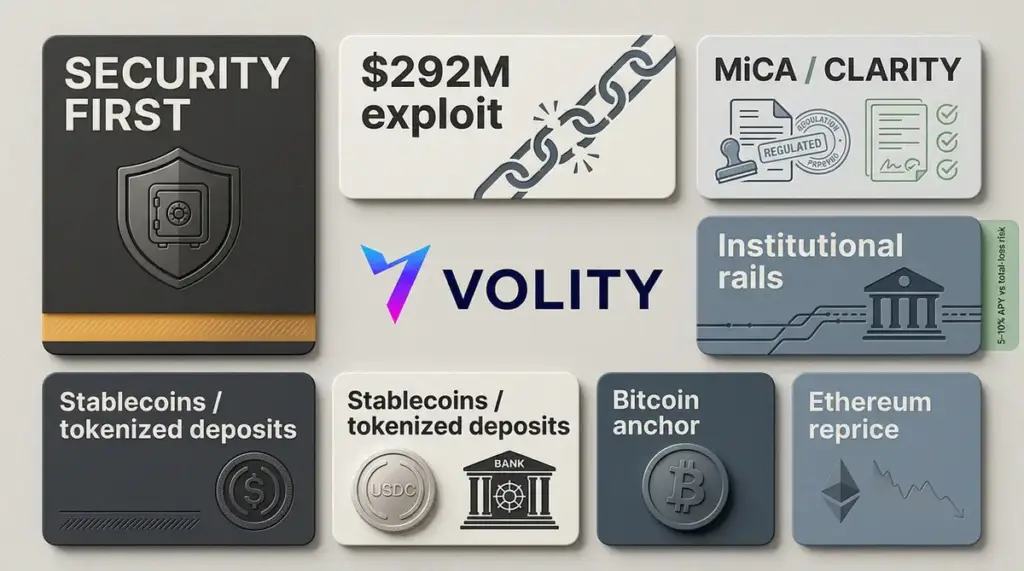
The most worrying plot of the day is the KelpDAO exploit, sized at roughly $292 million. LayerZero disclosed the attack details and is tightening cross-chain message checks. For DeFi this is an unpleasant but familiar lesson: bridges remain the most fragile link in crypto infrastructure.
Bankr survived an attack after which users are advised not to sign transactions or connect wallets. That usually means one thing: the front-end or related infrastructure may have been taken over by attackers.
Changpeng Zhao of Binance, after a GitHub incident, again pointed at the sector’s weak point. Developer accounts, repositories and code updates are becoming an entry door for attacks, not a technical periphery.
- Practical takeaway: an extra 5-10% APY does not cover the risk of a full deposit loss.
- For the trader: positions in cross-chain strategies should be counted as riskier than ordinary spot.
- For the investor: any unexpected wallet signature should be treated as malicious until proven otherwise.
Regulators Argue, but the Rules Are Getting Closer
In Europe, MiCA consultations are starting. This is not the final point, but the market gets a rare chance to see future rules before strict enforcement. Projects with European clients now have to count the cost of licences, reporting and banking partners.
In the US, attention is returning to the CLARITY Act. Alex Thorn of Galaxy estimates the bill’s passage chance at 75%. Consensys, meanwhile, warns that FDIC proposals may overly expand restrictions for banks working with crypto firms.
This matters to more than lawyers. Dollar infrastructure remains the bloodstream of the market. If banks tighten account access, liquidity will feel the cold quickly, especially on small exchanges and in derivatives.
Donald Trump is also calling on the Fed to review master account rules for crypto firms. South Carolina, by contrast, banned state agencies from joining CBDC programs. The US looks like a market with three steering wheels: Washington, states and courts pull the system in different directions.
Institutions Pick Infrastructure
Morgan Stanley re-filed for a Solana ETF under the ticker MSOL, with a staking option. If the regulator allows that structure, the market gets a new template for ETFs on PoS networks. The conversation then shifts fast from “can you buy the token” to “can you embed yield in the fund”.
Mouro is also closing a $400 million fund for investment at the AI, blockchain, fintech and infrastructure intersection. Santander is among the backers behind the structure. The signal is clear: venture money is not chasing only memes. It is buying the rails that will later carry payments, credit and tokenised deposits.
Other deals show the same shift. Paradigm is putting $110 million into SendCutSend and widening the field beyond pure crypto. Zerohash, after Mastercard’s exit, is seeking a valuation around $1.5 billion. Ark Invest is buying a stake in Bullish after a drawdown, betting on regulated venues.
Stablecoins Become a Banking Product
Stablecoins look less and less like a niche tool for exchange traders. The investor called the “Chinese Buffett” is moving into Circle, the USDC issuer. This is a bet not on a trendy ticker, but on a global dollar settlement layer.
In Europe, the Qivalis consortium is expanding through ABN AMRO and Rabobank. The more interesting signal comes from the UK though: the Bank of England directly says tokenised deposits and stablecoins should become part of the payment system.
In other words, banks are no longer just defending. They want to lead the digital-money market before non-bank issuers take the client interface and the margin.
Bitcoin Holds the Anchor Role; Ether Hunts for an Argument
For bitcoin, the market is again discussing the $60,000-$95,000 range. K33 sees the $60,000 area as a possible cycle bottom. Other models, including MVRV, allow a move to $95,000 if macro does not break demand.
But this is a scenario, not a one-way ticket. For the trader, what matters more is that large players still treat bitcoin as the first asset for institutional entry. So BTC drawdowns now read more often as a liquidity test than as a cancellation of the whole cycle.
The Ethereum picture is more complex. JPMorgan notes that Bitcoin is becoming the new institutional base layer while Ethereum lags. Over a week, ETH lost about 10%, large wallets trimmed positions, and the ascending channel cracked.
Vitalik Buterin meanwhile proposes a three-step plan to strengthen Ethereum privacy. The focus is likely back on zk technology and private layers on top of the main network. The market right now is paying for usage, fees and predictable yield though, not for road maps.
Alts and Memes Are Still Alive, but the Air Is Thinner
Dogecoin is again clinging to roughly $0.10. Technical analysts see a large “rounded bottom” formation, but without fresh-money inflow such a pattern quickly turns into a nice picture after the fact.
XRP is getting another wave of attention from the ETF story. Bulls are looking at $2, but the zone around $1.50 remains heavy resistance. That is also the natural area for profit-taking after strong moves.
Cloud-mining services are being marketed with promises of up to $5,700 a day. Those numbers should be read as a warning, not as an investment idea. When risk is not explained in detail, it is usually shifted onto the client.
On the presale market, Meme Punch raised about $140,000 in a day, and projects like DOGEBALL sell the dream of another multi-bagger. The louder the marketing, the shorter liquidity often lives though.
People, Law and Real Rails
Meta is shifting focus to AI, which is touching crypto and Web3 teams. The labour market in the sector remains uneven: experimental units are getting cut, while payment and infrastructure projects keep hiring selectively.
OpenTrade is helping fintech Ontop turn idle payroll-account balances into on-chain dollar yield. Tempo, linked to Stripe, is launching Morpho DeFi lending inside its own payment chain and aiming at $7.5 billion in volume.
Enforcement is not far behind. In Ireland, 1,000 BTC were seized in a drug case. In Minnesota, an argument around prediction markets has reached a conflict with the CFTC. Anonymity at large size is becoming an increasingly expensive illusion.
What to Trade More Carefully
- Cross-chain yield: bridges give convenience but carry a separate infrastructure-failure risk.
- ETH vs BTC: bitcoin currently looks like a clearer institutional asset.
- Solana: the MSOL staking ETF filing could support the PoS-ETF segment.
- Stablecoins: Circle, banking consortia and tokenised deposits are becoming the centre of the new cycle.
- Meme presales: aggressive promises more often need a cold no, not boldness.
The market is maturing unevenly. On one side, hacks still look almost routine. On the other, banks, funds and regulators are already building permanent capital channels. In a market like this, the winner is not the loudest token but the one with liquidity, risk control and a reason to exist after the next pullback.