Earnings set the trap, but sentiment pulls the trigger
Wall Street can turn any trading day into an argument about decimals. Today’s cleaner question is sharper: what moves first, the catalyst, the story, or the tape?
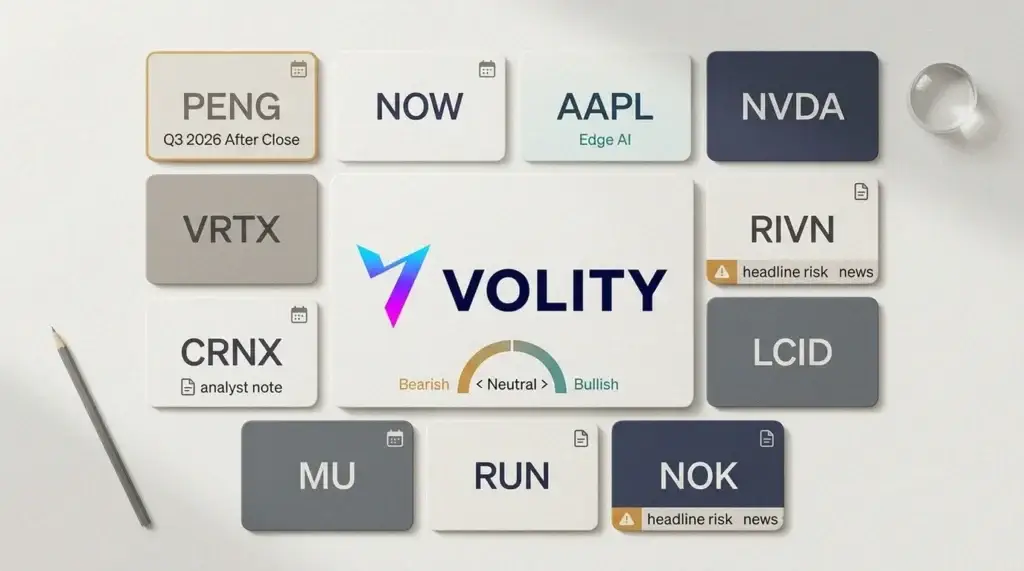
For active traders, that means watching earnings risk, AI-linked sentiment and the places where good news still meets weak price action. Several names now sit in that zone.
Penguin faces the after-hours test
Penguin Solutions (PENG) brings the most binary event on the board. The company reports Q3 2026 after the close, with its call set for 4:30 p.m. ET.
Expectations already lean constructive. Analysts look for year-on-year growth in earnings and revenue. Meanwhile, recent estimate revisions have pushed EPS expectations higher into the print.
That makes the setup less forgiving. A headline beat may not carry the stock if guidance sounds merely steady.
Instead, traders will listen for three things. First, AI and server demand must show up in orders. Second, margins need to hold after recent expansion. Third, management must defend its full-year outlook after earlier upgrades.
This is a classic high-beta infrastructure trade. Options pricing and after-hours liquidity matter as much as the press release. A strong number with thin follow-through can still trap late buyers.
Software gets a rare friend
On the software side, ServiceNow (NOW) has become the sentiment test. Guggenheim upgraded the stock from Neutral to Buy, pushing back against the view that AI destroys software value.
The point was simple. Current multiples, in that view, assume too much permanent decline. However, enterprise software has not yet surrendered its budget line to AI agents.
That matters because software has traded under a cloud for months. Investors keep asking whether AI makes seats, workflows and old pricing models less valuable.
Now the question is tactical. Does NOW build a multi-day bid, or does the upgrade become a one-session relief trade?
Follow-through would help the wider cloud group. A fail would tell traders that the market still sells rallies in expensive software.
Apple’s ai story moves beyond the iphone
Apple (AAPL) remains stuck between product cycle doubt and AI hope. However, the more interesting debate now sits beyond the iPhone.
Edge AI, where models run on local devices, has become a central PC industry theme. Macs may matter more to Apple’s next AI narrative than investors assumed.
This is not a forecast dressed as fact. It is a working thesis. If the next PC refresh cycle becomes AI-led, Apple could benefit through its Mac line.
The trade is also subtler than the usual iPhone upgrade argument. Investors are trying to value local compute, battery efficiency and ecosystem lock-in.
For AAPL, that makes each Mac demand signal more important. It also makes hardware margins part of the AI conversation again.
Power demand gives sunrun a second look
Sunrun (RUN) sits in a very different corner of the AI trade. The company links rooftop solar, battery storage and virtual power plants.
That combination matters as data centres draw more electricity. Utilities need flexible supply, and home batteries can help serve as distributed grid capacity.
Still, RUN is not a clean AI proxy. It remains sensitive to rates, consumer financing and solar policy. However, the storage story gives traders a better reason to watch it.
The chart may show consolidation, not excitement. Yet the theme is improving. AI power demand increasingly rewards companies tied to resilience, storage and grid flexibility.
Nokia has the headline, but not the bid
Nokia (NOK) offers a useful lesson in event trading. The company recently secured an AI-related network deal with Orange Belgium. Yet the stock still traded weaker in premarket action.
That mismatch is often where the real trade starts. Good news with a soft tape can mean broad risk-off selling. It can also mean investors doubt the deal’s financial weight.
Telecom equipment buyers are upgrading networks for heavier data loads. However, traders still want proof that these contracts can lift margins and orders.
For NOK, watch whether weakness gets bought during regular trading. If not, the market may be treating AI network headlines as noise, not revenue acceleration.
Banks bring defined dates
Financials add a cleaner calendar. Morgan Stanley (MS) reports Q2 results on July 15. First Horizon (FHN) is also lined up for mid-month earnings.
For MS, the focus is familiar. Traders will watch investment banking fees, wealth management flows and capital markets commentary.
Advisory work has been uneven. Meanwhile, trading revenue and recurring wealth fees can steady the model. Management’s tone may matter more than small EPS variance.
FHN has a more regional-bank flavour. Investors want deposit behaviour, credit quality and net interest income guidance.
Analysts broadly expect growth in earnings and revenue. However, rating dispersion keeps the setup sensitive to any cautious language on credit or funding costs.
Memory remains the emotional ai trade
Micron (MU) still sits near the centre of AI infrastructure. Its DRAM and high-bandwidth memory products support large-scale training and inference.
The bull case is straightforward. AI spending can support pricing, margins and a better memory cycle than past PC-led booms.
However, memory still has history. Supply discipline can fade, customers can pause orders, and pricing can turn quickly.
That tension makes MU a sentiment battleground. Bulls see a structural shift. Skeptics see a cycle wearing better clothes.
Fresh memory pricing data or capex commentary could move the stock quickly. Traders should treat conviction as useful, but not sacred.
Nvidia feels the cost of leadership
Nvidia (NVDA) carries a different burden. Every competitive headline now lands directly on the market’s most important AI stock.
Reports that China’s DeepSeek is working on its own AI inference chip fit that pattern. The immediate concern is share loss or pricing pressure.
Yet the fundamental hit remains unclear. China-related chip headlines often provoke fast selling before the market measures real risk.
For traders, the test is simple. Does NVDA weakness attract buyers, or does it start a wider derating of AI leaders?
The answer will matter beyond one ticker. Nvidia remains the risk appetite gauge for much of the AI complex.
Biotech and evs bring single-name risk
In biotech, the possible Vertex (VRTX) purchase of Crinetics (CRNX) for roughly $10 billion fits the classic M&A script.
Vertex would pay today for rare-disease growth tomorrow. Management has discussed more than $5 billion in potential peak sales from targeted assets.
Those numbers are deal guidance, not guarantees. The trade hinges on execution, regulatory odds and investor patience.
Meanwhile, EV names remain fragile. Rivian (RIVN) weakened after a public offering announcement, as dilution worries hit an already pressured sector.
Lucid (LCID) is digesting Q2 production and delivery figures alongside a leadership reshuffle. That combination can reset expectations, or deepen cash-burn concerns.
In both stocks, volume matters. Traders should watch whether buyers defend support after the first headline shock fades.
Watchlist for the tape
- High-rsi real estate: OPI, VNO and JAN can support momentum trades, or mean-reversion fades.
- Revision basket: WULF, NTRS, MGM, CSX, PINS, PANW, CF and ENLT may see volume from analyst changes.
- Cybersecurity focus: PANW remains central to the security theme, with analysts still arguing for upside.
- Media flow: AAPL, META, GOOGL and APO may react to television-led retail attention.
- Defensive yield: high-dividend utilities can catch bids when tech momentum looks tired.
Key takeaways
- PENG is an after-hours volatility event. Guidance may matter more than the Q3 headline.
- NOW tests whether software can turn an AI bear narrative into sustained buying.
- AAPL is gaining a Mac-driven AI angle, not just another iPhone story.
- NVDA and MU remain core sentiment gauges for the AI infrastructure trade.
- RIVN and LCID are capital-risk trades, where support levels matter more than slogans.
The useful map is still catalyst first, sentiment second, theme third. A strong headline starts the trade. Price action decides whether it survives.
Related coverage on Volity
- What Is a P/E Ratio and How to Use It
- Fundamental Analysis in Stock Trading: A Working Definition
- Growth Investing vs Value Investing: Which Style Fits You?
- Fractional Shares Explained: How to Start Investing With $50
- How to Start Stock Trading: A 2026 Beginner Guide
- Dividend Investing for Beginners: How to Start