Is CFD trading halal? Every fatwa we reviewed that addresses contracts for difference (CFDs) by name concludes against trading them. The three cited here all say you never own the asset and liken the trade to gambling. Two also cite riba (interest), and Fatwa.org.au names interest charged daily on open positions. This guide gives no ruling of its own. It shows what each named body wrote, where views differ, and how to check a provider’s leverage and swap terms before you take them to a scholar you trust.
TL;DR: With a CFD you trade a price difference and never own the asset, says the EU regulator ESMA. The CFD fatwas we read rule against it, and the International Islamic Fiqh Academy ruled against the closest contract types in 1992. A swap-free account removes the overnight swap, yet two sources we read still object to leverage and possession. Check the terms, ask a scholar and practise on a free demo. Volity offers Islamic (swap-free) accounts.
This is a summary of published sources, not a fatwa (a formal religious opinion). All sources were read on 10 November 2026. For the product basics, see the guide to CFD trading and the CFD hub.
What a CFD is and what you actually own
The European Securities and Markets Authority (ESMA), the EU’s markets regulator, describes a CFD as an agreement “to exchange the difference between the current price of an underlying asset (shares, currencies, commodities, indices, etc.) and its price when the contract is closed.” Its 2013 investor warning adds a line that matters here: “you never actually buy or own the asset underlying the CFD”.
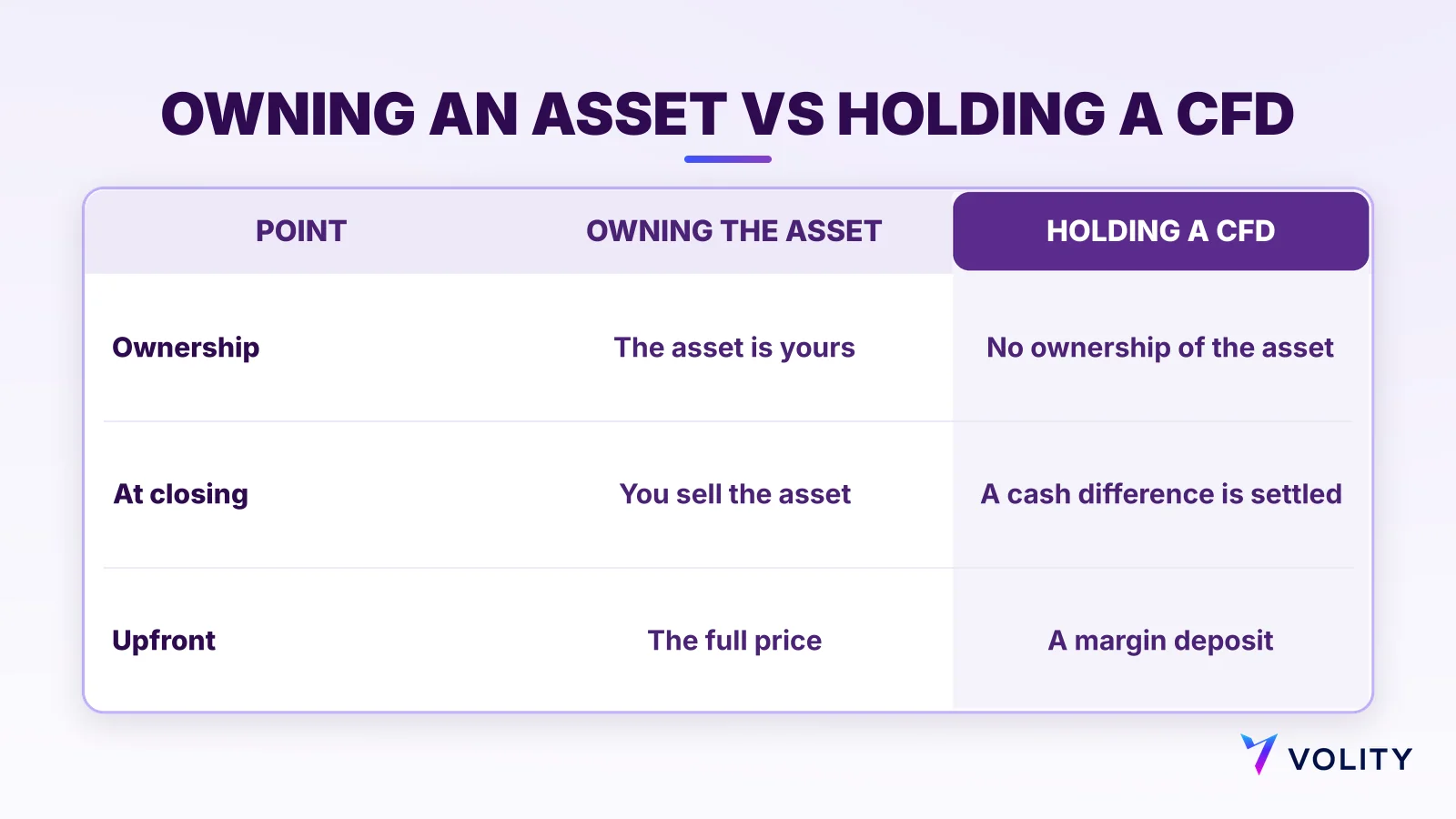
In practice you open a position on a market such as gold and pay a margin deposit, the part of the position’s value you put down as security. When you close, you receive or pay the cash difference between the opening and closing price. Nothing is delivered to you. Buying the asset itself means paying the full price, owning it and selling it later.
ESMA’s 2018 FAQ on CFD rules adds: “You do not need to own the underlying asset.” It also says “financing costs and transaction costs (such as bid-ask spreads) are typically based on the investment’s total value.” So the overnight charge typically follows the full position, not just your deposit.
The fatwas describe the same mechanics. A Darulfiqh fatwa by Mufti Faraz Adam says “the actual underlying asset is never owned” and calls CFDs “merely obligations to exchange certain amounts of money”. The 350+ CFD instruments on Volity work on the same model.
The scholarly concerns: ownership, leverage, interest
Ownership and delivery
The International Islamic Fiqh Academy (IIFA), part of the Organisation of Islamic Cooperation, issued Resolution No. 63 (1/7) in Jeddah in May 1992. It calls options “a new type of contracts that do not fall under any one of the Shariah nominate contracts”. It adds: “Since these contracts are initially not permissible, neither is their trading.”
On commodity contracts with no delivery, which “may be terminated by an opposite contract”, it rules: “This type of contract is the most prevalent in the commodity markets and it is essentially not permissible by Shariah.” On indices: “Sale and purchase of the index are not permissible since they are pure gambling”. Resolution No. 147 (5/16), Dubai, April 2005, repeats the commodity ruling.
None of these texts uses the word CFD. They cover the closest categories. AAOIFI, the Accounting and Auditing Organization for Islamic Financial Institutions, covers “derivatives of various kinds: Swaps, Indexes, Futures and Options” in Shari’ah Standard No. 20. Its full text is for members and licensed subscribers only, so its rulings are not quoted here.
The fatwas that name CFDs are direct. Darulfiqh rules: “It is not permissible to trade Contracts For Differences online.” Its reasons are the absence of a subject matter of sale, riba (interest, or any agreed increase on a loan), gharar (excessive uncertainty) and an element of gambling. Fatwa.org.au (Mufti Faizal Riza) notes that “the client does not become the owner of the shares”. It concludes: “It is, therefore, not permissible for a Muslim to trade in CFD.”
Leverage treated as a loan
Leverage lets you open a position larger than your deposit. Jordan’s General Iftaa’ Department, in a December 2024 article by Dr Hamzah Mash-Shoqah, says “leverage is a loan from the broker to the trader without an increase”. It adds that “any loan that brings about a benefit is considered riba”.
The Muslim World League’s Islamic Fiqh Council ruled on margin trading in Makkah in April 2006. As quoted by IslamQA, it found “obvious Riba” and judged the trade not permissible. IslamQA’s 2023 answer on Islamic forex accounts adds: “it is not permissible to combine a fee and a loan”. See the guides to CFD leverage and margin in CFD trading.
Interest on positions held overnight
ESMA lists “daily and overnight financing costs” among CFD costs, and Fatwa.org.au treats that charge as interest: “interest is applied daily to open CFD contracts by many CFD providers”. A question to Darul Ifta Birmingham said: “Leaving my positions open after 10 pm incurs interest”. The asker closed every position before 10 pm to avoid it. The answer still ruled against the trade, calling it “a form of betting or gambling”. It quoted Mufti Taqi Uthmani: where nothing is delivered and the aim is to wager on the difference, the set-up is “undoubtedly haraam (Prohibited) and impermissible in the Shariah”.
Gold has its own rules. AAOIFI’s Shari’ah Standard No. 57 on gold (2016) says “it is not permissible to sell an unspecified ingot (technically known in the market as unallocated ingot) without physical possession.” It concerns gold itself, not CFDs.
Where opinions differ
No body in the sources we read approved CFDs by name. That describes this sample, not every scholar. Some sources point another way.
The Securities Commission Malaysia’s Shariah Advisory Council, on 26 June 2006, “has approved single stock futures (SSF) as a Shariah-compliant instrument”, its media release says. The condition is that “the underlying stocks of the SSF are Shariah-compliant”. A single stock future trades on an exchange with standard terms. A CFD is an over-the-counter (OTC) contract with the provider, off any exchange. The council’s list of resolutions showed none on CFDs when checked on 10 November 2026.
A 2021 paper by Zahra Sohrab Beig and Saeid Kheradmandy in the journal Amoozeha-ye Feqh-e Madani goes further. Its abstract proposes that if commodity CFDs are read as a sulh (settlement) contract, the stated Sharia objections do not arise. It is an academic argument, not a fatwa.
Verdicts also follow the facts. Darul Ifta Birmingham ruled on the set-up its asker described, and noted differing fatawa on Bitcoin. That is why the exact terms are worth getting in writing.
The swap-free label does not settle it for every body. Jordan’s Iftaa’ Department calls Islamic forex accounts “free from interest (riba), overnight rollover fees, and swap contracts”. It still rules that “trading through an Islamic Forex account is impermissible”, because “Possession in the platform’s account is not considered legitimate possession of the currency according to Shari’ah”. IslamQA’s 2023 answer reaches the same verdict. Both concern forex, not CFDs by name.
What a swap-free account removes
On a conventional account, a position open past the daily cut-off is credited or debited an overnight amount, called swap or rollover. On Volity the cut-off is 22:00 GMT. The amount reflects the interest-rate differential, or the leverage cost for non-forex CFDs, and can be charged or received depending on direction. The rate for each instrument is on the platform, and the execution policy sets out the basis.
A swap-free account, often called an Islamic account, removes that overnight swap amount. Islamic (swap-free) accounts are available on Volity. Full costs are published on the charges and fees page.
The contract itself stays the same: no asset is delivered, and leverage still applies. Those are the points the Jordan article and the IslamQA answer raise. In those sources, removing the swap answers one objection, and others remain.
Written terms matter because overnight charging varies. The FCA’s 2025 review found firms “applying overnight funding charges separately on each client position, with no offset allowed”. Its October 2026 follow-up found that “Only a minority of firms have improved their disclosures to add annual percentage rates”. It also found that “Most respondents apply overnight funding charges on any matched/hedged CFD positions held by a client”. A matched position is a buy and a sell on the same market at once.
The guide to Islamic forex brokers compares swap-free accounts in more detail.
Questions to put to any provider
Work through these in order before you fund an account, and get each answer in writing.
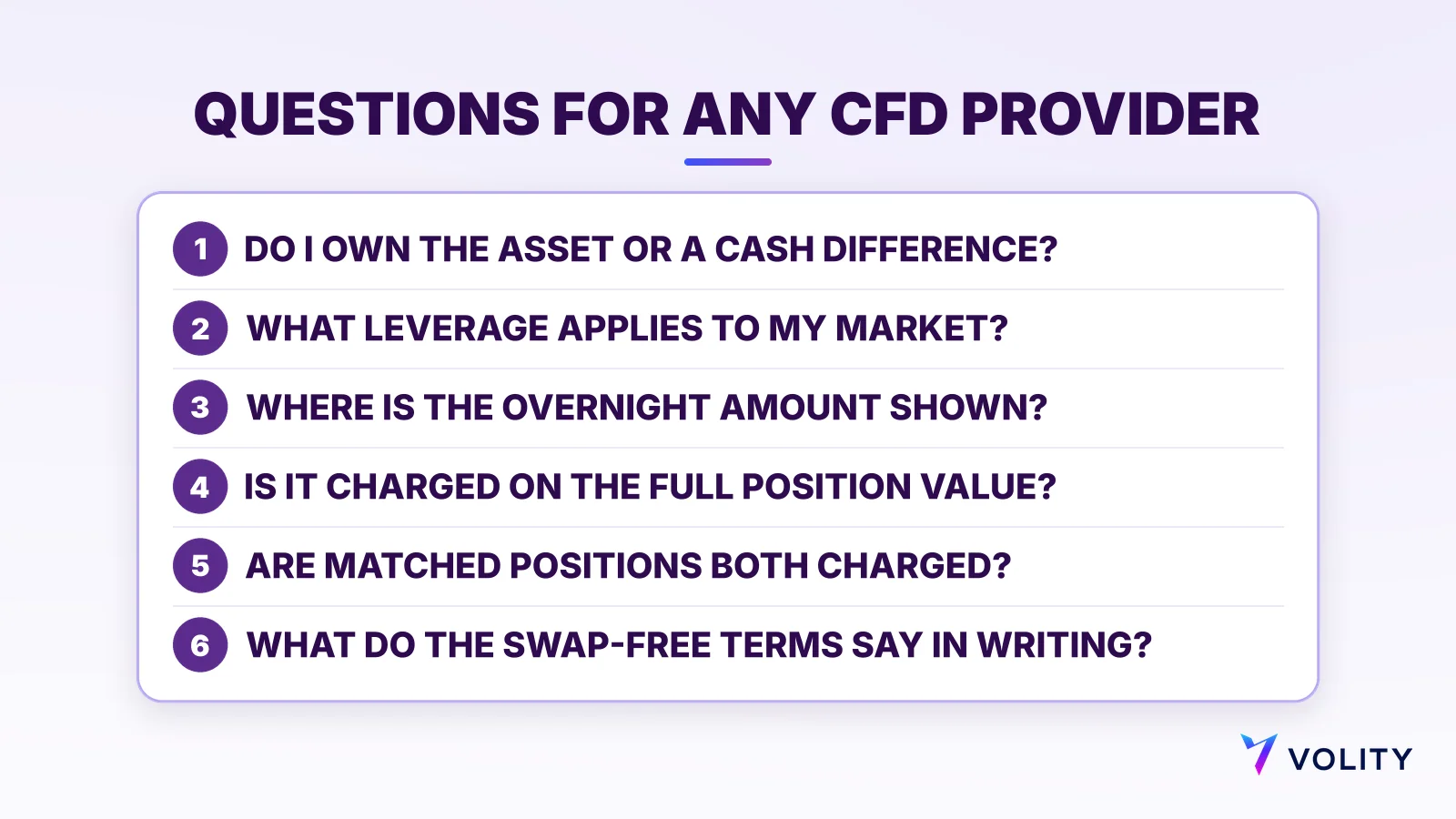
- Ask what you will own. The product terms should say whether the asset is delivered or a cash difference is settled.
- Read the leverage for your exact market. Leverage on Volity goes up to 1:500. Forex, metals, index CFDs and commodities go up to 1:500, crypto CFDs up to 1:50 and stock CFDs up to 1:20.
- Find the overnight cut-off and where each instrument’s overnight amount is shown. On Volity, the cut-off is 22:00 GMT and each rate is on the platform.
- Ask what the overnight charge is calculated on. ESMA says financing costs are “typically based on the investment’s total value”.
- Ask whether a buy and a sell on the same market are each charged. Most firms that answered the FCA in 2026 charge both.
- Check whether an annual percentage rate is shown for overnight funding.
- Get the full swap-free terms in writing and read the section on positions held overnight.
- Take the documents to a qualified scholar you trust.
Check any claim of religious approval too. AAOIFI’s gold standard says “no party is allowed to claim or indicate directly or indirectly, in any manner, that any of their products, contracts, IT systems are approved or certified by AAOIFI (without a written permission)”. If a provider cites a body’s approval, ask to see it in writing.
Test the rules on a free demo
A demo account lets you practise without real money, and a free demo is available on every Volity account tier. Open a position, see the leverage for that market and check each instrument’s overnight amount before real money moves. The demo cannot answer the religious question. The CFD demo account guide explains how it works.
Before you trade with real money, bring the product terms, the leverage for your market and the swap-free terms to a scholar you trust.
Fact check: CFD mechanics and overnight costs from ESMA (2013, 2018) and the FCA (2025, 2026). Rulings from IIFA Resolutions 63 and 147, AAOIFI Shari’ah Standards 20 and 57, Jordan’s General Iftaa’ Department, the Muslim World League Islamic Fiqh Council (via IslamQA), IslamQA, Darulfiqh, Darul Ifta Birmingham and Fatwa.org.au, and the Securities Commission Malaysia. Volity details from volity.io. Sources read on 10 November 2026.
Frequently asked questions
Are CFDs halal?
Every fatwa we reviewed that names CFDs concludes against trading them, including those from Darulfiqh, Fatwa.org.au and Darul Ifta Birmingham. All three cite the lack of ownership and liken the trade to gambling. This guide gives no ruling, so take the exact terms to a qualified scholar you trust.
Has any Islamic body accepted a product like a CFD?
Not by name in the sources we read. The Securities Commission Malaysia’s Shariah Advisory Council accepted exchange-traded single stock futures in 2006, with conditions. A 2021 academic paper proposes reading commodity CFDs as a settlement (sulh) contract, but it is not a fatwa.
Do CFDs involve interest?
On a conventional account there is usually an overnight charge. ESMA lists overnight financing among CFD costs, and on Volity a position held past 22:00 GMT may pay or receive an overnight amount. A swap-free account removes that overnight swap.
What is a swap-free CFD account?
It is a CFD account that removes the overnight swap on open positions. Each provider defines it in its own terms, so read them before your first trade. Islamic (swap-free) accounts are available on Volity, and the free demo lets you try the platform first.
Is leverage allowed in Islam?
The bodies we read on this point treat it as a problem. Jordan’s General Iftaa’ Department calls leverage “a loan from the broker to the trader”, and the Muslim World League’s Islamic Fiqh Council ruled margin trading impermissible in 2006. Ask a scholar about your exact terms.
Can I trade gold CFDs on an Islamic account?
Gold on Volity trades as a CFD on XAU/USD and XAU/EUR, so the CFD concerns above apply to it too. AAOIFI’s gold standard requires possession of gold itself and does not address CFDs. Check the swap-free terms for your market when you open the account, and test it on the free demo first.