Quick answer
CFD currency trading, or forex CFD trading, lets you speculate on currency-pair price moves without owning the currencies, going long or short with leverage. You profit from the difference between the open and close price. Forex CFDs offer tight spreads and 24/5 access but, like all leveraged products, amplify losses, so risk management is essential.
CFD currency trading uses contracts for difference to speculate on foreign exchange (forex) prices without owning the underlying currency. Volity offers 40+ currency pairs as CFDs on Volity MT with leverage up to 1:500, tight spreads from 0.6 pips on Standard, and CySEC-regulated execution under UBK Markets.
Forex CFDs vs spot forex
For most retail traders, “trading forex” and “trading forex CFDs” are the same activity. The distinction matters for some structures:
Spot forex (institutional model): actual currency transfer settled in 2 business days, sold via interbank market. Retail rarely accesses this directly.
Forex CFDs (retail model): a contract that mirrors spot price movements without actual currency transfer. The mainstream retail forex experience is CFD-based, even when the platform calls it “forex.”
On Volity, you trade forex through CFD wrappers. The execution feels identical to spot trading but operationally: – No currency delivery – Margin-based positions – Leverage available – Long or short with equal ease
Major, minor, and exotic pairs
Volity offers 40+ pairs across three tiers:
Major pairs (most liquid): EUR/USD, USD/JPY, GBP/USD, USD/CHF, USD/CAD, AUD/USD, NZD/USD. Tightest spreads, highest volume.
Minor pairs (cross pairs): EUR/GBP, EUR/JPY, GBP/JPY, AUD/JPY, EUR/AUD. Tight spreads, good liquidity.
Exotic pairs: USD/SGD, USD/HKD, USD/MXN, USD/TRY, USD/ZAR. Wider spreads, lower liquidity, more political risk premia.
For retail traders starting out, majors are the natural entry point. Spreads are tightest, liquidity is deepest, and the underlying economic factors are well-documented.
Leverage in forex CFDs on Volity
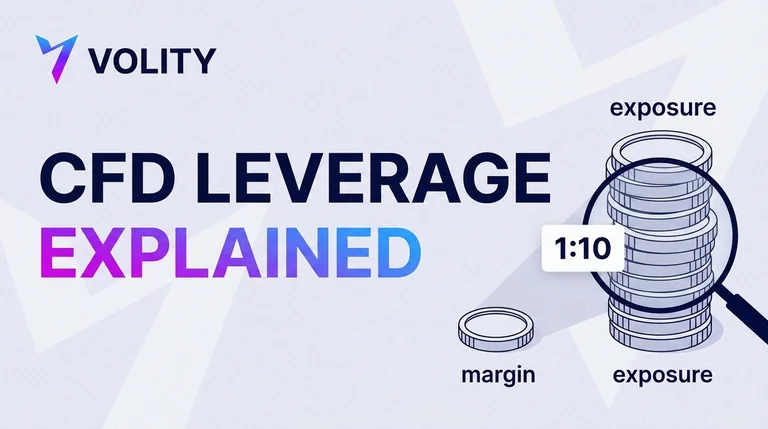
Volity supports up to 1:500 leverage on selected forex products. The maths is the same as other CFDs:
- 1 standard lot = 100,000 units of base currency
- EUR/USD 1 lot at 1.10 = $110,000 notional
- At 1:500, margin required = $220
- A 100-pip adverse move = $1,000 = 4.5x margin = liquidation long before that
At 1:500, most retail strategies blow up fast. Practical retail leverage on forex: 1:50 to 1:200 with strict 1-2% per-trade risk sizing.
What moves forex prices
Five primary drivers:
1. Interest rate differentials. Central bank policy (Fed, ECB, BoE, BoJ) sets short-term rates. Higher rates typically attract capital, strengthening the currency.
2. Economic data. GDP, inflation, employment (NFP, JOLTS), retail sales, manufacturing PMI. Pre-release positioning + post-release reaction is the standard forex trade.
3. Geopolitical events. Brexit, US-China trade tensions, military conflicts. Sterling and emerging-market currencies move on these.
4. Risk-on/risk-off sentiment. When equity markets sell off, traders bid safe-haven currencies (USD, CHF, JPY) and sell risk currencies (AUD, NZD, EM).
5. Carry trades. Borrowing low-yielding currencies (JPY historically) to fund high-yielding currency positions. Affects flows over weeks/months.
Cost structure
- Spread: from 0.6 pips on EURUSD Standard. Tightest on majors
- Swap: applied at 22:00 GMT on overnight positions. Positive or negative based on interest rate differential between the two currencies
- Commission: $0 on Standard accounts
- FX conversion: 1% if funding non-USD and trading USD-denominated pairs
Common forex CFD strategies
Trend following on majors. Identify a multi-day trend on EUR/USD or GBP/USD, enter on pullback to moving average, exit on trend break. Works in directional markets.
News trades around major releases. US NFP (first Friday monthly), CPI prints, FOMC decisions. Pre-position based on consensus; profit if actual diverges meaningfully.
Range fade on consolidating pairs. When a pair holds a defined range, fade extremes back toward the middle with tight stops on range break.
Carry trades (longer horizon). Long high-yield + short low-yield currency pairs, collect positive swap. Multi-week to multi-month holds.
Risk in forex CFD trading
- High-leverage drawdowns. 1:500 looks attractive in marketing; in practice, retail traders blow up at this leverage faster than at lower tiers
- News surprise gaps. Unexpected central bank moves (SNB removing the EUR/CHF floor in 2015) can gap pairs 20%+ in minutes. Stops do not protect against this
- Carry trade unwind risk. Carry trades work for years then unwind in days. Risk-off events flatten carry positions
- Overnight gap risk on weekends. Forex closes Friday 22:00 GMT and opens Sunday 22:00 GMT. Weekend news produces Sunday gaps. Some traders close positions before weekends
Sources
Related Volity CFD guides
- CFD Trading Platform on Volity: 10,000+ Markets
- Forex Trading Guide: How to Trade Currencies
- CFDs vs Futures: Key Differences
- CFD vs Spread Betting
- Crypto Perpetual Trading: CFD Alternative
Frequently asked questions
What is CFD currency trading?
CFD currency trading uses contracts for difference to speculate on forex prices without actual currency transfer. The retail experience is identical to spot forex but operationally: margin-based positions, available leverage, long or short with equal ease. Volity offers 40+ currency pairs as CFDs.
What is the difference between forex and forex CFDs?
Spot forex involves actual currency transfer settled in 2 business days, primarily institutional. Forex CFDs mirror spot price movements without currency transfer, primarily retail. For most retail traders, “forex trading” and “forex CFD trading” mean the same thing.
What leverage can I use on currency CFDs?
Volity supports up to 1:500 leverage on selected forex products. The required margin is displayed before order entry. Most retail strategies work better at 1:50 to 1:200 with strict 1-2% per-trade risk sizing rather than maximum leverage.
Which currency pairs are most liquid?
Major pairs (EUR/USD, USD/JPY, GBP/USD, USD/CHF, USD/CAD, AUD/USD, NZD/USD) have the deepest liquidity and tightest spreads. Minor (cross) pairs are next. Exotic pairs (involving emerging-market currencies) have wider spreads and lower liquidity.
When does forex trading happen?
Forex markets operate 24 hours a day Sunday 22:00 GMT through Friday 22:00 GMT. Three major sessions overlap: Sydney/Tokyo (Asia), London (Europe), New York (US). The London-NY overlap (13:00-17:00 GMT) is typically the most liquid window.
Are forex CFD profits taxable?
Yes in most jurisdictions. Treatment varies (capital gains, income, derivatives). Volity provides annual P&L statements for tax filing. Consult a local tax advisor for specifics.
Can I use the Volity demo for forex CFD practice?
Yes. The Volity demo supports all 40+ forex pairs with real spreads and live tick data. Practice with the same leverage tiers as live. Free, unlimited, no deposit.