The Crypto Trading Starter Kit
A plain-English PDF: what to check before you trade, how orders and risk really work, and the mistakes to skip. Get it free.
DAO participation involves smart contract risk, potential governance token volatility, and evolving regulatory frameworks. Individual token holders may face liability risks depending on jurisdiction. Past performance is not indicative of future results. Capital at risk.
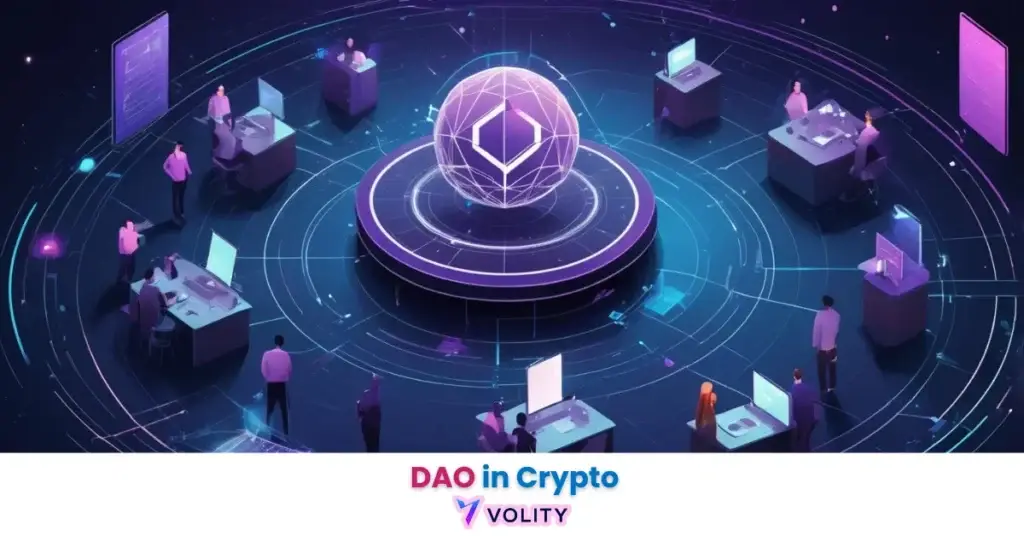
DAO (Decentralized Autonomous Organization) technology represents a paradigm shift in how global communities coordinate resources and make decisions without centralized intermediaries. By encoding organizational rules into immutable code, these entities provide a transparent alternative to traditional corporate hierarchies. This shift eliminates the need for centralized boards of directors or executive teams, replacing them with automated execution triggered by community voting.
As the ecosystem matures, decentralized organizations have moved from novelty to a working pattern for allocating pooled capital across decentralized finance and social coordination. However, participating in these structures requires a clear understanding of smart contract security and the shifting regulatory landscape. A DAO with no legal wrapper can function as a general partnership, which changes how token holders should think about their exposure to organizational liability.
While understanding DAO (Decentralized Autonomous Organization) is important, applying that knowledge is where the real growth happens. Create Your Free Forex Trading Account to practice with a free demo account and put your strategy to the test.
What is a DAO and how does it function in 2025?
DAO (Decentralized Autonomous Organization) is a blockchain-based collective that operates through automated smart contracts rather than centralized management. These entities encode voting rules, fund allocation mechanisms, and operational procedures into immutable code, eliminating intermediaries and enabling transparent decision-making.
A DAO member proposes changes, the community votes on the proposal, and if approved, smart contracts automatically execute the decision without human gatekeepers. This mechanism represents a radical departure from traditional corporations where executives retain discretion over resource allocation.
Understanding Smart contract automation is critical because it reveals how DAOs enforce decisions through code rather than legal contracts.
The transition from centralized startups to Decentralized Finance (DeFi) protocols identifies how organizational structure shapes incentive alignment. In a centralized startup, founding teams control capital and make strategic decisions unilaterally.
In a DAO, token holders collectively determine strategy through voting, which distributes decision power across all participants. This shift creates resistance to capture by any individual or small group, though it introduces new challenges around voter participation and whale dominance.
Treasury size varies enormously between protocols, and a DAO’s on-chain treasury is public: you can read the balance and its composition directly from the chain rather than taking any dashboard’s word for it.
Ready to Elevate Your Trading?
You have the information. Now, get the platform. Join thousands of successful traders who use Volity for its powerful tools, fast execution, and dedicated support.
Create Your Account in Under 3 MinutesWhat are the different models for DAO membership and governance?
DAO membership models provide the structural framework for participation, ranging from token-based voting to permissioned share-based systems. Token-based governance (ERC-20) identifies the most common model, where membership power scales with token holdings.
A user with 1,000 tokens receives 1,000 votes on proposals, which creates alignment with holders who have significant capital at stake. Share-based membership structures like Moloch DAOs identify an alternative where each holder receives equal voting power regardless of contribution size, similar to cooperative models.
Reputation-based voting systems represent a third approach where members earn voting power through contributions rather than holding capital, which incentivizes participation and expertise over wealth accumulation.
Distribution methods like Crypto airdrop distribution reveal how DAOs bootstrap membership, often dropping governance tokens to early users, liquidity providers, or protocol participants to decentralize voting power. The challenge with token-weighted voting identifies the “Whale” problem, when a few large holders accumulate enough tokens to control proposals. Many large DAOs also hold most of their treasury in their own governance token, which concentrates voting power and treasury value in the same hands and ties the treasury’s value to the protocol it is meant to fund. This structure can amplify inequality if large stakeholders vote purely to enrich themselves rather than optimize protocol outcomes.
DAO legal status is evolving through new frameworks like the Wyoming Decentralized Unincorporated Non-Profit Association (DUNA) Act, which provides a recognized legal personality. Traditional corporate law treats unincorporated associations as general partnerships, potentially making all members liable for organization debts and actions. The DUNA Act changes this framework by providing legal recognition for decentralized entities, enabling DAOs to sign contracts, hold property, and operate with a defined liability shield. Wyoming DAO LLC structures represent a more traditional wrapper, where the DAO registers as a limited liability company under state law, which is more familiar to regulators and institutional partners but requires a registered agent and maintains annual reporting requirements.
Regulatory stance of Ethereum blockchain governance foundations and other major protocols identifies a cautious approach where these entities avoid claiming they “govern” their protocols, instead positioning themselves as technical development teams. Comprehensive DAO-specific regulation is still being written in most jurisdictions, and courts have shown they are willing to treat an unincorporated DAO as a legal entity that can be sued. Wyoming DAO LLC registration requires a $100 initial filing fee, with an annual report due every year thereafter at a minimum of $60, so a DAO can now register formally with a state government.
For detailed regulatory requirements, the Wyoming Secretary of State’s Decentralized Autonomous Organization FAQ sets out the naming rules, the registered-agent requirement and the filing fees needed to establish a recognized DAO entity.
What are the major challenges and risks of decentralized organizations?
DAO risks include smart contract vulnerabilities, voter apathy, and the potential for personal liability as established by recent legal precedents. Smart contracts represent immutable code that executes automatically, which means security vulnerabilities cannot be patched post-deployment without a full migration. Vulnerability of Aave decentralized lending protocols and similar DeFi platforms to code exploits is the reason an unaudited contract holding a treasury is a standing risk rather than a hypothetical one. Power concentration and the “Whale” problem identify governance risks, protocols where token distribution is heavily concentrated in early holders often see low voter participation and proposals that enrich large holders at community expense.
Legal liability identifies a critical vulnerability for unincorporated DAOs. Where a DAO has no legal wrapper, the default classification available to a court is the general partnership, and a general partnership offers its members no liability shield at all. Token holders in an unincorporated DAO may therefore face personal liability for organizational actions, which is the opposite of the early assumption that a DAO structure protected participants. Past performance is not indicative of future results. As the encyclopaedic reference on decentralized autonomous organizations puts it, a DAO may functionally be a corporation without the legal status of one, and known participants sit closest to that exposure.
How does a DAO handle treasury management and “Rage Quits”?
DAO treasury management utilizes multi-signature wallets and “Rage Quit” mechanisms to protect member assets from mismanagement or unwanted proposals. Multi-signature (multi-sig) wallets require multiple authorized signers to approve transactions, which prevents any single person from unilaterally moving funds. A typical structure might require 3 of 5 signers to approve transfers over a certain amount, ensuring that no solo actor can steal treasury assets. “Rage Quit” identifies a mechanism where minority token holders can exit the organization and receive their proportional share of treasury assets if they disagree with a proposal, similar to a shareholder redemption right. This protection ensures that members opposed to a specific decision can leave with their capital intact rather than being forced to participate in unwanted actions.
Arbitrage considerations for voting efficiency drive some DAOs toward Arbitrum scaling solutions to reduce gas fees associated with on-chain voting. Large governance proposals might otherwise be prohibitively expensive to execute on Ethereum Layer 1. DAOs on the Solana blockchain identify another cost-optimization strategy where lower transaction fees enable more frequent proposals and broader participation without financial barriers for small token holders. These Layer 2 and alternative blockchain solutions represent necessary infrastructure improvements to make DAO governance accessible and cost-effective for all members.
Turn Knowledge into Profit
You have done the reading, now it is time to act. The best way to learn is by doing. Open a free, no-risk demo account and practice your strategy with virtual funds today.
Open a Free Demo AccountDAO Structures Compared: Wrappers, Voting and Treasury Control
The decisions that actually matter when you join a DAO are structural, not statistical: which wrapper it uses, how votes are weighted, and who can move the treasury. The following table sets those out side by side, with the Wyoming figures taken from the Secretary of State’s own DAO FAQ:
| What to check | Why it matters | Value |
| DAO treasury | Where the assets sit | Held on-chain and publicly auditable |
| Treasury composition | Dominant holding | Usually the protocol’s own governance token |
| Wyoming DAO LLC | Filing and annual fees | $100 initial, $60 minimum annual report |
| Voting power | Typical distribution | Concentrated in early holders and the native token |
| DAO Governance | Turnout on proposals | Typically a small fraction of eligible tokens |
Wyoming fees: Wyoming Secretary of State, Decentralized Autonomous Organization FAQ. Treasury and turnout rows describe the structure of DAO governance rather than a point-in-time measurement.
Treasury value follows a power law: a handful of protocols (Uniswap, MakerDAO, Aave) hold most of the decentralized capital and the long tail holds very little. Voter turnout is usually low because token holders face little incentive to spend time on proposals that carry no direct reward, which quietly reverses the democratic intention of DAOs. This dynamic creates an asymmetry where engaged minority holders determine outcomes while the silent majority of token holders do not vote.
Key Takeaways
- DAO (Decentralized Autonomous Organization) entities hold their treasuries on-chain, so composition and balance can be verified directly rather than taken on trust.
- DAO governance relies on smart contracts to automate voting and execute proposal outcomes without human intermediaries.
- DAO membership models vary from token-weighted systems to permissioned share-based structures like Moloch DAOs.
- DAO legal risk centres on the general-partnership default: without a wrapper, members can carry personal liability.
- DAO treasury security often employs multi-signature wallets and “Rage Quit” mechanisms to protect minority holders.
- DAO regulatory frameworks are maturing with Wyoming’s DUNA Act providing a legal personality for decentralized groups.
Frequently Asked Questions
This article contains references to DAO (Decentralized Autonomous Organization), Uniswap, Aave, and Volity, a regulated CFD trading platform. This content is produced for educational purposes only and does not constitute financial advice or a recommendation to buy or sell any financial instrument. Always verify current regulatory status and platform details before using any trading service. Some links in this article may be affiliate links.
What our analysts watch: We track three signals when reading the crypto tape. Spot ETF net flows reveal institutional demand. Stablecoin issuance shows sidelined buying power. Miner reserves indicate supply pressure.
What our analysts watch: When evaluating a DAO governance token, the Volity desk runs three separate checks. Voting concentration (top 10 wallet share above 50% means the “decentralisation” is mostly cosmetic).
Treasury composition (a treasury 80%+ in the project’s own token is structurally fragile; diversification into stables and ETH is the credible tell). And proposal velocity (active governance running multiple proposals per month indicates real participation; a quiet forum signals captured or abandoned governance).
All three together separate functioning DAOs from the rest.
Volity operates a trading platform and also publishes educational and analytical content about trading. The content on this page is for educational purposes only and should not be considered financial advice. Volity may benefit commercially when readers open trading accounts through links on this site.
Our content is produced and reviewed under documented editorial standards; see our comparison and review methodology.