Investing in financial products involves risk. Losses may exceed the value of your original investment.
The Crypto Trading Starter Kit
A plain-English PDF: what to check before you trade, how orders and risk really work, and the mistakes to skip. Get it free.
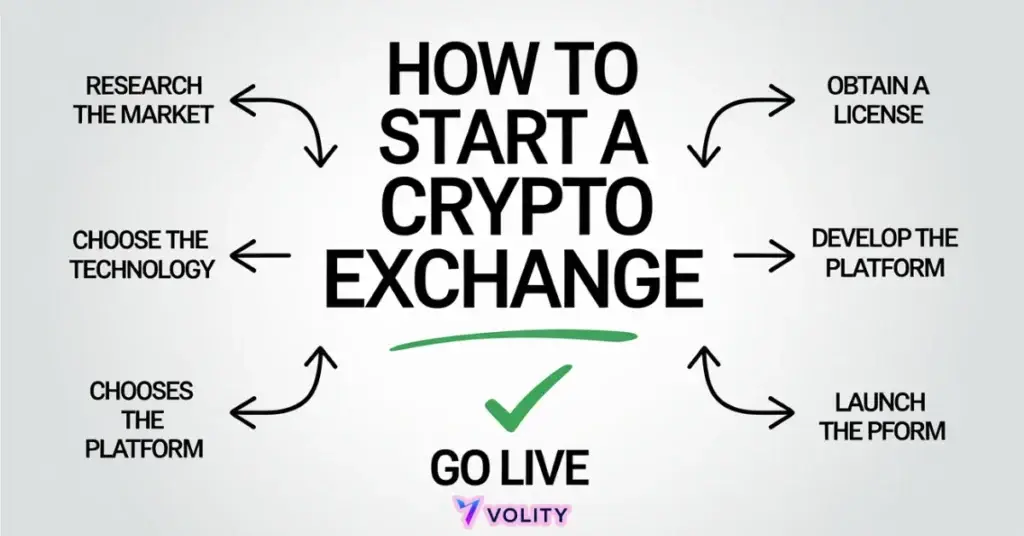
Starting a crypto exchange platform involves navigating complex technology, strict regulations, and critical liquidity challenges to build a robust and trustworthy trading environment. The cryptocurrency market continues its rapid expansion, creating significant opportunities for new exchange platforms. This guide explores the essential steps and considerations for entrepreneurs, covering everything from core mechanics and legal frameworks to post-launch growth strategies.
While understanding How To Start Crypto Exchange is important, applying that knowledge is where the real growth happens. Create Your Free Crypto Trading Account to practice with a free demo account and put your strategy to the test.
What is a crypto exchange?
A crypto exchange platform serves as a digital marketplace where users can buy, sell, and trade cryptocurrencies. These platforms connect buyers and sellers, facilitate transactions, and often provide additional services like wallet management and staking. The global cryptocurrency exchange market size was valued at USD 1.5 billion in 2022 and is projected to grow at a Compound Annual Growth Rate (CAGR) of 25.3% from 2023 to 2030.
A crypto exchange platform acts as an intermediary, allowing users to convert fiat currencies (like USD or EUR) into cryptocurrencies, exchange one cryptocurrency for another, or convert crypto back into fiat. These platforms are central to the digital asset ecosystem, providing the infrastructure for price discovery and liquidity. They function similarly to traditional stock exchanges but deal exclusively with digital assets built on blockchain technology.
The Core Mechanics
The operation of a crypto exchange platform involves several key components. When a user places an order (e.g., to buy Bitcoin), this order is added to the exchange’s Order Book, which lists all active buy and sell orders for a specific trading pair. A sophisticated Matching Engine then processes these orders, pairing buyers with sellers based on price and time priority. Once a match is found, the transaction is executed, and the respective cryptocurrencies are transferred between the users’ wallets. This entire process is underpinned by robust security protocols and real-time data processing to ensure accuracy and speed.
CEX, DEX, and Hybrid Models
Crypto exchanges primarily fall into three categories: Centralized (CEX), Decentralized (DEX), and Hybrid models. Each offers distinct features and operational approaches crucial for entrepreneurs to understand. Spot exchanges allow for immediate delivery of assets, while derivative exchanges enable trading of financial contracts whose value is derived from an underlying asset.
| Model | Key Features | Pros | Cons |
| Centralized | Intermediary, KYC/AML, fiat support | High liquidity, user-friendly, fast | Central point of failure, less privacy |
| Decentralized | Peer-to-peer, smart contracts | High privacy, no intermediary | Lower liquidity, complex UI, limited fiat |
| Hybrid | Combines CEX & DEX features | Balanced security & liquidity | Complex development, regulatory gray areas |
Centralized exchanges (CEX) are the most common, offering high liquidity and user-friendly interfaces. However, they involve a third party and require Know Your Customer (KYC) and Anti-Money Laundering (AML) checks. Decentralized exchanges (DEX) operate on blockchain technology without an intermediary, offering greater privacy and resistance to censorship. Hybrid models aim to combine the best aspects of both, providing improved security and user experience.
What technology is needed for a crypto exchange?
Starting a crypto exchange requires a robust and scalable technology stack capable of handling high transaction volumes and ensuring top-tier security. The core components include a powerful matching engine, secure wallet management systems, and reliable cloud infrastructure. These elements work in concert to create a seamless and trustworthy trading environment for users.
What Powers Your Exchange?
The heart of any crypto exchange platform is its Matching Engine. This sophisticated software processes and executes buy and sell orders from the Order Book in real-time, ensuring fair and efficient trade execution. A high-performance matching engine is crucial for handling thousands of transactions per second, preventing latency issues, and supporting high-frequency trading.
Equally vital is a secure Wallet Management system, which handles the storage and transfer of user funds. This system typically incorporates both hot wallets (for active trading) and cold wallets (for secure reserves). The entire operation relies on scalable and secure Cloud Infrastructure, providing the necessary computing power and storage to ensure continuous service availability and data integrity.
Ready to Elevate Your Trading?
You have the information. Now, get the platform. Join thousands of successful traders who use Volity for its powerful tools, fast execution, and dedicated support.
Create Your Account in Under 3 MinutesWhat are the key features of a successful crypto exchange?
A successful crypto exchange platform differentiates itself through a combination of essential features that improve user experience, security, and functionality. These features are critical for attracting and retaining a diverse user base in a competitive market. Prioritizing these elements during development creates a platform that is both robust and appealing to traders.
Key Features for a Competitive Edge
- A successful crypto exchange platform prioritizes an intuitive User Interface (UI)/User Experience (UX). Many users find existing crypto exchanges challenging to navigate, making a clear and responsive design a significant competitive advantage. An excellent UI/UX ensures ease of use for new traders while providing advanced tools for experienced ones.
- Furthermore, robust API Integration is essential, allowing external applications like trading bots, data analytics tools, and portfolio trackers to connect seamlessly. This expands the ecosystem around the exchange and enhances its utility.
- Finally, offering a wide array of Trading Pairs, allowing users to exchange various cryptocurrencies for each other or for fiat, attracts a broader audience and boosts liquidity.
What is the legal framework for crypto exchanges?
The legal framework for crypto exchanges is complex and constantly evolving, requiring meticulous attention to Regulatory Compliance. Over 60% of crypto exchange failures are attributed to security breaches or regulatory non-compliance. Entrepreneurs often face significant legal hurdles, including obtaining appropriate licenses and implementing stringent anti-money laundering procedures.
The legal framework governing crypto exchange platforms is highly fragmented and varies significantly across jurisdictions. Entrepreneurs must engage legal counsel early to navigate this intricate landscape. Key considerations include obtaining an Exchange License, which is often mandatory and can involve rigorous application processes and capital requirements. Regulations typically cover areas such as consumer protection, data privacy, and financial crime prevention. The evolving nature of these laws means that platforms must remain agile and prepared to adapt their operations to new legal mandates. Failing to establish a clear Regulatory Compliance strategy can lead to severe penalties, operational disruptions, and a loss of user trust.
KYC/AML Implementation
Know Your Customer (KYC) and Anti-Money Laundering (AML) procedures are mandatory pillars of Regulatory Compliance for most crypto exchange platforms. KYC involves verifying the identity of users to prevent fraud, terrorism financing, and other illicit activities. This typically includes collecting personal information, government-issued IDs, and proof of address. AML processes monitor transactions for suspicious patterns, reporting any anomalies to financial authorities. Implementing robust KYC/AML protocols is not only a legal obligation but also a crucial step in building trust and credibility within the financial ecosystem. These measures help protect both the exchange and its users from financial crime.
Comprehensive Security Measures
Robust Security Measures are paramount for any crypto exchange platform to protect user assets and data. Given that over 60% of crypto exchange failures are attributed to security breaches, a multi-layered approach is essential to protect user assets and data. This includes implementing Multi-Factor Authentication (MFA) for user accounts, which adds an extra layer of protection beyond passwords. For asset storage, Cold Storage solutions, such as hardware wallets not connected to the internet, are critical for holding the majority of user funds. Additionally, DDoS Protection mechanisms safeguard the platform against distributed denial-of-service attacks, ensuring continuous availability. Regular security audits, penetration testing, and encryption of sensitive data further fortify the exchange against potential threats.
Liquidity: Why It’s Crucial for Your Exchange
Liquidity is the ability to easily buy or sell an asset without significantly impacting its price. For a crypto exchange platform, it represents the ease with which users can execute trades at stable prices. Achieving sufficient liquidity is a primary challenge for 70% of new crypto exchanges, often requiring partnerships with market makers or existing platforms. Without deep liquidity, users face wider bid-ask spreads and difficulty executing large orders, leading to a poor trading experience and deterring adoption.
Liquidity is the cornerstone of a thriving crypto exchange platform. It directly impacts user satisfaction, trading volume, and the overall viability of the exchange. High liquidity means there are always enough buyers and sellers to facilitate trades quickly and at fair market prices. Conversely, low liquidity results in slippage, where trades execute at prices worse than expected, and can make it difficult for users to enter or exit positions. This deters serious traders and can quickly cripple a new exchange.
Strategies to Cultivate and Maintain Liquidity
- Cultivating and maintaining Liquidity is a continuous process for a crypto exchange platform. One key strategy is Market Making, where entities (either internal or external professional market makers) actively place both buy and sell orders to create depth in the Order Book. This narrows the bid-ask spread and ensures trades can be executed efficiently.
- Another vital strategy is API Connectivity to other exchanges or liquidity providers. By aggregating order books from multiple sources, a new exchange can instantly tap into existing market depth.
- Offering competitive trading fees, attracting institutional traders, and implementing incentive programs for active traders also contribute significantly to building and sustaining robust liquidity.
Build vs. buy crypto exchange software?
When launching a crypto exchange platform, entrepreneurs face a fundamental decision: develop a custom solution from scratch or use a pre-built White Label Solution. Each approach presents distinct advantages and disadvantages in terms of cost, time to market, flexibility, and control. Understanding these trade-offs is crucial for aligning the development path with business goals and available resources.
Choosing Your Development Path
- Developing a custom Crypto Exchange Platform from scratch offers maximum flexibility and control, allowing for unique features and deep integration with specific business models. However, this path is often time-consuming and expensive, requiring a dedicated team of blockchain developers, security experts, and UI/UX designers.
- Conversely, a White Label Solution provides a ready-to-launch platform that can be branded and customized. This significantly reduces development time and initial costs, making it a faster route to market.
- The trade-off is often less flexibility and reliance on the white label provider’s technology stack and security protocols. The choice depends on budget, desired customization, and urgency.
How Much Does It Cost to Start a Crypto Exchange?
The cost to start a crypto exchange platform varies widely depending on the chosen development path, features, and regulatory requirements. A significant portion of the initial investment goes towards Development Cost, particularly for a custom build. Licensing Cost also represents a substantial expense, varying by jurisdiction. Additionally, ongoing Operational Cost includes infrastructure, security, marketing, and Customer Support.
The financial outlay for launching a crypto exchange platform is multi-faceted. Development Cost is a primary factor; a Minimum Viable Product (MVP) for a crypto exchange can be developed within 3-6 months, with costs ranging from $50,000 to $200,000, depending on features and development team. This estimate focuses on core functionality. Beyond development, Licensing Cost for regulatory compliance can range from tens of thousands to millions of dollars, depending on the target regions. Integrating a Payment Gateway for fiat on/off-ramps incurs additional setup and transaction fees. Finally, ongoing Operational Cost for server infrastructure, security audits, marketing, and a robust Customer Support team must be factored into the long-term budget.
Beyond the Initial Launch
Beyond the initial launch, successful operation of a crypto exchange platform requires continuous attention to user needs and market dynamics. Robust Customer Support is paramount for building trust and handling user disputes effectively, which is a common pain point for users. Implementing a multi-channel support system (e.g., live chat, email, ticketing) ensures users receive timely assistance. Additionally, refining the Pricing Model, such as maker-taker fees, flat fees, or tiered structures, is critical for revenue generation and competitive positioning. Regular platform maintenance, security updates, and active community engagement are also vital for building a loyal user base and ensuring long-term viability.
Regional Regulatory Frameworks: US vs. EU
Navigating the divergent regulatory landscapes of key markets like the US and EU is paramount for successful global expansion, yet often overlooked in initial guides. This complexity necessitates a nuanced understanding and a tailored Geopolitical Compliance Strategy. While many guides offer general advice, specific comparative analysis of major regional frameworks is crucial for global entrepreneurs. The regulatory environment for crypto exchange platforms differs significantly between regions, posing unique challenges and opportunities. A clear Geopolitical Compliance Strategy is essential for any exchange aiming for international reach.
| Aspect | UK Framework (e.g., FCA) | EU Framework (e.g., MiCA) |
| Licensing | FCA cryptoasset registration under the Money Laundering Regulations | Unified: MiCA license valid across all EU states |
| Asset Classification | FCA token taxonomy: security, e-money and unregulated tokens | MiCA categorizes as e-money tokens, asset-referenced tokens, utility tokens |
| KYC/AML | FCA AML/CTF requirements, FATF standards | Robust AMLD5/6, aligned with FATF standards |
| Consumer Protection | FCA financial promotion rules and conduct oversight | Comprehensive MiCA rules for transparency, risk disclosure |
| Passporting | No EU passporting post-Brexit; FCA authorisation is UK-only | MiCA allows “passporting” across EU states |
In the United Kingdom, regulatory compliance centres on the Financial Conduct Authority (FCA): crypto exchanges must register with the FCA under the Money Laundering Regulations and comply with its financial promotion and conduct rules before marketing to UK consumers. Conversely, the European Union’s Markets in Crypto-Assets (MiCA) regulation aims to create a harmonized framework across all member states. MiCA provides a single license that can be “passported” across the EU, simplifying compliance for exchanges operating within the bloc. Understanding these distinct approaches is vital for strategic market entry and avoiding costly legal pitfalls.
Turn Knowledge into Profit
You have done the reading, now it is time to act. The best way to learn is by doing. Open a free, no-risk demo account and practice your strategy with virtual funds today.
Open a Free Demo AccountPost-Launch Growth & Emerging Technologies
Sustainable growth for a crypto exchange platform requires a proactive post-launch strategy encompassing marketing, strategic partnerships, and continuous innovation through emerging technologies like AI-powered Risk Management. Many guides focus on the initial setup but neglect the critical aspects of sustained growth and innovation. Many new crypto exchanges struggle to survive beyond 3 years without dedicated growth strategies. This highlights the importance of forward-thinking approaches.
After a successful launch, the focus shifts to user acquisition, retention, and platform evolution. Effective marketing and community building are crucial for attracting initial users and building a loyal base. Strategic partnerships with liquidity providers, blockchain projects, and payment processors can expand the exchange’s offerings and reach.
Beyond traditional growth tactics, leveraging emerging technologies provides a significant competitive edge. AI-powered Risk Management offers cutting-edge solutions for fraud detection, market manipulation prevention, and improved security. AI algorithms can analyze vast datasets to identify suspicious activities in real-time, protecting both the platform and its users. Integrating Tokenomics Integration can transform user loyalty and platform growth by creating innovative incentive structures, such as staking rewards or governance tokens. This fosters a sense of ownership and encourages active participation. Furthermore, incorporating Gamification Features, like trading competitions, loyalty programs, or achievement badges, can significantly boost user engagement and encourage consistent trading activity. These elements differentiate an exchange in a crowded market by making the trading experience more interactive and rewarding. By embracing these advanced strategies, a crypto exchange platform can move beyond mere survival to achieve sustainable, long-term success and innovation.
Bottom Line
Launching a successful crypto exchange platform is a multifaceted endeavor that demands a strategic blend of technological prowess, rigorous regulatory adherence, and a keen understanding of market dynamics. From developing a robust matching engine and secure wallet systems to navigating complex global compliance frameworks and cultivating deep liquidity, each step is critical. Post-launch, sustained growth hinges on continuous innovation, strategic partnerships, and leveraging emerging technologies to enhance security and user engagement. Entrepreneurs who meticulously plan and adapt to this dynamic sector are best positioned for long-term success.
Key Takeaways
- Starting a crypto exchange involves navigating complex technology, strict regulations, and critical liquidity challenges.
- Launching a successful crypto exchange requires meticulous planning across technology, legal frameworks, and user experience.
- Robust security measures, a powerful matching engine, and secure wallet management are technological cornerstones.
- Regulatory compliance, including KYC/AML and obtaining licenses, is paramount and varies significantly by region.
- Achieving and maintaining liquidity is crucial for user satisfaction and the exchange’s overall viability.
- Post-launch growth requires continuous innovation, strategic partnerships, and leveraging emerging tech like AI-powered risk management.
Frequently Asked Questions
What our analysts watch: Three workstreams determine whether a new exchange survives its first eighteen months. Licensing roadmap (which jurisdiction first, which passport second, what minimum-capital number triggers the application). Liquidity sourcing (in-house market makers, third-party PB, or aggregator routing, each with materially different cost structures). Banking and stablecoin rails (the silent kill switch on most projects). When the team plans these in parallel rather than in series, time-to-launch shortens by a factor of two to three.
Related guides
Volity operates a trading platform and also publishes educational and analytical content about trading. The content on this page is for educational purposes only and should not be considered financial advice. Volity may benefit commercially when readers open trading accounts through links on this site.
Our content is produced and reviewed under documented editorial standards; see our comparison and review methodology.