Quick answer
A rug pull in crypto is a scam where developers hype a token, attract investment, then suddenly withdraw the liquidity or sell their holdings, crashing the price and leaving investors with worthless coins. Warning signs include anonymous teams, unlocked liquidity and unrealistic promises. Check liquidity locks, audits and team transparency before buying any new token.
The Crypto Trading Starter Kit
A plain-English PDF: what to check before you trade, how orders and risk really work, and the mistakes to skip. Get it free.
Investing in financial products involves risk. Losses may exceed the value of your original investment.
Not every crypto project is worth your investment, and the reality is, you never know when things might go south. One minute, everything seems fine, and the next, you’re left with nothing.
This is what happens when a rug pull occurs – and it’s a risk that every crypto investor needs to be aware of. Let’s discuss in detail what is a rugg pull in Crypto – so you can save your investment from scamming.
By Volity Editorial, Volity research desk.
What our analysts watch: Three contract-level checks filter the vast majority of rug-pull setups before the trade is taken. Liquidity-pool token lock duration on services like Unicrypt or Team Finance signals whether the LP can be pulled tomorrow or is committed for months. Mint authority status on the token contract reveals whether the deployer can dilute holders without notice. And contract ownership renouncement, paired with a published audit from a reputable firm, separates serious projects from stand-up scams. None of these checks are sufficient alone, but the absence of all three is the cleanest red flag a retail trader can read.
Frequently asked questions
How big is the rug-pull problem in 2026?
Rug pulls and exit scams remain a meaningful share of crypto-related losses, although the centre of gravity has shifted from ICO-era launches to DeFi protocol exploits and meme-coin liquidity drains. FATF virtual-asset risk and policy hub covers the international policy direction on virtual asset service providers, with several jurisdictions tightening custodial and travel-rule supervision through 2026. The headline takeaway: regulated venues with KYC and proof-of-reserves materially reduce rug-pull exposure, but on-chain self-custody users remain responsible for their own contract diligence.
What does a token-contract red-flag scan actually look like?
A practical scan checks: whether mint and burn functions are callable by privileged addresses, whether the LP tokens are time-locked, whether the contract has a recent independent audit, whether the team is identifiable, and whether a non-trivial share of supply is concentrated in deployer or insider wallets. Investopedia coverage of crypto rug pulls sets out the standard taxonomy with worked examples. Block-explorer tooling makes most of these checks fast, and any retail trader holding meaningful size on a low-cap token should run them before adding.
Are rug-pull losses recoverable through regulated channels?
Recovery is rare but not impossible. The U.S. SEC Division of Enforcement brings actions against U.S.-nexus crypto fraud, and victim funds occasionally get distributed through receiver processes. Cross-border cases are harder. The structural lesson: prevention beats recovery. Trading crypto-linked instruments on regulated venues with proper disclosure, like Volity through UBK Markets under CySEC licence 186/12, removes the most common rug-pull surface entirely.
What is a Rug Pull in Crypto?
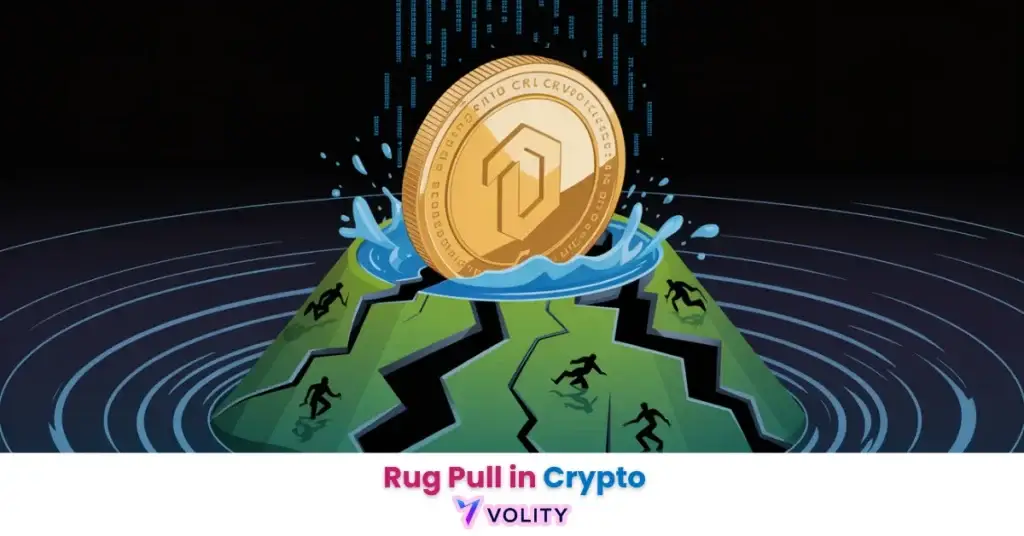
A rug pull is a scam in the crypto world. It happens when the creators of a crypto project suddenly disappear. They take all the money invested in the project. Investors are left with worthless tokens. Those investors are the textbook bagholder, holding a position that will not recover.
The name comes from the phrase “pulling the rug out from under someone.” This means to take away support unexpectedly.
rug pulls are common in DeFi projects, especially on Decentralized Exchanges (DEXs). Developers create a token, raise money, and then vanish, taking all the funds. So, this leaves investors with no way to sell their tokens.
In simple terms, it’s a quick way for scammers to steal from unsuspecting investors. Always be cautious and do your research before investing.
Types of Rug Pulls in Cryptocurrency
| Type of Rug Pull | Description | Example | Warning Signs |
| Liquidity Pulls | When the creators remove all liquidity from a token pool, causing its value to collapse. | Investors buy a token paired with ETH, but the creators withdraw liquidity, leaving the token worthless. | Sudden price drop, inability to sell the token, no liquidity in the pool. |
| Fake Projects | Scammers create fake projects, raise funds, and then disappear, leaving investors with worthless tokens. | A new project promises high returns, collects funds, and then disappears. | Lack of transparency, anonymous team, no working product or whitepaper. |
| Pump and Dump | Fraudsters artificially inflate a token’s price, sell their tokens at the peak, and leave the value to collapse. | A token’s price spikes suddenly due to coordinated buying, then crashes when the scammers sell off their holdings. | Rapid price surge followed by an immediate crash, sudden interest from influencers. |
| Team Exit | The core team behind a project disappears, leaving it without leadership or support. | The team of a DeFi project steps down and abandons the project, causing its collapse. | Sudden disappearance of team members, no further development or support. |
How Rugging Work in Crypto?
Here’s how it works: The creators launch a new cryptocurrency project. They promote it heavily through social media and influencers. Consequently, the token is listed on decentralized exchanges (DEXs) where liquidity pools are created. Investors buy in, as they hope to make a profit. However, once enough money is raised, the creators either sell their tokens or remove the liquidity from the pool, which causes the token’s price to collapse.
For example, you buy a token that quickly increases in price. But once the developers pull the liquidity, the price crashes, and you’re left with worthless tokens.
Signs of a Rug Pull
- Sudden price spikes with no clear reason
- Low liquidity making it hard to buy or sell
- An anonymous or unclear development team
- No security audits or contract verification
- Unrealistic promises of high returns
- Overhyped social media marketing campaigns
- Unlocked liquidity or no lock on liquidity
- Sudden exit of key team members
- Lack of active project development or updates
Is Rug and Pull Same as Pump and Dump Scam?
No, a rug pull and a pump and dump are not the same, though they both involve deceptive and fraudulent practices in the cryptocurrency market.
A rug pull refers to when the developers of a cryptocurrency project suddenly withdraw all liquidity or funds, leaving investors with worthless assets. It typically happens in DeFi projects or token sales, and the developers vanish after siphoning off the funds, which leaves investors with no chance of recovering their money. Many of these projects had no real utility from the start, the kind of shitcoin that only ever traded on hype.
On the other hand, a pump and dump involves artificially inflating the price of a cryptocurrency by coordinated buying, often driven by hype and misleading information. Once the price peaks, the perpetrators sell their holdings at the inflated price and profit, while others who bought in during the pump are left with worthless coins.
The key difference is that a rug pull is more of an exit scam where the developers disappear with all the funds, while a pump and dump scam is focused on price manipulation for personal gain by selling off at the peak.
How to Identify and Avoid Rug Pulls?
- Research the project’s team, technology, and goals
First of all, investigate who is behind the project. Check if the team members have a proven track record in the crypto or blockchain space. In fact, you should look for transparency in their goals, roadmaps, and technology. If the project lacks clarity or transparency, it’s a red flag. - Ensure the project has undergone third-party security audits
Security audits help identify vulnerabilities in the project’s code. Reputable projects will have undergone audits by trusted third-party companies. You should check the audit reports and make sure there are no significant vulnerabilities that could be exploited. - Engage with the project’s community
See, a strong and active community can be a sign of legitimacy. You must participate in discussions on social media platforms, forums, and Telegram channels. Carefully look for any signs of excitement or concern from the community. It should be clear that projects with no community interaction or with only hype-driven messages are suspicious. - Be cautious of unrealistic returns, excessive marketing, and lack of transparency
If a project promises high returns with little risk, it’s likely too good to be true. Excessive marketing and pressure to invest quickly are often used to create FOMO (Fear of Missing Out). You should know that legitimate projects grow at a steady pace and don’t rely on hype alone. So, always trust your instincts, if something feels off, it’s better to walk away.
Notable Rug Pulls in Crypto History
| Project | Description | Amount Lost | Year |
| OneCoin | A Ponzi scheme disguised as a cryptocurrency project. It promised high returns but was never backed by anything. | Over $4.4 billion | 2017 |
| Thodex | A Turkish crypto exchange where the owner disappeared after stealing over $2 billion worth of funds. | Over $2 billion | 2021 |
| AnubisDAO | A DeFi project where the creators drained the liquidity pool and vanished, leaving investors with nothing. | Over $60 million | 2021 |
| Uranium Finance | A DeFi project where the developers drained the liquidity pool and vanished. | Over $50 million | 2021 |
| Squid Game Token | A token created in the name of the popular Netflix show, which turned out to be a scam. The developers locked the ability to sell and disappeared. | Over $3 million | 2021 |
Conclusion
Rugging is a serious threat in Crypto. If you’re about to invest in a new Crypto project, you should avoid getting caught in a rug pull: always investigate the team and their track record. Look for security audits, especially third-party ones.
If something seems too good to be true, trust your instincts. High returns with little risk? That’s clearly a red flag. So, be cautious and stay informed.
Related guides
- Cryptocurrency trading
- Risk management
- Best crypto investments
- Crypto trading guide
- Spot trading platform
Volity operates a trading platform and also publishes educational and analytical content about trading. The content on this page is for educational purposes only and should not be considered financial advice. Volity may benefit commercially when readers open trading accounts through links on this site.
Our content is produced and reviewed under documented editorial standards; see our comparison and review methodology.