The Crypto Trading Starter Kit
A plain-English PDF: what to check before you trade, how orders and risk really work, and the mistakes to skip. Get it free.
Delisting is a high-impact event that often leads to rapid and total loss of asset value. Assets removed from major exchanges face extreme liquidity risk. Always monitor exchange announcements and withdrawal deadlines. Past performance is not indicative of future results. Capital at risk.
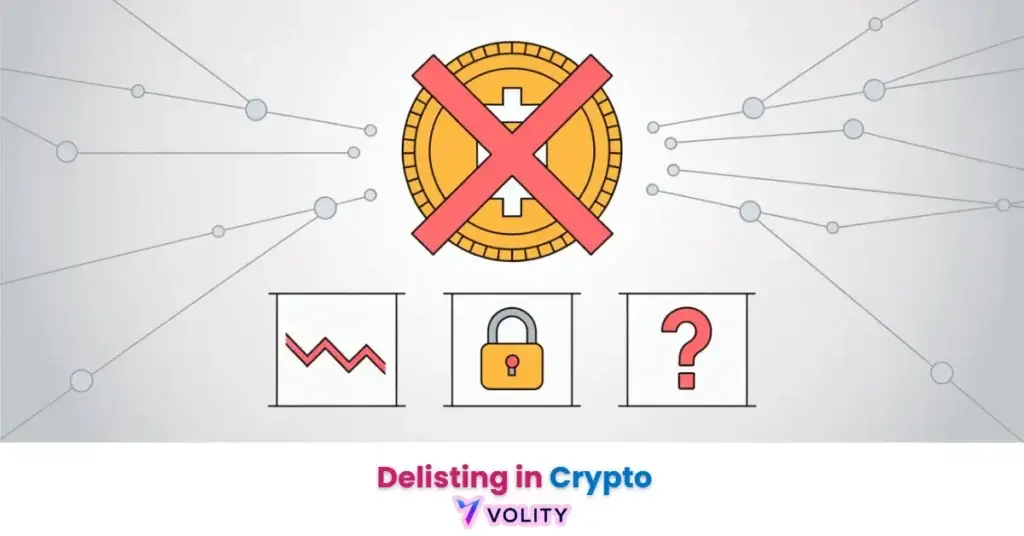
Delisting is the removal of a cryptocurrency from a trading platform due to failure to meet volume, security, or regulatory standards. A delisting removes the venue that carried most of a token price discovery, so the practical response is to move the asset to a non-custodial wallet inside the stated withdrawal window rather than to wait for a price recovery.
While understanding Delisting Crypto is important, applying that knowledge is where the real growth happens. Create Your Free Crypto Trading Account to practice with a free demo account and put your strategy to the test.
Delisting reveals a rigorous filtering process where exchanges remove assets to maintain market quality and user safety. Binance ran two spot delisting waves in April 2026, removing 14 tokens in total from its spot trading platform, alongside separate perpetual contract terminations.
Success in navigating these events requires rapid response to exchange alerts and an understanding of the 12-day average withdrawal window. This guide identifies the primary triggers for removal, the 2026 regulatory context, and the recovery options for affected holders.
What is delisting in crypto and how does it occur?
Delisting is the process of removing a cryptocurrency and its associated trading pairs from a centralized exchange interface due to non-compliance or poor performance. The delisting lifecycle involves multiple stages. Exchanges first announce a review period during which assets must meet specific benchmarks. Following the announcement, trading halts for the affected pairs, preventing any new positions from opening. Finally, a withdrawal deadline, typically 12 days to 3 months, allows holders to transfer their holdings to non-custodial wallets. Spot delistings differ markedly from perpetual contract terminations, where positions face automatic settlement at a marked price rather than gentle closure windows.
The process reflects how centralized platforms self-regulate to maintain listing standards. Voluntary delistings, where a project team requests removal to migrate a token or wind a product down, differ from involuntary removals triggered by a compliance or liquidity failure, and the withdrawal mechanics are the same in both cases.
Ready to Elevate Your Trading?
You have the information. Now, get the platform. Join thousands of successful traders who use Volity for its powerful tools, fast execution, and dedicated support.
Create Your Account in Under 3 MinutesWhy do crypto exchanges delist tokens in 2026?
Crypto exchanges delist tokens when assets fail to maintain minimum liquidity benchmarks, network security standards, or regional regulatory compliance. Low liquidity is a primary housekeeping criterion; tokens generating zero trading volume become operational liabilities for exchange infrastructure. In April 2026 Binance removed eight assets from spot trading on 1 April, including Arena-Z (A2Z), Ampleforth Governance Token (FORTH), Hooked Protocol (HOOK), IDEX, Loopring (LRC), Neutron (NTRN), Radiant Capital (RDNT) and Solar (SXP), and six more on 23 April: Beefy.Finance (BIFI), FIO Protocol (FIO), FunToken (FUN), Measurable Data Token (MDT), Orchid (OXT) and Wanchain (WAN). The stated reason in both cases was the exchange periodic review. The EU’s MiCA (Markets in Crypto-Assets) regulation introduced new compliance pressure in 2026, forcing exchanges to remove stablecoins and hybrid protocols that failed to meet reserve segregation and transparency rules.
Network stability concerns also drive delisting decisions. Tokens with historical 51% attack vulnerabilities or abandoned development, such as Solar (SXP) in April 2026, become regulatory and reputational risks for exchanges. KYC and AML compliance standards now enforce stricter customer identity verification, pushing exchanges to remove assets that cannot be adequately linked to verified transaction histories.
Binance Periodic Review and Delisting Announcements serves as the official source for current delisting waves and withdrawal deadlines.
What happens when a coin is delisted from a major exchange?
Delisting from a major exchange triggers a sharp reduction in market visibility and a corresponding collapse in trading liquidity and asset price. Tokens caught in the April 2026 Binance waves fell by double digits within 24 hours of the notice as retail and institutional capital left the venue. The loss of primary trading pairs, particularly BTC/USDT and ETH/USDT, forces remaining holders into OTC (over-the-counter) or peer-to-peer markets, where price discovery becomes opaque and slippage multiplies.
The withdrawal window represents the critical survival period for holders. Exchanges typically provide 12 days to move funds to private wallets before permanently closing deposit and withdrawal infrastructure for that token. Missing this deadline often results in permanent loss of access, as the exchange ceases customer support and closes associated wallet contracts.
Real trading example:
A FunToken (FUN) holder who stayed in the position after the 23 April 2026 Binance removal faced a token that fell with the rest of that wave, in a 20 to 25 percent band over 24 hours, while order book depth thinned. Withdrawing to an Ethereum wallet during the notice window also carried network fees. Past performance is not indicative of future results.
Rug Pull avoidance and exit scams explains how to identify warning signals before delistings occur.
How does delisting affect price and liquidity?
Delisting affects price by removing the primary gateway for institutional and retail capital, which concentrates selling into a thinner book. Volume falls away in the first 24 hours and spreads widen sharply as market makers step back from a pair they can no longer hedge on the venue, so sellers who wait are the ones who pay for it.
Exchange contagion amplifies this effect. When Binance delists a token, secondary exchanges often follow within days, on the reasoning that if the largest venue rejected an asset then the same regulatory or security concern applies to them. Market capitalization keeps falling while the remaining venues withdraw, and where a token stabilises depends entirely on whether any real liquidity is left behind it.
Slippage in crypto and execution risk details how reduced liquidity multiplies execution costs and creates timing risk for withdrawals.
Can a delisted token be re-listed or traded elsewhere?
A delisted token can be traded on decentralized exchanges (DEXs) or re-listed on centralized platforms if the project fixes its underlying security or compliance failures. Most ERC-20 tokens delisted from centralized exchanges retain trading capability on Uniswap, PancakeSwap, and Jupiter as long as community-provided liquidity pools exist. Relisting on a tier one exchange requires resolving the original failure, whether that is a regulatory settlement, MiCA authorisation, or completing a network upgrade.
Re-listing is exceptionally rare. The reasons are regulatory entanglement, loss of market confidence after the announcement, and exchange priorities shifting toward newer assets. ESMA: Markets in Crypto-Assets Regulation (MiCA) sets out the authorisation regime a venue and an issuer have to satisfy in the EU.
DEX decentralized exchange alternatives explains how to migrate from centralized exchanges to DEXs and navigate liquidity limitations.
April 2026 Binance Delisting Wave (EAV Table)
Binance delisting benchmarks reveal the specific assets removed during the 2026 Q2 market quality review. The April delisting wave targeted low-volume and non-compliant assets, signaling stricter exchange standards moving into mid-2026.
| Entity | Delisting Date | Reason Cited | 24h Price Change |
| Loopring (LRC) | April 1, 2026 | Periodic review | About -10% in 24h |
| IDEX (IDEX) | April 1, 2026 | Periodic review | Double-digit decline in 24h |
| Beefy.Finance (BIFI) | April 23, 2026 | Periodic review | About -32% in 24h, the largest fall of the wave |
| FunToken (FUN) | April 23, 2026 | Periodic review | In a 20-25% band in 24h |
| DEGENUSDT | April 2026 | Perpetual termination | Settled at the mark price |
Delisting dates and asset lists from the Binance periodic review announcements of 18 March and April 2026; 24-hour price moves as reported at the time.
Turn Knowledge into Profit
You have done the reading, now it is time to act. The best way to learn is by doing. Open a free, no-risk demo account and practice your strategy with virtual funds today.
Open a Free Demo AccountKey Takeaways
- Delisting is the permanent removal of a cryptocurrency from an exchange due to failure to meet technical, financial, or legal standards.
- Binance removed 14 tokens from spot trading across two April 2026 waves, on 1 April and 23 April, under its periodic review.
- Delisted tokens fall sharply on the notice; in the April 2026 Binance waves the moves ran from about 10 percent to about 32 percent in 24 hours.
- The EU’s MiCA regulation is a new primary driver for 2026 delistings as exchanges remove non-compliant stablecoins and hybrid protocols.
- Holders are usually granted a 12-day window to withdraw assets to a non-custodial wallet before trading is permanently halted.
- Trading remains possible on decentralized exchanges (DEXs) for most delisted ERC-20 tokens, though liquidity is significantly lower.
Frequently Asked Questions
This article contains references to Delisting and Volity, a regulated CFD trading platform. This content is produced for educational purposes only and does not constitute financial advice or a recommendation to buy or sell any financial instrument. Always verify current regulatory status and platform details before using any trading service. Some links in this article may be affiliate links.
What our analysts watch: Delistings are rarely a surprise; they are usually the last step in a slow signal chain. We watch three leading indicators on every position. Drop in 30-day average volume below liquidity thresholds, exchange-issued monitoring or warning labels, and inability of the project team to respond on disclosure questions within 14 days. When two of three trigger, we exit before the formal notice.