Investing in financial products involves risk. Losses may exceed the value of your original investment.
The Crypto Trading Starter Kit
A plain-English PDF: what to check before you trade, how orders and risk really work, and the mistakes to skip. Get it free.
Quick answer
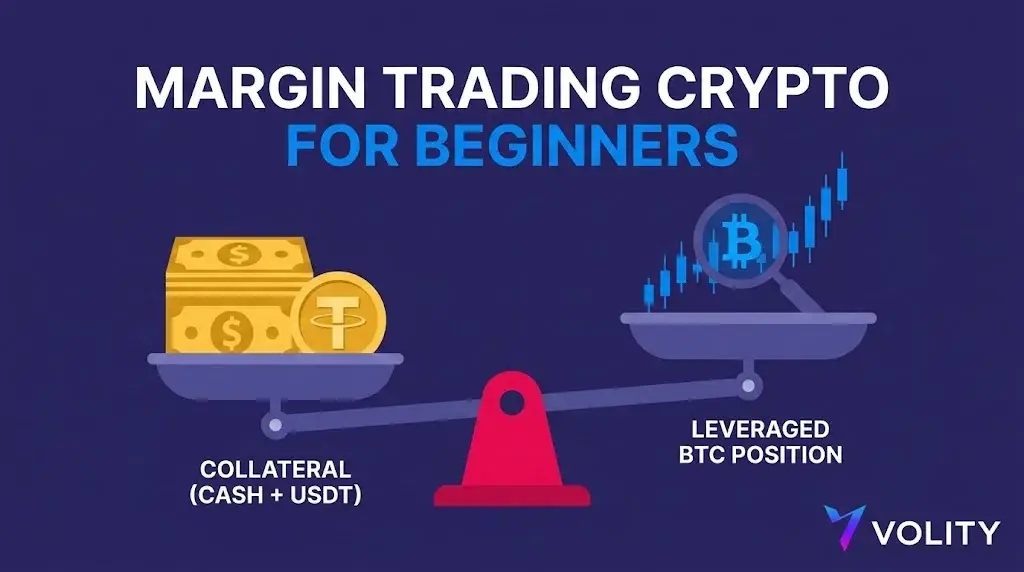
Margin and leverage in crypto are related but not the same: margin is the collateral you post, leverage is the multiple it controls. Post $1,000 of margin at 10x leverage and you control a $10,000 position. Confusing the two is what blows up beginner accounts. For how borrowed positions are maintained and liquidated, see crypto margin trading mechanics; for how high the multiple can safely go, see crypto leverage trading.
Margin trading crypto is the practice of putting up part of a position as collateral and borrowing the rest from the broker. The position works on the full notional; the cash you posted is the buffer between you and a margin call. For retail clients in the EEA, the maximum leverage on cryptoassets is 1:2 under ESMA product-intervention measures, which means the buffer is exactly half the notional. That tight cap is not a bug; it is what keeps a normal weekly drawdown from becoming a forced exit.
How margin works in practice
Three numbers. Internalise them before you fund.
- Initial margin: the cash to open. 50% of notional at 1:2.
- Maintenance margin: the equity floor. Typically 25% on retail crypto.
- Free margin: equity above maintenance. This is what you have left to absorb adverse moves and to open new positions.
Walk-through: BTC at $60,000, you go long $4,000 of notional at 1:2. Initial margin: $2,000. Maintenance threshold: $1,000. If BTC falls 25% to $45,000, your equity falls to $1,000 and you are on a margin call. Below that, the platform begins closing positions to protect both you and the broker. Negative balance protection on retail accounts means your loss is capped at the $2,000 you posted.
What is the difference between margin trading and leverage trading?
In retail crypto the terms are interchangeable. Margin is the cash you post; leverage is the multiplier on your exposure. Saying “1:2 leverage” and “50% margin” describes the same position. Where the words diverge is in institutional language: “margin” can also refer to the line of credit a prime broker extends, while “leverage” describes the resulting exposure ratio. For a retail desk, focus on the ratio and the equity floor.
What are the EEA caps?
- Cryptoassets: 1:2
- Major FX: 1:30
- Non-major FX, major indices, gold: 1:20
- Other commodities, non-major equity indices: 1:10
- Individual equities: 1:5
Professional clients on request who meet MiFID II suitability criteria can access higher leverage. Retail caps are firm. Anything advertising 1:100 or 1:500 retail crypto leverage in the EEA is offshore.
How do you size a margin trade?
Position size is dictated by the stop, not by available margin. The framework we run on the desk:
- Define the stop in price terms. Just beyond the recent swing low for a long, recent swing high for a short.
- Calculate dollar risk. (Entry minus stop) multiplied by units.
- Cap dollar risk at 1% of account equity. On a $10,000 account, that is $100.
- Solve for units. Units = $100 / (entry minus stop).
Concrete: ETH entry $3,400, stop $3,300, distance $100. On a $10,000 account at 1% risk, position size is 1.0 ETH ($3,400 notional). At 1:2 that requires $1,700 margin. Plenty of headroom for the next trade.
What does it cost to hold?
- Spread. 1-3 bp on BTC/USD majors, wider on alts.
- Overnight financing. Charged daily on the borrowed portion. Visible per symbol.
- Slippage on stops. In fast moves, expect 5-15 bp slippage from advertised price.
When does margin make sense?
Two clear cases. Short-duration directional trades where the carry cost is small. Hedging a spot crypto holding by shorting an equivalent notional on margin to neutralise short-term downside. Anything else is usually a leverage problem dressed as an opportunity.
What goes wrong
- Sizing by margin not by risk. “I have $2,000 free margin, so I’ll use it all” ignores the stop. Account-killer.
- No pre-set stop. A margin position without a hard exit is a position the market controls.
- Holding through binary events. ETF approvals, exchange exploits, exchange-rate freezes. The price gap is bigger than your stop band.
- Cross-margin contamination. Multiple positions sharing a margin pool: one losing trade can liquidate a winning one. Use isolated margin while you build experience.
Margin trading crypto at Volity
Volity offers leveraged crypto CFD exposure on 20+ coins. Retail leverage is capped at 1:2 (ESMA). Professional clients on request may access higher leverage subject to a MiFID II suitability assessment. Negative balance protection applies on retail accounts. Eligible retail clients of UBK Markets are covered by the Cyprus Investor Compensation Fund up to EUR 20,000 per client per firm. Execution is by UBK Markets Ltd (CySEC 186/12).
Volity operates a trading platform and also publishes educational and analytical content about trading. The content on this page is for educational purposes only and should not be considered financial advice. Volity may benefit commercially when readers open trading accounts through links on this site.
Our content is produced and reviewed under documented editorial standards; see our comparison and review methodology.