Trading NFP requires extreme discipline. Chasing the initial spike before digesting wage and revision data is the most common way to lose on the release. Spread expansion during the first 90 seconds destroys risk-reward ratios; a tight stop becomes worthless once the spread widens into it. Algorithmic “Spike & Reverse” patterns can whipsaw retail traders who anchor to the headline move, triggering stops before the true reversal executes. Gold’s expanded range around the release calls for a substantial reduction in position size, but many traders keep normal lot sizes and are wiped out by an ordinary move. Market reversals can occur after prior-month revisions completely negate strong headline numbers, trapping aggressive traders who entered before all components were digested. Past performance is not indicative of future results. Capital at risk.
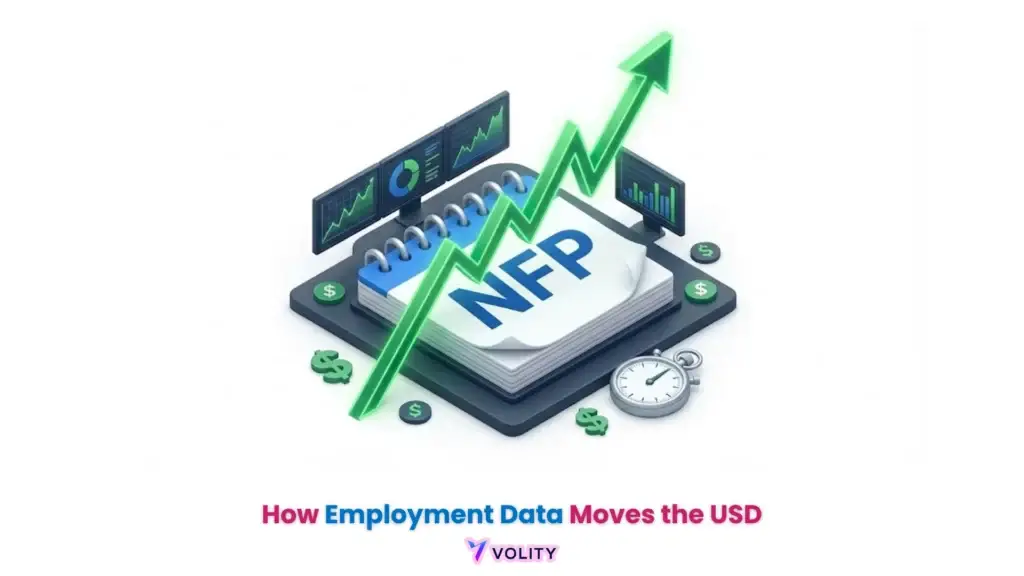
The Non-Farm Payrolls (NFP) report is a high-impact US employment indicator released on the first Friday of every month. In 2026, it remains the primary driver of monthly volatility, routinely producing several times the normal half-hour range in Gold and the major dollar pairs. Successful NFP trading requires filtering the initial headline spike and waiting for the market to digest Average Hourly Earnings and prior-month revisions before executing directional setups.
Non-Farm Payrolls (NFP) trading functions as the ultimate test of a trader’s discipline and execution speed. This high-impact event summarizes the net change in US employment, excluding farm and government workers, and serves as a primary barometer for global economic health. In the 2026 market, it remains the “King of Economic Data” for both retail and institutional participants.
Traders navigate wider spreads and heavy algorithmic competition around the release by focusing on the multi-component report rather than the surface headline number.
While understanding Trading Non-Farm Payrolls (NFP) is important, applying that knowledge is where the real growth happens. Create Your Free Forex Trading Account to practice with a free demo account and put your strategy to the test.
What is NFP and why does it drive extreme market volatility?
Non-Farm Payrolls is a monthly employment report issued by the US Bureau of Labor Statistics as part of the Employment Situation release, and it measures the net change in paid workers excluding farm, government and a few other categories. The report quantifies how many jobs were added or lost in the prior month, excluding agricultural and government sectors.
- The four core metrics: Headline NFP (net jobs added), Unemployment Rate (percentage of workforce without jobs), Average Hourly Earnings (wage inflation proxy), and Participation Rate (percentage of population in workforce)
- Release schedule: the report is published at 8:30 a.m. Eastern Time on the third Friday after the reference week ends, which usually but not always falls on the first Friday of the month, landing in the London to New York liquidity overlap
- Market Liquidity: Major USD pairs see spreads widen sharply during the first sixty seconds as orders hit market makers simultaneously, which is the single biggest hidden cost of trading the release
Turnover concentrates sharply into the release window, and that concentration is what creates both the opportunity for disciplined traders and the risk for accounts that trade the first ninety seconds. For scale, the foreign exchange market turns over trillions of dollars per day in total, and a data release pulls a disproportionate share of that into a few minutes.
The “Spike & Reverse” Algorithmic Pattern
Algorithmic front-running identifies the 2026 trend where an initial headline-driven spike is immediately reversed once the wage and participation data are digested. Automated systems parse the release and act on it far faster than a person can read it, which is what creates the appearance of conviction in the first print.
The identifying of the “fakeout” move in the first 90 seconds reveals a pattern where headline beats trigger USD strength that reverses within 5 minutes as wage growth disappointments emerge. Fast execution concentrates around the print, and clusters of resting stops just outside the pre-release range are the obvious place for that flow to go.
Ready to Elevate Your Trading?
You have the information. Now, get the platform. Join thousands of successful traders who use Volity for its powerful tools, fast execution, and dedicated support.
Create Your Account in Under 3 MinutesAsset-Specific Volatility: EUR/USD and Gold in 2026
EUR/USD and Gold (XAU/USD) represent the two primary instruments for capturing the directional momentum triggered by NFP data. These assets show asymmetric volatility profiles that require different position sizing and execution approaches.
EUR/USD typically travels a multiple of its normal half-hour range in the thirty minutes after the release, with stronger-than-expected employment growth pushing the dollar higher and weakening EUR/USD. Gold moves further still in percentage terms as investors reassess real interest rate expectations. Measure both against the instrument’s current Average True Range on the day rather than against a fixed pip figure, because the range itself changes from month to month. USD/JPY sensitivity peaks when the NFP surprise diverges from market expectations about the Fed’s next rate-hike decision, as this directly impacts the interest rate differential between the Federal Reserve and Bank of Japan.
Gold reacts to NFP through the real interest rate channel rather than through the jobs number itself, so the largest moves tend to come when a surprise lands while other conditions are already stressed. That combination, rather than the release in isolation, is what produces an outsized day.
Market Volatility frameworks teach that external shocks (like geopolitical events) combined with high-impact economic data can trigger volatility that exceeds historical norms.
Wait 3–5 minutes after the 13:30 UTC release before entering any trade; this allows spreads to compress from their 5–10 pip peak back to normal levels and filters out the initial algorithmic “fakeout” spike.
Three Professional NFP Trading Strategies for 2026
Successful NFP trading playbooks identify the “Wait and Confirm” method as the most robust strategy for retail participants. Three distinct approaches cater to different risk tolerances and execution capabilities.
The Fade (Contrarian) strategy trades against the initial 1-minute spike if the secondary metrics (wages) contradict the headline, capturing reversals as the market realizes the true employment picture conflicts with first-reaction sentiment. The Post-Release Trend strategy enters after 15 minutes once the post-flow trend has stabilized, allowing algorithmic noise to subside before committing capital. The Straddle (Volatility Play) places buy and sell stops outside the pre-release range, profiting from large intraday ranges but accepting high slippage risk.
Worked example of the fade: a headline that beats consensus lifts the dollar on the first print, but the wage component within the same release comes in soft. A trader applying the fade waits for price to break back through the pre-release level and takes the reversal, on the reasoning that the rate expectation, not the job count, is what the dollar is actually pricing. This is an illustration of the rule, not a record of a specific release. Past performance is not indicative of future results. This example demonstrates how secondary data components often override headline impact in determining the true market direction.
WARNING: Never trade NFP with a “fixed” pip stop-loss in 2026; due to the expanded volatility of assets like Gold (XAU/USD), stops must be calibrated using the 15-minute Average True Range (ATR) to avoid being swept by noise.
Common Mistakes: Why NFP Traders Lose Money in 2026
Statistical analysis of NFP trading identifies that over-leveraging and tight stop-losses are the primary causes of retail account wipeouts. Professional risk management requires position sizing reductions during NFP windows, but the allure of high volatility often overrides prudent position management.
| Release Phase | Volatility (Gold, vs its own daily range) | Spread Expansion | Recommended Action |
| Pre-Release | Baseline range | Normal | Flat / No Trade |
| 0-2 Mins | Peak range of the session | At its widest | Avoid Execution |
| 5-15 Mins | Elevated, decaying | Normalizing | Setup Identification |
| 30-60 Mins | Elevated, directional | Normal | Trend Following |
| Post-Session | Returning to baseline | Normal | Take Profit / Exit |
The phases above describe the shape of a typical release, not measured amounts. Size each phase against the instrument’s Average True Range on the day, because the absolute range differs from month to month.
The 0-2 minute window represents a “no-trade zone” where spreads peak and algorithmic bots dominate execution, making human traders at a severe disadvantage. The 5-15 minute window is where professional setups form once the initial shock has dissipated and traders can assess whether the headline surprise was supported or contradicted by wage and participation data.
💡 KEY INSIGHT: In 2026, “Average Hourly Earnings” and “Prior-Month Revisions” are more significant for US Dollar direction than the headline job number, as they directly influence the Federal Reserve’s inflation and rate-hike expectations.
Turn Knowledge into Profit
You have done the reading, now it is time to act. The best way to learn is by doing. Open a free, no-risk demo account and practice your strategy with virtual funds today.
Open a Free Demo AccountWhy does the market sometimes ignore a strong NFP headline?
Component divergence identifies the market regime where strong job growth is overshadowed by weak inflationary wage data or downward prior-month revisions. A strong headline NFP number becomes irrelevant if simultaneously released wage data shows deflation or if the prior month was revised downward by 100+ thousands of jobs.
The “Priced In” effect explains why markets sometimes ignore positive data, if financial markets have already rallied in anticipation of a strong beat during the pre-release trading period, the release triggers profit-taking rather than continuation buying. Fed Policy Drift reveals that NFP matters less when the Fed has explicitly stated they are currently focused on CPI inflation rather than employment growth. Participation Rate dynamics show that a falling unemployment rate can be “bearish” if the participation drop suggests workers are leaving the labor force rather than finding employment, this forces policymakers to reassess whether the economy is truly strong.
Fundamental Analysis frameworks teach that no single data point drives markets in isolation; instead, all components must align for a sustained directional move.
Risk Management: Surviving the First Friday
NFP risk management means cutting position size substantially to account for the increase in average true range around the release. Many retail traders fail to adjust position size during news events, maintaining their standard lots and getting destroyed when volatility spikes.
Managing slippage means accepting that a market order in the release window can fill well away from the quoted price, turning a profitable setup into an immediate loss. Spread awareness matters because widening eats the stop from the inside: the distance to your stop shrinks by the extra spread while the target stays where it was, which silently worsens the risk-to-reward ratio you thought you had entered.
Risk Management in Trading practices should always include position sizing reductions during high-impact news windows. Forex Trading for Beginners education emphasizes that NFP trading should be optional, only participate if conditions are ideal and discipline is unshakeable.
Key Takeaways
- Trading Non-Farm Payrolls (NFP) is a high-impact news strategy that requires navigating extreme volatility and wide spreads in the forex and gold markets.
- Average Hourly Earnings are often the true driver of US Dollar direction in 2026, as they provide the clearest signal for future Fed interest rate decisions.
- EUR/USD and Gold both travel a multiple of their normal half-hour range after the release; measure it against the instrument’s current Average True Range rather than a fixed pip count.
- Wait and Confirm is the standard professional playbook, advising traders to wait 3–5 minutes for spreads to normalize and the initial “fakeout” to clear.
- Prior-month revisions can completely neutralize a strong headline number, leading to counter-intuitive market reactions that trap aggressive retail traders.
- Risk management during NFP involves reducing position sizes and utilizing ATR-based stops to survive the expanded range of the 13:30 UTC window.
Frequently Asked Questions
This article contains references to Trading Non-Farm Payrolls (NFP), US economic data, and Volity, a regulated CFD trading platform. This content is produced for educational purposes only and does not constitute financial advice or a recommendation to buy or sell any financial instrument. Always verify current regulatory status and platform details before using any trading service. Some links in this article may be affiliate links.