Investing in financial products involves risk. Losses may exceed the value of your original investment.
Bitcoin coinbase listings is a core topic for traders in 2026. The complete guide follows.
Crypto markets shrug off Fed fog as Coinbase targets DAI and exploits resurface
Crypto tried to look busy on a quiet macro tape, and mostly managed it. Bitcoin held near $75,000 after the Federal Reserve stood pat, even as technical traders pointed to fading momentum. Meanwhile, Coinbase said it will delist DAI in May, a decision that nudged stablecoin plumbing into the spotlight. Elsewhere, a Wasabi Protocol exploit and fresh scam disclosures reminded markets that, in crypto, operational risk still trades like a macro factor.
The mood felt classic late cycle: spot prices resilient, derivatives cautious, headlines noisy. However, the next shove could come from outside the sector. US mega cap earnings, geopolitics and rate expectations still decide whether traders pay up for risk, or trim and run.
Bitcoin holds the line, but the tape looks tired
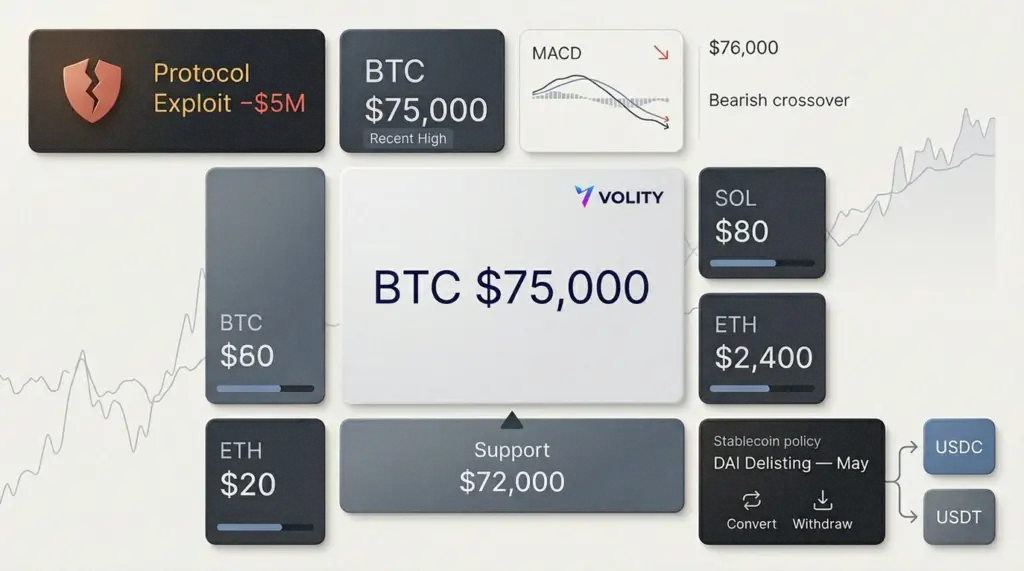
Bitcoin slipped after the FOMC and then stabilised, hovering around $75,000 with a choppy intraday profile. Technicians flagged a bearish daily MACD crossover near $76,000, and some desks talked openly about a pullback toward $72,000 if support gives way. Meanwhile, prediction markets clustered around $75,000 as the month end magnet, with high implied confidence.
Order flow also looked less friendly than the price suggested. Reports of elevated whale selling on Binance sat awkwardly beside flat to muted funding, which often signals a rally running on spot bids rather than leveraged follow through. Any wobble in equities can translate quickly into crypto de risking.
Geopolitics sat in the background, while US tech earnings loomed in the foreground. Alphabet and Meta results can swing Nasdaq futures, and crypto has lately shadowed that move tick for tick.
Coinbase puts DAI on the clock, and stablecoins take centre stage
Coinbase’s plan to delist DAI in May landed as the day’s most practical headline. Users face a simple choice: convert, withdraw, or get caught in the churn. However, the larger issue is what happens when major venues tighten listing standards for stablecoins that sit outside the most straightforward reserve frameworks.
Regulators also kept circling the category. Australia floated draft work on stablecoin interoperability for payments, while US lawmakers continued to spar over how yield bearing designs should be treated. Meanwhile, payments pilots kept multiplying, with Solana linked to South Korea’s Shinhan Card for stablecoin testing and Meta reported to be exploring stablecoin rails for creator payouts using USDC on Solana and Polygon.
In Hong Kong, officials warned about counterfeit stablecoins tied to the names of licensed issuers. That, too, is a quiet reminder that branding risk grows as stablecoins edge closer to everyday payments.
Altcoins wobble as hacks return to the front page
Solana traded heavily, with technicians watching $80 as the level that matters. A break below it would fit the rounded top chatter making the rounds on crypto desks, and would likely pull correlated names with it. Ethereum looked stuck as well, leaning on $2,400 as resistance while traders debated whether the next clean stop sits below $2,000.
The market also absorbed another security gut punch. Wasabi Protocol disclosed a multi chain exploit that drained more than $5 million, while Meteora cited a $1.5 million OTC scam loss in the first quarter. Meanwhile, US enforcement headlines mixed deterrence with spectacle, including a federal crackdown on pig butchering networks and a seizure of nearly $500 million in Iranian linked crypto assets.
These events rarely change long term narratives. However, they do change short term positioning. Traders widen spreads, market makers pull size, and marginal buyers demand a discount.
Rush of launches and expansion plans, even as risk appetite flickers
Corporate momentum did not slow. Ripple opened a Dubai headquarters and said it will expand its Middle East and Africa staffing. Filings tied to the New York Stock Exchange framed XRP as an eligible commodity trust asset, and Ripple’s stablecoin push kept racking up settlement figures, with $59 million cited on XRPL at low fees.
Elsewhere, token launches and AI themed payments talk filled the calendar. OKX pushed “agent” payment tools, while BNB Chain touted a large count of on chain AI agents. The industry continues to sell the next productivity story, even when liquidity feels fragile.
By the numbers
- Bitcoin near $75,000; bearish MACD crossover flagged near $76,000.
- Downside level cited by traders: $72,000 if support breaks.
- DAI delisting at Coinbase: May deadline to convert or withdraw.
- Wasabi Protocol exploit: more than $5 million drained.
- April crypto market cap: about $2.7 trillion, up roughly 10%.
Key takeaways
- Bitcoin is holding spot levels, yet flat funding suggests limited leverage support.
- Coinbase’s DAI decision may widen stablecoin spreads and shift flow towards USDC and USDT pairs.
- Watch $80 on SOL and $2,400 on ETH as near term risk gauges for alt beta.
- Exploit headlines can trigger liquidity pullbacks faster than macro news on slow days.
- Tech earnings and rate expectations still dominate the risk calendar, and crypto remains correlated.
Crypto entered the day with a macro excuse to sell and ended it with mostly sector specific reasons to hesitate. Meanwhile, April’s rebound, helped by ETF inflows and big corporate buying, still sits in the background as support. However, in the near term, stablecoin policy, exchange listings and security failures may set the tone as much as any central banker.
For more on this topic see our deep-dives on Bitcoin at $90K: Crypto Market Risks and Investment Strategies, Bitcoin Price and Multi-Billion Options Expiries: What to Watch, and Bitcoin ETF Inflows Lift BTC While Pi Network Turns Bearish.
What our analysts watch: Three reads turn the operational-risk tape into a position thesis. The funding-versus-spot divergence (flat-to-muted derivatives funding alongside spot resilience near 75,000 dollars is the diagnostic that the rally has a thinner leverage layer than headline price suggests; the resolution typically comes through either a leverage rebuild that extends the rally or a spot capitulation that compresses the technical floor toward the 72,000 dollar level the desks have flagged).
The stablecoin listing-standard cascade (Coinbase tightening listings around DAI is the leading edge of a broader category-wide compression that favours USDC and USDT pairs in spread terms; the second-order effect is that liquidity in DAI-denominated DeFi pools widens, which raises slippage costs and compresses the protocol revenue line). The exploit-driven liquidity pullback pattern (Wasabi-class incidents do not change long-term narratives but they trigger market-maker size pullbacks and wider spreads on the day of disclosure; the disciplined trader treats the disclosure window as a 24-to-48-hour spread-cost spike rather than a thesis-changing event).
The ESMA investor protection tracks the U.S. enforcement context that frames cross-jurisdictional operational risk, the FATF virtual asset standards document the AML and counterparty framework that anchors venue-level compliance reads, and the CoinDesk live market coverage tracks the listing and exploit cycle. Volity offers BTC, ETH, and stablecoin pair CFD execution under CySEC oversight via UBK Markets (licence 186/12), with entities in Saint Lucia and Cyprus.
Frequently asked questions
Why does flat funding matter when spot price is holding near 75,000 dollars?
Because flat-to-muted funding indicates that perpetual-futures positioning is not adding leverage on the way up, which is the diagnostic that the marginal buyer is the spot allocator rather than the leveraged trader. The structural read is constructive for the multi-week thesis (spot-led rallies tend to absorb shocks better than leverage-led rallies) but cautious for short-duration price momentum (the absence of leverage compression that drives breakout dynamics is the same factor that capped the rally below the 79,000 dollar trigger). The disciplined position-sizing response is to fade leverage-driven entries at the 75,000 dollar level and to weight spot exposure for the multi-week horizon rather than chasing intraday breakouts.
What does the Coinbase DAI delist mean for traders running stablecoin pair strategies?
It means that the cost-of-execution differential between DAI pairs and USDC or USDT pairs widens during the May transition window, with the structural effect that DAI-denominated DeFi pools and CeFi pairs become marginally more expensive to trade. The right tactic is to migrate the active book to USDC and USDT pairs ahead of the deadline, to avoid the spread-cost spike that typically accompanies the final week before a major venue delist. The longer-term read is that listing standards across major U.S.-licensed venues are converging toward a USDC-and-USDT default, which compresses the optionality that DAI offered as a third-stablecoin hedge.
How should traders read the Wasabi Protocol exploit against the broader DeFi risk tape?
The right framing is that the exploit is a 24-to-48-hour positioning event rather than a thesis-changing factor for the broader DeFi category. The historical pattern is that exploit disclosures trigger immediate market-maker pullbacks (wider spreads, smaller size) and a temporary risk-off rotation across DeFi tokens, with the price impact typically clearing within one to two weeks unless the protocol-level damage compresses TVL permanently. The disciplined response is to widen stops on DeFi-token positions during the disclosure window and to treat the spread-cost spike as a short-term tax on execution rather than as a signal to abandon the position.
Does the 75,000 dollar prediction-market clustering function as resistance or as a magnet?
It functions as a magnet rather than as resistance, which is the technical distinction that matters for trade sizing. Prediction-market clustering reflects the consensus expectation rather than the order-book pressure, and the pattern that emerges around magnet levels is range-bound oscillation with low realised volatility until a confirmation catalyst breaks the cluster. The right tactic is to fade extension moves away from the cluster (sell rallies above 76,000 dollars and buy dips below 74,000 dollars) until a tape-level catalyst (FOMC, U.S. tech earnings, ETF flow shift) breaks the magnet structurally. Treating the cluster as resistance leads to whipsaw losses; treating it as a magnet inside a defined range produces the better risk-adjusted outcome.
Related guides
- Bitcoin explained
- Cryptocurrency trading
- Crypto trading platforms
- Best crypto investments
- Risk management
Volity operates a trading platform and also publishes educational and analytical content about trading. The content on this page is for educational purposes only and should not be considered financial advice. Volity may benefit commercially when readers open trading accounts through links on this site.
Our content is produced and reviewed under documented editorial standards; see our comparison and review methodology.