Investing in financial products involves risk. Losses may exceed the value of your original investment.
Etfs stablecoins reshape is a core topic for traders in 2026. The complete guide follows.
The crypto market at a crossroads: institutions arrive, stablecoins reshape payments, regulation tightens
Crypto is losing its casino lighting. As April closes, the market looks less like a mood swing and more like an infrastructure story.
Bitcoin sits near $78,000 and Ether around $2,300. However, the more telling move sits off the chart.
Big balance sheets now buy dips with the patience of bond managers.
Bitcoin’s institutional second act
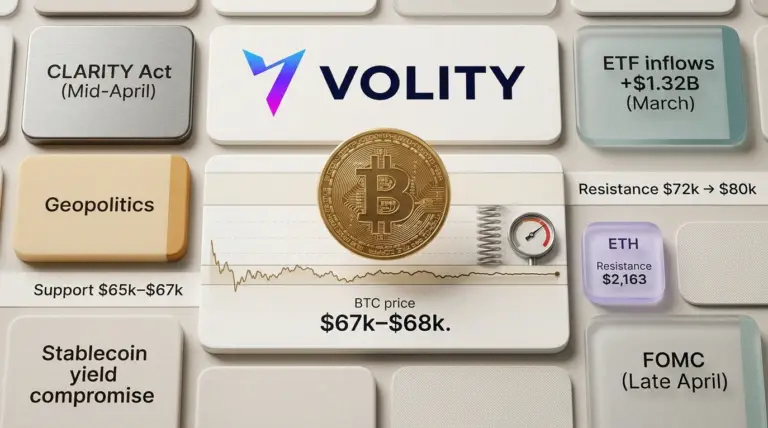
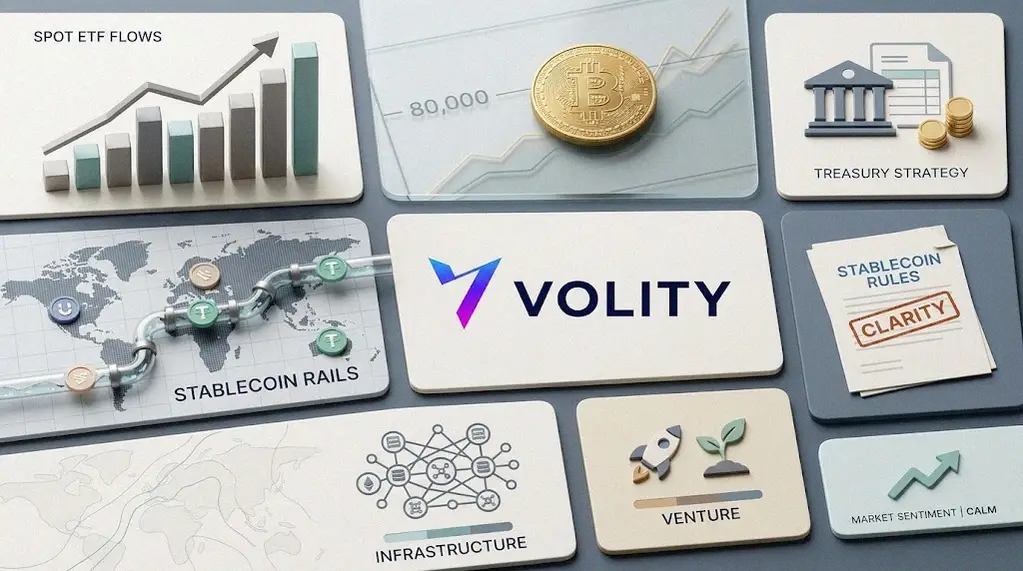
Spot Bitcoin ETFs have re-opened the on-ramp for cautious capital. Pullbacks now read as allocation windows, not exit alarms. The next psychological test is simple. If Bitcoin holds above $80,000, systematic buyers may lean in and drag the complex higher.
Meanwhile, MicroStrategy again played the role of corporate bellwether. It bought 34,164 BTC for about $2.54 billion, at an average of $74,395. The firm flagged a 9.5% year-to-date Bitcoin yield. That language matters, because it treats Bitcoin as a treasury programme, not a punt.
BlackRock’s dominance inside the ETF pipe also changes the feel of flows. If one allocator absorbs most inflows, liquidity becomes steadier, yet sentiment can narrow. In other words, Bitcoin looks more “macro” each week, but it also becomes more sensitive to risk-parity rebalancing and rate expectations.
Ethereum holds ground, yet stablecoins steal the plot
Ether has shown a kind of stubbornness around $2,300. However, watchers noticed the Ethereum Foundation unstaked roughly $48 million of ETH. It may prove mundane treasury management. Still, in a market obsessed with supply stories, any visible liquidity shift invites front-running and second-guessing.
Meanwhile, stablecoins have moved from “crypto plumbing” to payment rails with real corporate logos attached. DoorDash is now using stablecoin rails to pay drivers and merchants across more than 40 countries. That is not a meme trade. It is a distribution deal for blockchains.
Wall Street’s posture has also shifted. Morgan Stanley has launched a fund aimed at stablecoin issuers.
JPMorgan has said tokenisation will reshape the funds industry. The argument is no longer whether stablecoins “matter”.
The argument is who controls the rails, who earns the spread, and who carries the compliance burden.
Altcoins sort into utilities and venture bets
As the market matures, the altcoin universe is beginning to rank itself by usefulness. Hype still prints candles. However, infrastructure keeps the bid.
- Solana (SOL) keeps its place as a high-throughput venue with deep liquidity and active builders.
- XRP stays in the payments conversation, helped by new institutional tooling and Ripple’s roadmap to make XRPL quantum-resistant by 2028.
- BNB Chain has become a hotspot for AI-agent activity, with reported growth that looks almost comic on a chart.
- TRON (TRX) remains a workhorse for stablecoin circulation.
- Chainlink (LINK) benefits from tokenisation chatter, including its selection in plans to tokenise $11 billion in real-world securities.
However, this hierarchy has a dark mirror. The more projects market themselves as “financial infrastructure”, the less tolerance investors have for outages, exploits, or governance drama.
Washington tightens the frame
Regulation is shifting from speeches to sentence structure. The proposed CLARITY Act has become the focal point, with more than 100 crypto firms pressing the Senate to act. Mike Novogratz has suggested a May passage window. If lawmakers deliver workable definitions around staking, airdrops, and non-securities assets, institutional legal teams can finally stop treating everything as radioactive.
Yet an uglier fight sits inside the stablecoin details. US banks are lobbying senators to kill stablecoin yield rules.
That is rational self-interest. Yield-bearing stablecoins threaten deposits, and deposits fund banking.
The bill is not just a crypto framework. It is a quiet contest about who gets to manufacture “money-like” liabilities in the next decade.
Elsewhere, the map is adjusting. Hong Kong keeps pushing a regulated digital-asset hub model. European jurisdictions keep sketching tokenisation frameworks. Meanwhile, capital in Asia is gaining cleaner channels into compliant crypto exposure, which in turn pressures US lawmakers to produce something usable.
DeFi learns the same lesson again
Even as the market “institutions” itself, DeFi still pays a security tax. A recent hack reminded traders that composability cuts both ways. Aave and Kelp are seeking $71 million in ETH to support rsETH. Contagion risk remains a feature, not a bug, in interconnected protocols.
This is how a two-tier market forms. Bitcoin, Ether, and major stablecoins attract allocation committees.
Meanwhile, complex DeFi strategies trade more like venture capital. Even older coins can stumble.
Litecoin reportedly rewrote chain history after a privacy exploit. That sort of headline clears a room quickly.
Enforcement and politics: the new background noise
Government pressure is also becoming operational. The US Treasury froze $344 million in crypto tied to Iran’s IRGC under Operation Economic Fury. The Justice Department secured a 70-month sentence against a crypto scam launderer. Sanctions screening and transaction monitoring are now core product features for any firm courting institutions.
Politics, inevitably, has joined the party. Donald Trump hosted a MEME coin gala at Mar-a-Lago that reportedly drew Democratic senators. It read like farce. However, it also showed how normal crypto has become inside American influence networks.
By the numbers
- Bitcoin: near $78,000, with $80,000 as the near-term line in the sand
- Ethereum: about $2,300; Ethereum Foundation unstaked about $48 million
- MicroStrategy: bought 34,164 BTC for about $2.54 billion at $74,395 average
- DeFi support bid: Aave and Kelp seeking $71 million in ETH for rsETH
- Sanctions action: $344 million frozen in Iran-linked crypto case
Key takeaways
- Watch $80,000 on Bitcoin for confirmation of institutional dip-buying strength.
- Stablecoins now trade as a payments and regulation story, not a crypto-only one.
- Ether’s price matters less than whether stablecoin settlement concentrates on its rails.
- DeFi risk will be repriced quickly after any exploit, so position sizing matters more than narratives.
- CLARITY Act language on stablecoins could move markets as much as any Fed speaker.
April’s crypto story is not volatility. It is adoption with paperwork.
Bitcoin is becoming a macro allocation via ETFs. Stablecoins are sneaking into payrolls and merchant flows.
Tokenisation is turning into a bank product roadmap. The next cycle may hinge less on hype and more on who owns the rails, wins trust, and survives regulation.
For more on this topic see our deep-dives on Crypto Rally: Robinhood, Bitcoin ETFs and Ethereum’s CROPS Catalyst, XRP ETF Inflows Surge as Bitcoin and Ethereum ETFs Bleed Cash, and Zcash Price Prediction: Is ZEC a Smart Crypto Investment?.
For more on this topic see our deep-dives on Crypto and NFT Market Crash: Key Insights and Investment Opportunities, Singapore Gulf Bank x Fireblocks: Secure DeFi Banking and Payments, and Crypto ETFs, Meme Coin Volatility and Bitcoin Drawdowns Explained.
What our analysts watch: Three lenses keep the macro layering legible. The first is the ETF flow concentration: BlackRock taking the bulk of spot bitcoin inflows narrows the marginal buyer to a handful of allocator decisions, which steadies prices but compresses sentiment dispersion.
The second is stablecoin float dynamics; payroll-grade adoption raises monthly velocity and changes how the cash leg of crypto interacts with cross-border payment rails, which pulls regulators into the conversation faster than tokenisation alone. The third is the regulatory clock around stablecoin yield rules; bank lobbying against yield-bearing stablecoins is a contest over who manufactures money-like liabilities, and the resolution moves bank stocks and crypto majors at the same time.
Reading all three at once is the only way to position the cycle rather than chase candles.
Editorial FAQ
How does spot ETF intake actually change crypto market structure?
It introduces a regulated, low-friction wrapper that allocation committees, pension trustees, and family offices can hold under existing investment policies, which expands the eligible buyer pool by an order of magnitude. The flow shows up as steadier price action and shallower drawdowns, with sharper reactions to macro data than to crypto-native catalysts. The Bank for International Settlements publishes quarterly reviews on the crypto-TradFi transmission mechanism and the implications for market liquidity.
What does payroll-grade stablecoin adoption change for monetary plumbing?
It pulls stablecoin float out of trading sleeves and into operating-cash flow, which raises monthly velocity and brings stablecoins into the same supervisory frame as e-money and payment institutions. Cross-border payroll across more than 40 countries also intersects with FX policy, capital controls, and AML obligations. The International Monetary Fund publishes Global Financial Stability Reports that map the financial-stability and capital-flow implications of cross-border stablecoin use.
How should a retail trader interpret the stablecoin yield-rule fight?
The Senate language on stablecoin yield is functionally a contest between bank deposit franchises and stablecoin issuer business models. A regime that bans retail yield protects deposits and slows on-chain growth. A regime that allows it accelerates stablecoin float and pressures bank net-interest margins. Either outcome moves both bank stocks and crypto majors. Bank of England covers stablecoin design, reserve mechanics, and the policy debate around yield-bearing structures.
Related coverage on Volity
- How to Avoid Crypto Scams: A Beginner Safety Checklist
- How to Choose a Trading Platform: A 10-Point Checklist
- Demo vs Live Trading Account: A 7-Step Checklist Before You Go Live
- How to Size a Trade: Position Sizing and Risk Per Trade for Beginners
- Risk-Reward Ratio Explained: How to Set It and Why It Matters
- ETF vs Index Fund: The Difference and Which to Pick
Frequently asked questions
How are stablecoins reshaping crypto market plumbing?
Stablecoins now dominate onchain settlement volumes, replacing fiat rails for many crypto-to-crypto and remittance flows. USDC and USDT collectively settle more value than several traditional payment networks on a typical day, and their reserves anchor pricing in nearly every major DEX. The BIS analysis of stablecoin growth documents the scale shift.
Do ETFs make crypto less volatile or just shift the volatility?
Spot ETFs add a slow, regulated demand channel that smooths weekly returns, but they do not eliminate the leverage cycle on perpetual futures. Volatility migrates from spot exchanges to derivatives, with funding rates and basis becoming more reliable stress indicators than spot orderbook depth alone.
What regulatory risk should ETF and stablecoin holders watch?
Stablecoin issuers face reserve disclosure rules and possible bank-like capital requirements in major jurisdictions, while ETF issuers face evolving custody and surveillance-sharing standards. The FATF travel rule guidance sets the global baseline that local regulators are now codifying into law.
How should a long-term holder allocate between BTC ETFs and stablecoins?
Treat the BTC ETF allocation as your growth asset and stablecoins as the optionality reserve for buying drawdowns rather than a yield product. Resist the temptation to chase stablecoin yields above 8 percent, because those rates almost always reflect protocol-specific risk that breaks during market stress. The IMF Global Financial Stability Report covers the systemic angle.
Related guides
- Bitcoin explained
- Ethereum explained
- Cryptocurrency trading
- Crypto trading platforms
- Spot trading platforms
Volity operates a trading platform and also publishes educational and analytical content about trading. The content on this page is for educational purposes only and should not be considered financial advice. Volity may benefit commercially when readers open trading accounts through links on this site.
Our content is produced and reviewed under documented editorial standards; see our comparison and review methodology.