Investing in financial products involves risk. Losses may exceed the value of your original investment.
Bitcoin ethereum censorship is a core topic for traders in 2026. The complete guide follows.
Crypto market surges as Ethereum picks a fight with censorship
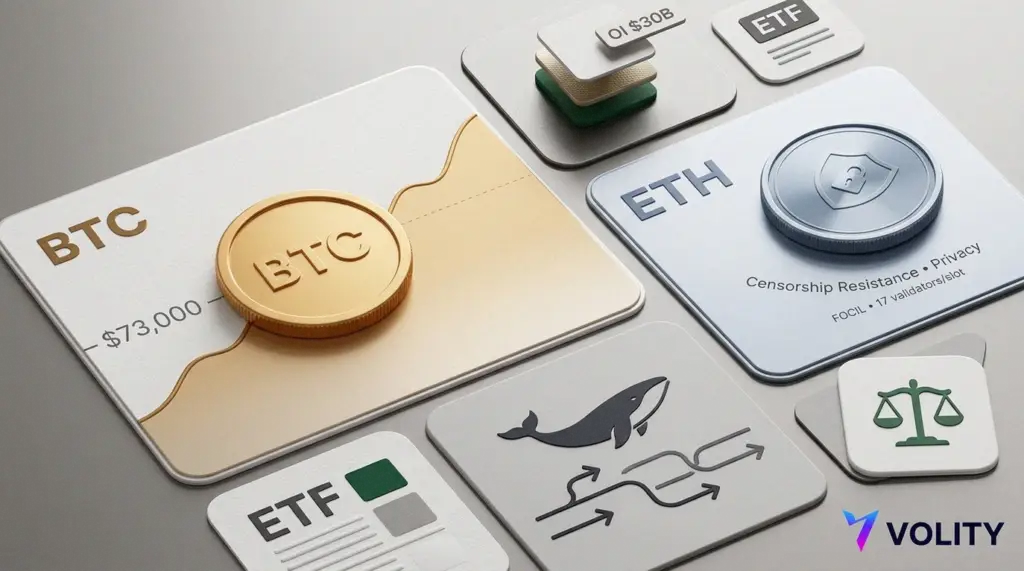
Bitcoin pushed above $73,000 on Friday as traders leaned back into risk, despite fresh tremors in the Middle East and an oil market that refuses to sit still. However, this rally looked less like a single macro bet and more like a crowded trade building across crypto. Derivatives open interest surged past $30bn, while funding rates firmed, signalling that leverage, not just spot demand, did much of the lifting.
Meanwhile, Ethereum outperformed, jumping about 5% after the Ethereum Foundation laid out a roadmap that places censorship resistance and privacy closer to the centre of the chain’s identity. The message was blunt. Ethereum wants to behave less like a polite fintech platform and more like infrastructure that still works when politics turns ugly.
Ethereum Foundation hardens the base layer
The Foundation’s 2026 roadmap groups work into three tracks: Scale, Improve UX, and Harden the L1. The most marketable headline sat inside the least flashy bucket. “Harden the L1” targets censorship resistance through FOCIL, short for Fork Choice enforced Inclusion Lists, drafted as EIP-7805.
In simple terms, FOCIL would reduce the power of block builders and relays to quietly ignore certain transactions. It does that by selecting 17 validators at random for each slot. Those validators can force the inclusion of valid transactions within a fixed window, rather than leaving inclusion to off-chain gatekeepers. The proposal takes aim at MEV-driven centralisation, where the entities that assemble blocks gain influence that looks uncomfortably like control.
FOCIL is slated for a late-2026 upgrade referred to as Hegota. Vitalik Buterin and several researchers have backed the direction. However, the trade-off is complexity. Protocol-level “inclusion lists” must be implemented carefully, or they risk shifting incentives in unexpected ways.
- Scale: push the gas limit towards 100m and boost L1 capacity with zkEVM-related work.
- Improve UX: make smart accounts first-class, including work such as EIP-8141 for sponsored gas and smoother cross-L2 use.
- Security: post-quantum preparation and a 128-bit security floor for zkEVM systems by year-end targets.
Buterin again framed Ethereum as a “global shared data bulletin board”. Meanwhile, the Foundation’s tone implied a willingness to resist surveillance pressure as more institutional money circles the ecosystem. That is not just culture war rhetoric. It is an attempt to keep Ethereum useful in the scenarios where regulators, payment networks, or intermediaries decide that some transactions should not exist.
Bitcoin rallies with macro winds at its back
Bitcoin’s move above $73,000 arrived even as headlines around US-Iran tensions kept crude elevated. Still, BTC behaved like a liquidity barometer. Traders talked up rate cuts again after banks pushed expectations towards September. Risk markets took the hint, and crypto followed.
Support near $65,000 has held through recent chop, which helped systematic strategies stay engaged. Meanwhile, MicroStrategy’s Michael Saylor again hinted at continued buying. Markets often treat that as theatre, but it matters at the margin when supply is already tight on exchanges.
ETFs, leverage and “whale” positioning
ETF chatter also powered the tape. BlackRock’s staked ETH ETF debut was described as “very solid” in early market talk, and that helped ETH trade back above $2,100. However, flows remain the real scorecard, especially if a rally is leaning on leveraged longs.
On-chain watchers flagged large withdrawals, including a reported $155m in ETH shifting away from venues. Meanwhile, a Matrixport-linked address was said to be running roughly $300m in ETH and BTC long exposure, showing sizeable unrealised gains. That sort of positioning can stabilise a move until it suddenly does not, especially if funding flips from supportive to punitive.
Elsewhere, the product pipeline stays noisy. Grayscale’s AVAX ETF went live, while XRP traded near $1.40 amid talk of outflows and a “Wyckoff accumulation” narrative. The market still feels like it is pricing optionality across several majors, not just BTC and ETH.
Meme coins grab headlines again
Speculation did not stay in the blue chips. The TRUMP token jumped about 52% after a promotion offering top holders a chance at a Mar-a-Lago lunch. Meanwhile, Pi Network’s coin rose roughly 30% after a Kraken listing ahead of Pi Day. These are attention trades, and attention has a habit of vanishing faster than liquidity.
Regulatory pressure builds in the background
Washington stayed busy. US actions targeted alleged DPRK-linked laundering networks, while senators pressed Binance over Iran-related sanctions concerns. Meanwhile, the SEC chair signalled interest in a “minimum effective dose” of disclosure as tokenisation pilots expand, and the CFTC reiterated its stance on prediction market rules.
In Asia, Hong Kong granted stablecoin licences to HSBC and Standard Chartered. The stablecoin race continues shifting from a crypto-native experiment into a bank-supervised product category, which could reshape fee pools and distribution over time.
By the numbers
- BTC traded above $73,000 on Friday.
- ETH rose about 5% and reclaimed $2,100.
- Crypto derivatives open interest pushed above $30bn.
- FOCIL design calls for 17 randomly selected validators per slot.
- FOCIL is targeted for a late-2026 upgrade.
Key takeaways
- ETH: roadmap headlines can move price, but implementation risk grows as timelines extend.
- BTC: the rally still reads as liquidity-led, so watch rates pricing and the dollar more than narratives.
- Leverage: rising open interest supports momentum until funding turns, then it accelerates reversals.
- Memes: treat promo-driven spikes as liquidity events, not durable fundamentals.
- Regulation: stablecoin licensing outside the US is becoming a competitive edge for distribution.
For more on this topic see our deep-dives on Bitcoin Price Analysis: Forecast Frameworks, Trends and BTC vs ETH, Bitcoin Price, Iran Tensions and Miner Selling: Reading Crypto Risk, and Crypto News: $50M USDT Heist, UNI Burn Vote, Bitcoin and Token Unlocks.
What our analysts watch: Three reads turn the censorship-resistance narrative into a sized position rather than a thesis bet. FOCIL adoption velocity (the 17-validator inclusion-list mechanic only matters once a meaningful share of validators run the upgrade in production; the early indicator is testnet acceptance pace ahead of the late-2026 Hegota release). Cross-asset ETF flow split between Bitcoin and Ethereum products (when the IBIT inflow rate stalls while ETHA and ETHB capture the marginal allocation, the Ethereum thesis hardens beyond the Bitcoin-companion read). Macro rate path alignment (rate-cut expectations rebuilding to a September timeline against the trajectory mapped by the Bank of England monetary policy compresses the discount rate on long-duration risk assets, which structurally favours the highest-beta institutional crypto exposure). Volity offers BTC, ETH, and major altcoin CFD execution under CySEC oversight via UBK Markets (licence 186/12), with entities in Saint Lucia and Cyprus.
Frequently asked questions
Why does FOCIL matter for the Ethereum institutional bid rather than only for retail traders?
Because institutional allocators price MEV-driven centralisation as a regulatory risk vector, not as a technical curiosity. When block builders and relays can quietly drop transactions, the network carries the same operational risk profile as a permissioned venue, which raises the cost of capital that fiduciary allocators apply to the asset. FOCIL converts the inclusion guarantee into a protocol property rather than an off-chain promise, which is the specific feature that compresses the regulatory risk premium and lifts the price the allocator can justify paying. The Investopedia reference on Ethereum covers the broader protocol-economics framework that anchors the thesis.
How does the BlackRock ETHB launch reshape the Ethereum allocator stack?
It reshapes it by introducing the income-bearing exposure that the Ethereum spot ETF complex did not deliver at launch. ETHB targets the staking yield component of Ethereum returns inside a regulated wrapper, which broadens the potential allocator base from pure capital-appreciation buyers to insurance, pension, and endowment desks that require a yield component for the policy mandate. The structural read is that the Ethereum institutional bid now has a second product category to absorb flow, which compresses the marginal flow risk that priced into the asset through 2024. The CoinDesk ETF coverage tracks the issuer-level flow split that confirms the thesis.
Should retail traders chase the 5 percent ETH outperformance day or wait for confirmation?
The disciplined answer is to size the position around the structural thesis rather than the single-day move. A 5 percent move on a roadmap release is consistent with positioning compression rather than fundamental rerating; the structural rerating shows up over multi-week windows as ETF flow redirects toward Ethereum products and as the BTC dominance ratio compresses meaningfully below the 55 percent threshold. The right framing is to treat the day as a confirmation signal for the thesis rather than as the optimal entry; the optimal entry typically arrives during the next general crypto drawdown when the thesis is intact but the price is not.
Does the post-quantum security work change the Bitcoin-versus-Ethereum trade today?
It does not change the trade today but it shifts the multi-year risk distribution. The Ethereum 128-bit security floor for zkEVM systems by year-end is a forward-looking commitment that the protocol carries the engineering capacity to migrate cryptographic primitives ahead of practical quantum threats, which is the same property that the Bitcoin community has drafted but not yet implemented. The structural read is that both networks are on credible post-quantum migration paths and neither carries quantum risk inside the typical multi-quarter trading horizon; the differentiation between the two assets remains the institutional flow path and the protocol-economics framework rather than the cryptographic posture.
Related guides
- Bitcoin explained
- Ethereum explained
- Cryptocurrency trading
- Crypto trading platforms
- Best crypto investments
Volity operates a trading platform and also publishes educational and analytical content about trading. The content on this page is for educational purposes only and should not be considered financial advice. Volity may benefit commercially when readers open trading accounts through links on this site.
Our content is produced and reviewed under documented editorial standards; see our comparison and review methodology.