Investing in financial products involves risk. Losses may exceed the value of your original investment.
Bitcoin nasdaq iran is a core topic for traders in 2026. The complete guide follows.
Markets shake off Iran shadows: tech roars, gold shines as de-escalation hopes fuel rally
NEW YORK – US equities surged again on Thursday as traders leaned into a simple idea: the Iran risk may be peaking. Meanwhile, a fresh burst of appetite for big tech and chips did the heavy lifting, with volatility deflating fast.
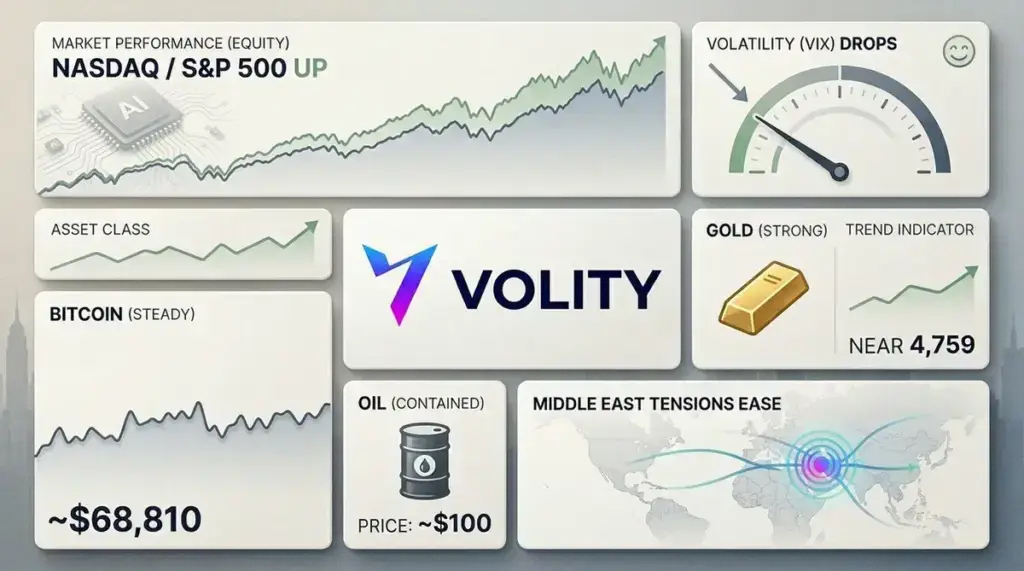
The S&P 500 jumped 2.9% to 6,528.52, while the Nasdaq Composite rallied 3.8% to 21,590.63. However, the most telling move sat in the fear gauge. The VIX sank 17.5% to 25.25, flipping the mood from hedged and jumpy to risk-on and almost breezy.
The spark came from President Trump, who told reporters at an Easter brunch that the US was “sort of pretty much winding that up” in Iran. Desks that had spent days paying up for protection began unwinding it. Iranian President Masoud Pezeshkian also talked up a “necessary will” for peace, provided guarantees follow. As a result, the market started to price an off-ramp rather than a long grind.
Oil behaved, which helped everything else behave. Crude hovered near $100 a barrel, easing fears of an abrupt jump to $110 amid renewed talk of the Strait of Hormuz and an April 6 deadline. Meanwhile, defence names and energy lagged as traders rotated away from the war-trade and back towards growth.
Chip stocks take the wheel
Semiconductors led from the front. Micron (MU) ripped higher, and Western Digital surged with it, as investors returned to the AI infrastructure script. Nvidia (NVDA) rose alongside ARM and Microsoft, while mega-cap tech broadly joined the move, including Amazon, Meta, and Alphabet.
Importantly, the rally did not feel like a thin chase. Instead, it looked like a positioning reset, with geopolitics fading a notch and earnings optimism returning. Traders pointed to expectations of 13.5% US earnings growth in 2026, far above 8.7% for EAFE, with productivity gains doing some work against inflation.
Gold keeps running, copper turns lively
Even as equities celebrated, gold did not get the memo to stop acting like a hedge. Gold tracked a fourth straight advance and held near $4,759, buoyed by a softer dollar and familiar rate-cut chatter. Meanwhile, copper flipped bullish, touching about $5.25 per pound on China demand hopes and supply friction tied to Chile, a move that left aluminium looking comparatively flat-footed.
Crypto also stabilised. Bitcoin held around $68,800, up roughly 0.9%, which supported proxies like MicroStrategy (MSTR) amid ongoing deal talk in crypto equities. Risk appetite expressed itself across multiple lanes, not just the Nasdaq tape.
Gaps, momentum, and the next test
With volatility dropping, premarket gap-watch returned to the daily routine. Names like SQX and GSAT drew “gap-and-go” attention on news flow, although those trades can turn quickly when early buyers run out. Meanwhile, copper-linked vehicles such as COPX and AA attracted fast money, and chip leaders like NVDA and MU became obvious dip-buy candidates for trend followers.
However, a calmer headline tape does not mean an easy one. Bank earnings sit near the front of the April calendar, and traders will watch credit quality and consumer spending comments closely, especially with tax-season distortions in the mix. As yields stay firm, bonds could still act as a brake if inflation worries reassert themselves.
By the numbers
- S&P 500: +2.9% to 6,528.52
- Nasdaq: +3.8% to 21,590.63
- VIX: -17.5% to 25.25
- WTI crude: near $100, with $110 tail-risk talk fading
- Gold: near $4,759, four-day rise
Key takeaways
- Volatility fell faster than prices rose, which signalled hedge unwinds, not just optimism.
- Chips drove breadth, so watch MU and NVDA for follow-through or failed breakouts.
- Oil staying near $100 kept risk appetite intact, so a sudden spike could reverse flows.
- Gold strength alongside stocks suggests traders still want insurance.
- Into bank earnings, expect sharp moves if guidance clashes with the soft-landing script.
For more on this topic see our deep-dives on Bitcoin and XRP ETF Flows: How Fed Policy Drives Crypto Allocations, Why Crypto Prices Fall Around FOMC: DeFi Risk and Bitcoin Drawdowns, and Bitcoin and Tariff Shocks: Why Trade Fears Trigger Crypto Liquidations.
What our analysts watch: Three reads anchor the desk approach to de-escalation rallies. The VIX-versus-SPX delta is the cleanest signal; a VIX drop that exceeds the SPX gain on a percentage basis is structural hedge-unwinding, while a VIX drop smaller than the SPX gain is fresh-money chase.
The $4,759 gold print alongside an equity rally is the second read, since gold strength during a risk-on session signals traders are buying insurance even as they buy beta, which historically precedes choppier follow-through rather than clean trend extension. And the breadth dispersion (advancing-declining issues) on the S&P 500 is the third; rallies driven by chip-sector concentration without broad participation tend to fail at prior resistance, while rallies with 70-percent-plus advancing breadth tend to extend.
The Bank of England monetary policy H.4.1 weekly release frames the liquidity backdrop the rally extends inside, the Nasdaq sector data tracks chip leadership and breadth dispersion in real time, and the ECB Economic Bulletin reference on the VIX explains the mechanics underwriting the volatility-collapse trade. Volity offers US equity, indices, and CFD execution under CySEC oversight via UBK Markets (licence 186/12).
Frequently asked questions
Why does volatility collapse faster than price rises in de-escalation rallies?
The pre-event hedge book is short gamma; once the headline risk resolves, dealers cover by selling protection, which compresses implied volatility mechanically. The price move is bounded by realised volatility expansion, while the volatility move is bounded by the speed of dealer hedge unwind. The asymmetry is structural, not directional, and it produces the predictable VIX-collapse signature that follows event resolutions.
Is a chip-led rally a higher-quality signal than a broad rally?
Counterintuitively, no. Chip-led rallies inherit the high beta and crowded positioning of the chip complex, which means they are more vulnerable to single-name disappointments and concentrated sell signals. A broad rally with rising small-cap participation is structurally healthier because it signals risk appetite is genuinely expanding rather than concentrating in the leadership names that hedge funds were already long.
Why does gold rise alongside equities in some rallies but not others?
Gold is responding to two variables simultaneously: real yields (negative correlation) and global insurance demand (positive correlation with uncertainty). When real yields are softening on dovish Fed signals at the same time uncertainty is resolving, gold can rise into an equity rally because the rate-driver dominates the insurance-driver. The pattern is normal in rate-cut-pricing regimes; gold falling alongside equities is the typical pattern in rate-hike regimes.
How should a retail trader size positions into the day after a hedge-unwind rally?
Reduce gross exposure by approximately 25 percent, since hedge-unwind sessions are typically followed by retracement sessions as fresh-money allocators wait for confirmation. The retracement is shallow if breadth was strong and deep if breadth was thin. Sizing for the retracement preserves the option value of adding on confirmation rather than chasing a tape that has already done most of the move.
Volity operates a trading platform and also publishes educational and analytical content about trading. The content on this page is for educational purposes only and should not be considered financial advice. Volity may benefit commercially when readers open trading accounts through links on this site.
Our content is produced and reviewed under documented editorial standards; see our comparison and review methodology.