Investing in financial products involves risk. Losses may exceed the value of your original investment.
Bitcoin oil shocks is a core topic for traders in 2026. The complete guide follows.
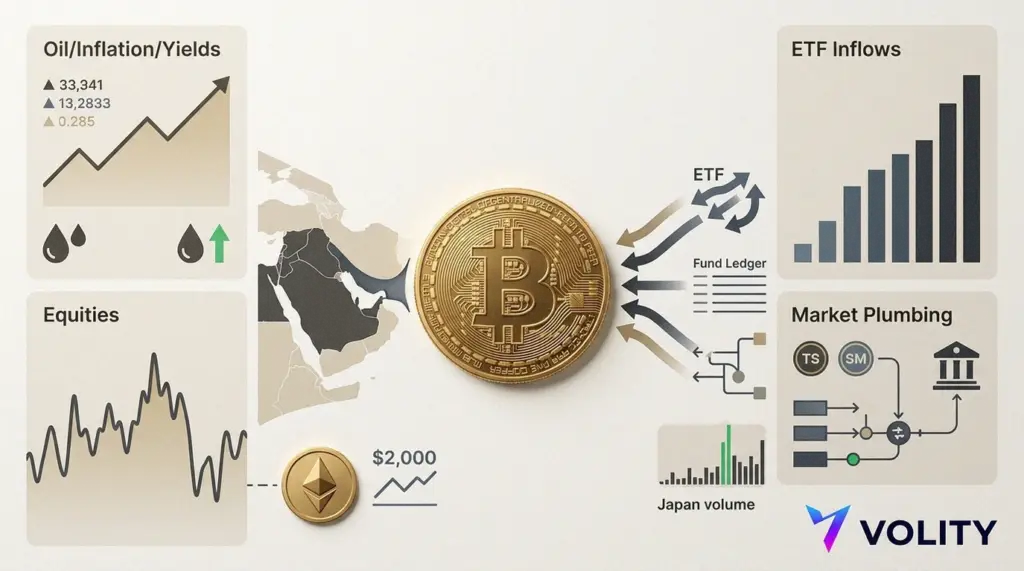
Bitcoin pushed through $68,000 even as Middle East headlines kept traders on edge, and that contrast framed the day’s tape. On one side sat oil, nerves and higher yields. On the other sat the steady, almost boring grind of institutional buying and market plumbing that keeps getting built.
Iran’s widening strikes rippled across risk assets, while crude jumped on renewed fears around the Strait of Hormuz. That corridor matters because it carries roughly a fifth of global oil consumption. Every fresh threat lands straight in inflation expectations, and then in rate pricing.
Equities took the hit. The Dow fell 403.51 points, while the S&P 500 slid 0.94% and the Nasdaq dropped 1.02%. Meanwhile, traders shoved the first widely expected Fed cut from July towards September, as energy risk complicated the disinflation story.
Crypto did not offer a clean safe haven bid. However, it did not capitulate either. Instead, Bitcoin behaved like a grown-up risk asset with a second engine: flows. That second engine kept it buoyant even as the macro wind turned awkward.
The oil shock tests bitcoin’s “digital gold” story
Oil’s spike created a familiar, uncomfortable setup. When energy jumps, yields tend to follow, and duration gets punished. Equities wobble and liquidity tightens, which can drag crypto with it.
Yet this time, the market also saw real buying that looked less like retail thrill-seeking and more like portfolio work. Dips were met by bids, not silence.
Institutions keep buying into the noise
Last week’s crypto fund flow numbers told the clearest story in the room. Total inflows hit $619 million, while Bitcoin products took about $521 million. That is not tourist money. It is allocation money.
In parallel, Strategy Corporation showed how corporate crypto treasuries now behave during volatility. The firm bought 17,994 BTC for $1.28 billion, marking what it called its 101st major purchase. Meanwhile, Bitcoin-focused funds have grown to about $108.3 billion in assets under management, a reminder that the “institutional era” is no longer a slogan.
Wall Street keeps wiring crypto into finance
The day’s more durable signal sat underneath price. NYSE’s parent invested in OKX at a $25 billion valuation, with plans for OKX to list tokenised stocks and derivatives by year-end. That is not a meme trade. It is distribution.
Then came a step that would have sounded fanciful a few years ago. Kraken became the first crypto firm to receive a Federal Reserve master account, giving it access to the same payment rails used by thousands of banks. Although it operates as a “skinny” bank without discount window access, the symbolism matters. The regulatory perimeter around crypto keeps expanding, even as politics stays noisy.
Ethereum holds the line, but conviction splits by timeframe
Ethereum traded around $2,002.86, up about $70 on the day and clinging to $2,000. However, it remained slightly below its level a year ago, which captures the frustration of ETH holders since the last cycle’s highs.
Near term, the chart crowd sees pressure. Meanwhile, the long-term camp keeps pointing to adoption and network utility. Standard Chartered has floated a $40,000 ETH by 2030 projection, while more conservative bulls talk about $10,000. Either way, the gap between today’s price and long-term targets remains enormous, which keeps ETH a battleground between patience and impatience.
Japan’s volatility feeds crypto activity
Traditional market stress keeps nudging more activity into crypto venues. During the Nikkei 225 sell-off, Japanese crypto trading volume reportedly surged 200%. Sometimes that reflects hedging. Sometimes it reflects opportunism. Either way, it shows crypto remains a live outlet when conventional markets start lurching.
Stablecoins and settlement creep into the mainstream
Infrastructure news continued to stack up. Broadridge and Crypto.com linked up to enable crypto order routing for brokers through NYFIX, with Crypto.com as Broadridge’s first crypto trading connection in Asia. Meanwhile, Circle settled $68 million in minutes using USDC rails, which highlights a simple truth. When settlement gets faster and cheaper, habits follow.
Regulation brings mixed signals, but the centre holds
A terror-financing case against Binance collapsed in court, lifting one reputational cloud. Meanwhile, the US Treasury flagged crypto ATMs as a growing fraud vector, a reminder that the industry still has sharp edges. However, the bigger market read came from the institutional steps forward, not the warnings.
By the numbers
- BTC: above $68,000
- ETH: about $2,002.86
- Weekly crypto fund inflows: $619m, with $521m into BTC products
- Strategy purchase: 17,994 BTC for $1.28bn
- Equities: Dow -0.83%, S&P 500 -0.94%, Nasdaq -1.02%
Key takeaways
- Oil-driven inflation risk can still pull crypto into risk-off trading, especially if yields keep rising.
- However, persistent institutional inflows are damping downside follow-through after headline shocks.
- Tokenisation plans and Fed payment access matter more than daily candles because they change market structure.
- ETH’s $2,000 area remains a sentiment line, while longer-dated forecasts keep long-only buyers engaged.
- Expect volatility spikes around geopolitics, yet also expect buy-the-dip behaviour to stay visible.
For now, crypto sits in an awkward middle ground. It is still sensitive to oil, rates and fear. However, it is also being stitched into the financial system, one account, one venue and one tokenised product at a time. That tension should keep prices jumpy, while the plumbing quietly becomes harder to ignore.
For more on this topic see our deep-dives on Bitcoin Price Rallies on ETF Flows: Reading Spot ETF Demand, Bitcoin and Tariff Shocks: Why Trade Fears Trigger Crypto Liquidations, and Bitcoin Price: Reading Breakout and Breakdown Levels Around $70k.
What our analysts watch: Three lenses dominate our reading of the equity tape. Sector rotation tells us where capital is moving (defensives versus cyclicals, value versus growth). Earnings revisions show whether analyst expectations are catching up to or trailing reality. Real yields and the dollar set the discount rate that valuation multiples respond to. When earnings estimates rise faster than the index price and real yields stabilise, the setup tends to favour patient longs.
Frequently asked questions
How much money do I need to start trading stocks?
Many regulated brokers now allow account opening with no minimum deposit and offer fractional shares for as little as $1. A practical starting balance for a long-only beginner is $500 to $2,000, enough to diversify across a handful of positions without paying meaningful percentage spreads. The FCA publishes investor education resources worth reading before opening an account.
What is the difference between stocks, ETFs, and CFDs?
A stock is direct ownership in a company. An ETF is a basket of stocks (or other assets) traded as a single security. A CFD (contract for difference) is a leveraged derivative that tracks the underlying price without conferring ownership. Each has different cost, tax, and risk profiles. ESMA imposes leverage caps on retail CFDs in the EU and UK.
How do I choose a trustworthy broker?
Verify regulation with a tier-one authority (FCA in the UK, CySEC in Cyprus, BaFin in Germany, ASIC in Australia, or your local regulator). Check segregated client funds, negative-balance protection, transparent fees, and a clean disciplinary record. Avoid any platform offering guaranteed returns or pressuring deposits. The FCA Financial Services Register is free to search.
Should I day-trade or invest long-term?
Most retail accounts that day-trade lose money over time. Long-term passive investing in diversified index ETFs has historically delivered competitive returns with far less effort and lower stress. Active day-trading can work, but it requires capital, an edge proven over hundreds of trades, and the time to monitor positions intraday. Start passive; layer active only after the basics are durable.
Related guides
- Bitcoin explained
- Cryptocurrency trading
- Crypto trading platforms
- Best crypto investments
- Risk management
Volity Editorial, Volity research: The Volity desk treats geopolitical-shock days as flow tests, not narrative tests. The Strait of Hormuz carries roughly twenty percent of seaborne oil, so threats to the corridor transmit directly into rate pricing within minutes. The honest read on Bitcoin during those windows is to track three numbers: realised oil volatility, ten-year yield change, and net spot ETF flow. When ETF flow stays positive into a yield spike, the digital-gold thesis is being tested live. When it goes negative, BTC trades like long-duration risk and follows the equity tape down.
Volity analyst FAQ
Why does Bitcoin react to oil-market shocks?
Crude price moves transmit into rates expectations through inflation channels, and rates expectations price every risk asset including Bitcoin. The mechanical chain runs from oil to inflation expectations to bond yields to dollar liquidity to BTC. Bitcoin behaves like a long-duration risk asset on that transmission, with a secondary scarcity bid layered on top. The Investopedia oil-price transmission primer walks through the channels in detail.
Are spot Bitcoin ETF inflows a reliable buy signal during geopolitical stress?
Sustained net positive ETF flows during stress windows indicate sticky institutional demand absorbing supply, which structurally supports the price floor. Single-day prints are noise; multi-week net flow is signal. The CoinDesk Bitcoin price reference contextualises flow data against intraday price action across recent stress events.
What does the Strait of Hormuz have to do with crypto?
The corridor carries close to twenty percent of global seaborne oil. Any meaningful threat to throughput drives the crude curve, which feeds inflation expectations and ten-year yields. Crypto enters the chain through the rates channel rather than as a direct energy proxy. The Bank of England monetary policy page remains the canonical source for the rates backdrop that shapes BTC during these episodes.
Should I treat Bitcoin as a hedge or as a risk asset?
Bitcoin behaves as a hybrid: long-duration risk asset on the path lower, scarcity-bid asset on the path higher, with the regime decided by flow rather than narrative. The Volity desk treats BTC as risk-on by default and reclassifies only when ETF flows confirm sticky demand through a stress window. Static labels produce sloppy trades. Flow-conditional framing produces durable ones.
External references
- Investopedia oil-price primer
- CoinDesk Bitcoin price
- Bank of England monetary policy
Volity operates a trading platform and also publishes educational and analytical content about trading. The content on this page is for educational purposes only and should not be considered financial advice. Volity may benefit commercially when readers open trading accounts through links on this site.
Our content is produced and reviewed under documented editorial standards; see our comparison and review methodology.