Investing in financial products involves risk. Losses may exceed the value of your original investment.
The spread is the cost you pay on every gold trade, and most traders underestimate it. On XAU/USD a difference of one or two pips, repeated across hundreds of trades, is the difference between a profitable year and a flat one. This guide makes the cost visible so you can keep it low.
What the gold spread is
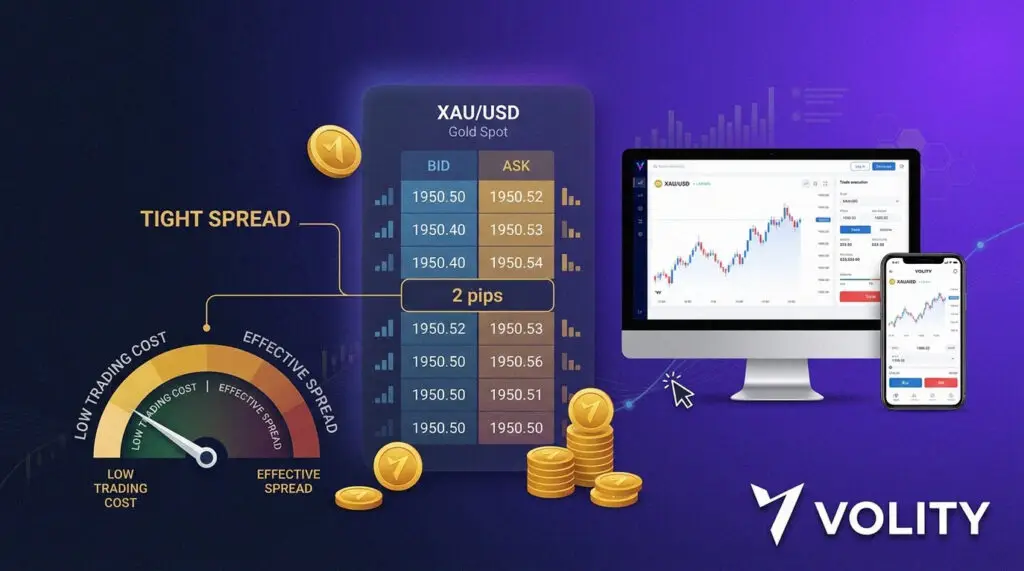
The spread is the gap between the buy (ask) and sell (bid) price of XAU/USD. If gold is quoted 2,400.10 / 2,400.40, the spread is 30 cents, or 30 pips. You pay it the instant you open a trade, because you buy at the higher price and could only sell at the lower one. It is a real, immediate cost, not a fee you see on a statement.
What counts as tight vs wide
On XAU/USD, a spread under about 20 pips in active hours is competitive, and raw or ECN accounts can show single digits plus a small commission. Anything consistently above 30 to 40 pips in the main sessions is expensive. The headline “tight spread” in a broker’s marketing is the best case; what matters is the spread you actually get during the hours you trade.
The other costs: swaps and commissions
Two more costs complete the picture. Swap (overnight financing) is charged for holding a gold position past the daily rollover; swap-free accounts remove it, which matters for multi-day positions. Commission applies on raw-spread accounts in exchange for tighter spreads. Add spread plus commission plus swap to see your true cost per trade. Volity publishes its costs in full in the charges and fees breakdown.
Why gold spreads widen
Spreads are not fixed. They widen when liquidity thins, most notably around the Comex close (roughly 22:00 to 01:00 GMT) and at the Friday close and Sunday open, and they spike during high-impact news such as CPI and Fed decisions. Trading the London and New York overlap keeps you in the tightest-spread window, covered in best time to trade gold.
How to keep your gold costs low
Trade the active sessions, avoid the thin overnight window, choose an account type that fits your style (raw plus commission for scalpers, standard for swing traders), use swap-free if you hold positions overnight, and compare total cost rather than the headline spread. Our best gold trading platform guide ranks platforms on real cost, not marketing.
Quick answer: The gold spread is the gap between the buy and sell price of XAU/USD and is the main cost of every trade; under about 20 pips in active hours is competitive. Your true cost is spread plus commission plus overnight swap. Spreads widen in thin liquidity, so trading the London and New York overlap and comparing total cost keeps gold trading cheap.
Learn the fundamentals in our guide to trading gold.
Sources
This guide draws on the following public sources.
- World Gold Council – Gold Demand Trends, quarterly demand and supply data
- LBMA – LBMA Gold Price, the global benchmark and how it is set
- LBMA – LBMA Good Delivery standard for gold bars
- World Gold Council – Historical gold price data and performance
- U.S. Energy Information Administration – EIA petroleum supply, demand and price data
- U.S. Energy Information Administration – EIA natural gas storage, production and price series
- Silver Institute – Silver supply and demand fundamentals
- SPDR Gold Shares – SPDR Gold Shares (GLD) official fund information
- LBMA – LBMA precious metal benchmark prices