A gold trading platform lets you trade the price of gold without buying, storing or insuring metal. On Volity you trade spot gold as a CFD on XAU/USD or XAU/EUR, long or short, from the same account that holds forex, indices, commodities and crypto, with leverage up to 1:500. This page shows what a platform for gold must give you, which costs and risks to check, and how to test it all on a free demo first.
TL;DR: Volity is a gold trading platform for spot gold CFDs (XAU/USD and XAU/EUR), long or short, 24/7, from one account. Spreads are dynamic and shown live on the platform. The Markets account is commission-free, and positions held overnight pay or receive a financing amount. Leverage goes up to 1:500, so size every trade from your stop-loss. Open the free demo, watch the live gold spread, then decide.
Gold has had a strong run. The World Gold Council’s Gold Demand Trends Q3 2026 puts the average gold price at US$4,262 an ounce in the third quarter of 2026. That is 23% higher than a year earlier and the third strongest quarterly average on record. When each move is worth more in money terms, the platform matters more. How it prices gold, what it charges to hold a position and which risk tools it gives you decide how much of a move you keep.
What a gold trading platform should give you
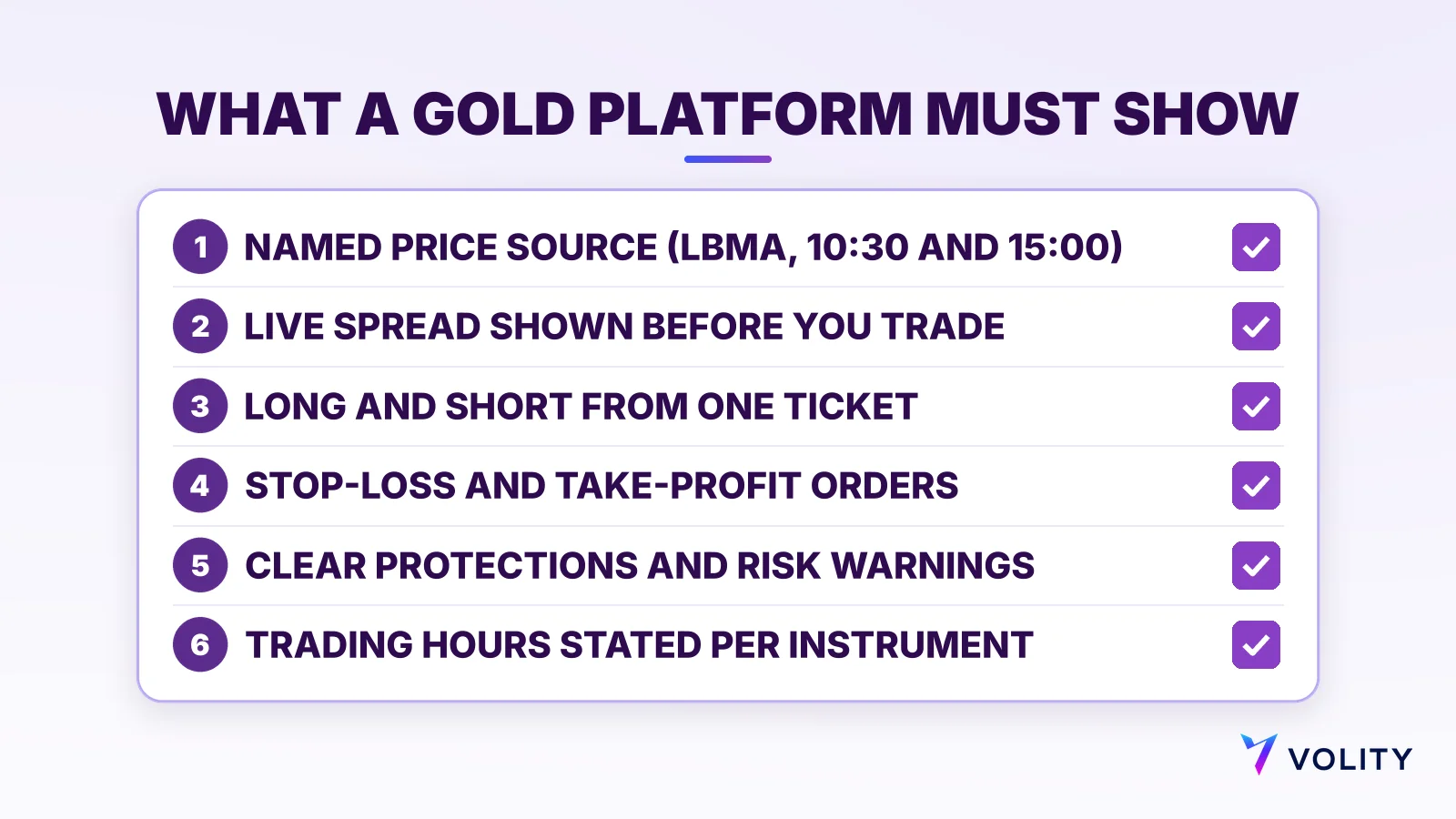
Before you fund any account, check where the gold price comes from, how orders are filled, the charts and order tools, the protections and the hours. Each takes a few minutes to verify.
A price you can trace to a benchmark
Gold has a spot price, which is the price for immediate delivery, and it has a daily benchmark. The World Gold Council’s gold price data lists the spot price, the LBMA Gold Price and several regional prices side by side.
The LBMA says ICE Benchmark Administration administers the LBMA Gold Price independently and that the auction platform is in line with the IOSCO Principles for Financial Benchmarks. The price is set in electronic auctions at 10:30 and 15:00 London time, run by ICE Benchmark Administration. Prices are formed in US dollars, and the result is also published in pounds and euros.
A CFD platform quotes its own live buy and sell prices around the market price of gold. The quote on your screen moves all day, while the benchmark is fixed twice. A good platform tells you plainly what its gold price tracks.
Execution and a spread you can see
The spread is the gap between the buy price and the sell price. You pay it every time you trade, because you buy at the higher price and close at the lower one. A good platform shows the live spread on the order ticket, before you click. Execution is how your order is filled: at what price, and how quickly. Volity’s execution policy states that trades are executed at the best available market price.
Charts and order tools
Gold traders use charts to find price levels and to decide where a trade is wrong, so look for several timeframes, indicators and drawing tools. A stop-loss is an order that closes your trade at a price you choose if the market moves against you. A take-profit closes it when the price reaches your target. You should be able to set both with the trade itself.
Protections and plain risk warnings
Retail CFD rules in Europe, the UK and Australia set a baseline. The ESMA measures agreed in 2018 added a margin close-out at 50%, which closes positions when your equity falls to half the margin they need. They also added negative balance protection, so a retail client cannot lose more than the money in the account. The FCA made similar permanent CFD rules from 1 August 2019, including a standard risk warning that shows the share of retail accounts that lose money.
Trading hours stated clearly
A platform should state its hours for every instrument. On Volity, gold is one of a growing range of markets that trade 24/7, alongside crypto, silver, US500, US100 and WTI. Forex trades 24/5.
If you want brokers set side by side on published costs, read our comparison of the best gold trading platforms. The rest of this page covers how gold works on Volity itself.
How gold trading works on Volity
On Volity, gold is traded as a contract for difference (CFD). A CFD is an agreement to settle the difference in an asset’s price between the moment you open a trade and the moment you close it. You never own the metal. There is no bar, vault or storage bill. What you hold is exposure to the gold price.
Two gold markets are available. XAU/USD is gold priced in US dollars, and XAU/EUR is gold priced in euros. XAU stands for one troy ounce of gold, as our guide to what XAU means explains. Here is what that gives you in practice:
- Go long (buy) if you expect the price to rise, or short (sell) if you expect it to fall, from the same order ticket.
- Use leverage up to 1:500. Leverage means you put up a deposit, called margin, that is only a fraction of the trade’s full value.
- Hold gold in the same account as your forex, indices, commodities and crypto positions, so your whole book sits in one place.
A Volity Markets account starts from $1, with funding from 10 EUR. The free demo is available on every account tier, so you can practise on gold before you add money. More gold guides sit in the gold hub.
Client deposits are kept in separate bank accounts, apart from the firm’s own money. Volity operates under CySEC licence 186/12 via UBK Markets, with entities in Saint Lucia, Cyprus and Hong Kong. For eligible claims relating to covered investment services provided by UBK Markets Ltd, Cyprus Investor Compensation Fund protection may apply, subject to the scheme’s rules and limits. You can look up any licence on the CySEC website or, for UK firms, the FCA register.
Costs to check before you trade gold
A gold trade can carry a spread, an overnight financing amount and, on some accounts, a commission. Each one is published, so you can work out what a trade costs before you place it.
| Cost | What it is | Where to check it on Volity |
|---|---|---|
| Spread | The gap between the buy and sell price, paid when you trade | Live on the platform for each instrument; it is dynamic and moves with market conditions |
| Overnight financing | An amount paid or received on positions held past 22:00 GMT | The rate for each instrument is shown on the platform |
| Commission | A per-lot charge on accounts that trade on tighter spreads | None on the Markets account; Pro and VIP amounts are on the fees page |
Volity spreads, gold included, are dynamic. They change with market conditions, and the live figure for XAU/USD and XAU/EUR is shown on the platform. The fair way to judge a gold spread is to watch it on the demo at the hours you plan to trade.
Overnight financing is the cost that is easiest to overlook. If you hold a gold position past 22:00 GMT, it pays or receives an overnight amount. For CFDs on markets such as gold, the amount reflects the cost of the leverage, and whether you pay or receive depends on your direction. For a trade you plan to hold for weeks, this may cost more than the spread. Islamic (swap-free) accounts are also available.
Currency is the last thing to check. XAU/USD settles profit and loss in US dollars and XAU/EUR in euros. Volity charges no fee when a position priced in another currency is closed. There is no custody fee and no platform fee, withdrawals are free, and real-time market data is free for active traders. Every charge is listed on the Volity charges and fees page.
Managing risk on a gold trade
Gold can move sharply around economic news, and leverage makes those moves count for more on your account. Leverage is the ratio between the size of your trade and the margin you put up. A hypothetical example, with round numbers chosen to keep the sums simple, shows how it works.
Say gold is at $4,000 an ounce and you buy 10 ounces. Your exposure is $40,000. At 1:500 the margin is $80. At 1:20 it would be $2,000. Now say gold falls $40. You lose $400 on 10 ounces, which is five times the $80 margin, or a fifth of the $2,000 margin. Leverage changes how much cash a trade ties up. The loss per ounce stays the same.
Regulators set their own limits for retail clients. ESMA’s 2018 measures cap retail CFD leverage between 30:1 and 2:1, with 20:1 for gold. The FCA’s policy statement PS19/18 asks for margin of 5% of the exposure on gold, which works out at the same 20:1. In Australia, ASIC set 20:1 for gold from 29 March 2021 and has extended its order to 23 May 2027. These are regulator rules for retail clients in those places.
On Volity, metals trade with leverage up to 1:500. Higher leverage makes it easy to take a position far bigger than your account can carry. When ESMA agreed its CFD measures in March 2018, it reported national regulators’ analyses showing that 74-89% of retail accounts typically lose money on CFDs. That is a 2018 figure, from before the rules took effect, but the lesson holds.
So size each trade from your stop-loss. Decide how much of your account you are ready to lose on one trade. Then divide it by the distance from your entry to your stop. Hypothetically, if you accept a $100 loss and your stop sits $20 below your entry, your size is 5 ounces. If gold reaches the stop, you lose about $100 plus the spread, whatever leverage you used. In a fast market the stop can fill at a worse price than you set. That gap is called slippage, so leave room for it.
For setups that place these stops at sensible levels, see our guide to gold trading strategies.
Trading gold on desktop and mobile
The Volity trading platform is Volity MT, with charts powered by TradingView. It runs on desktop and mobile, on the same account.
On a phone, keep the essentials close: the XAU/USD chart, your open positions and the stop on each one. The mobile trading platform page shows what the app covers.
Gold trades 24/7 on Volity, but activity is not even through the day. The London benchmark auctions at 10:30 and 15:00, and major economic releases, are moments when the price can jump. Our guide to the best time to trade gold covers the sessions in more detail.
Open an account or try the demo
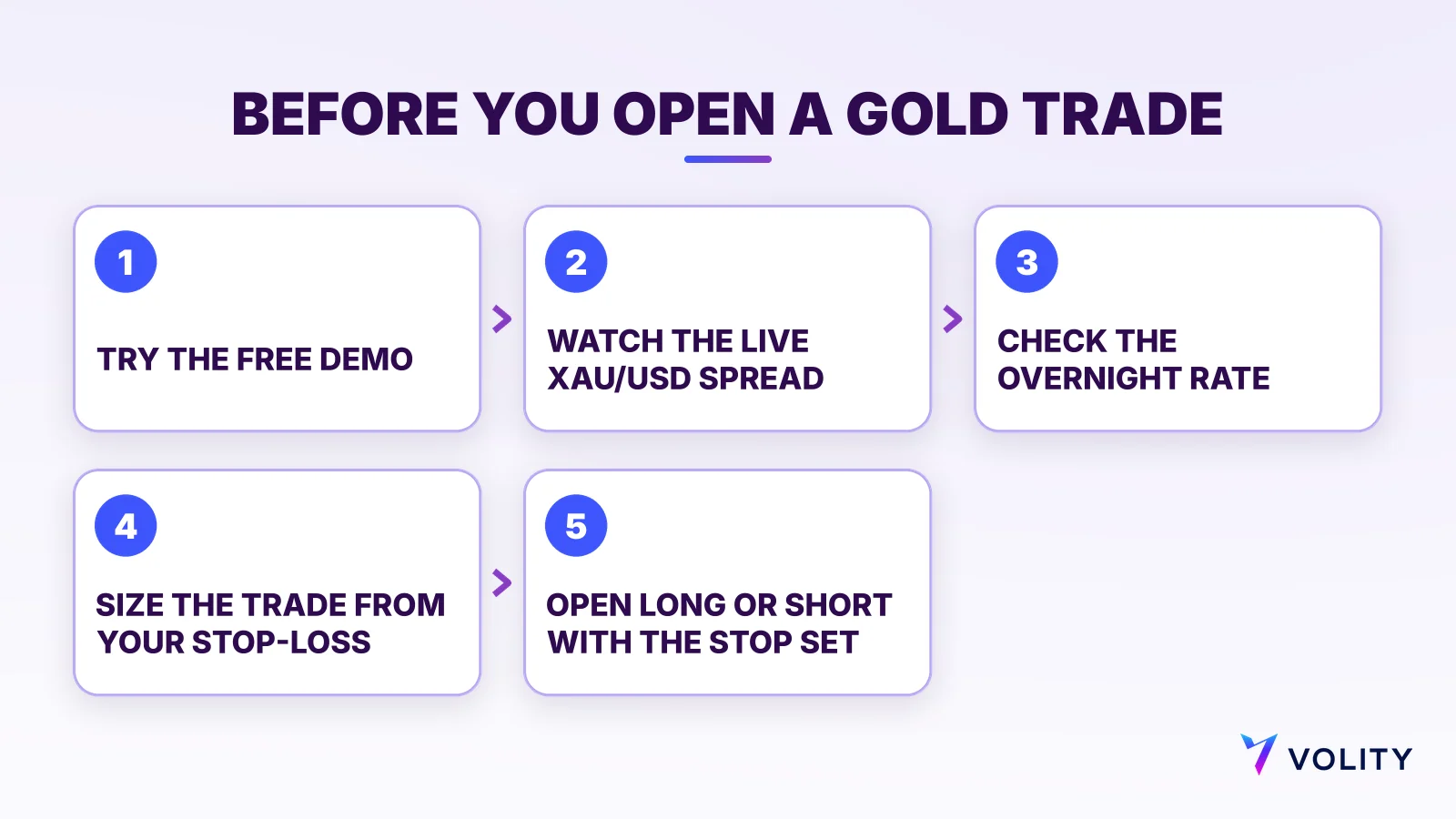
The quickest way to judge any gold trading platform is to use it. A demo runs on real market data, so you see the live XAU/USD spread and the overnight rate without risking money. This routine takes one session:
- Sign up and choose the free demo account.
- Open the XAU/USD or XAU/EUR chart.
- Watch the live spread at the hours you plan to trade, including around 10:30 and 15:00 London time.
- Check the overnight rate for gold on the platform.
- Pick a stop-loss level and size the trade from it, using the method above.
- Place a small demo trade, long or short, with the stop attached.
- Close it and check the result against your own sums: ounces times the price change, minus the spread.
New to practice accounts? See how a CFD demo account works.
Before your first live gold trade, you should be able to name three numbers: the spread you saw on the demo, the overnight rate if you hold past 22:00 GMT, and your loss at the stop. If you can state all three, the platform has given you what it should. If you cannot, stay on the demo a little longer.
Fact check: Volity product and cost details from volity.io, read 10 November 2026. LBMA Gold Price details from the LBMA and ICE Benchmark Administration. Price and demand figures from the World Gold Council, Gold Demand Trends Q3 2026 (published 3 November 2026). Retail CFD rules from ESMA (2018), FCA PS19/18 (2019) and ASIC (2020, extended in 2022). Checked 10 November 2026.
Frequently asked questions
What is the best platform to trade gold?
It is the one whose costs, tools and hours fit how you trade. The comparison guide linked above sets brokers side by side, and on Volity you can test all of it on the free demo.
Can I trade gold 24 hours a day?
Yes. On Volity, gold is one of a growing range of markets that trade 24/7, alongside crypto, silver, US500, US100 and WTI. Forex trades 24/5. The price can move fastest around the London benchmark auctions and major economic releases.
How much money do I need to start trading gold?
A Volity Markets account starts from $1, with funding from 10 EUR. A sensible amount is one where the loss at your stop is small next to your balance. The demo is free, so you can start there and add money later.
Is gold trading on Volity a CFD or real gold?
It is a CFD on spot gold, XAU/USD or XAU/EUR. You trade the price of gold and gain or lose on its moves. Gold exposure on Volity comes through these CFDs, with no bars, delivery or vault storage involved.
Can I go short on gold?
Yes. A CFD lets you sell first and buy back later, so you gain if the price falls and lose if it rises. On Volity you open a short gold position from the same order ticket as a long one.
How is the gold price on a trading platform set?
The platform quotes live buy and sell prices around the global spot price of gold, which moves all day. The LBMA Gold Price is a separate benchmark, set in auctions at 10:30 and 15:00 London time. The gap between the buy and sell price is the spread.