Crypto market resets as whales, regulators and robots move in
Crypto is limping through mid-2026 with the oddest sort of hangover. Prices look tired, yet the machinery around the market keeps improving. Traders face a familiar problem, but with sharper edges. The tape says downtrend. The plumbing says build-out.
That split matters. Bitcoin is no longer just a speculative thermometer. It has become the market’s argument with itself. Meanwhile, altcoins are suffering a harsher verdict. Liquidity has narrowed, narratives have faded, and investors now ask for cash flows, users and legal cover.
Altcoin depression deepens
The cleanest story is still the altcoin depression. More than 80% of top-100 tokens fell in June. Every tracked theme posted negative median returns. Ethereum also finished the second quarter down about 25%, its third straight losing quarter.
Across the broader altcoin complex, tokens outside Bitcoin and Ethereum have lost roughly 23% of market value in six months. Even the larger names remain badly bruised. Ether, BNB, XRP, Solana and TRON still trade about 60% below their peaks, on average.
So the old altseason playbook looks stale. In earlier cycles, traders could buy almost anything with a ticker and a community. Now, however, the market behaves more like small-cap equities. Selection matters. Balance sheets matter. Token supply schedules really matter.
Bitcoin sits in the tug of war
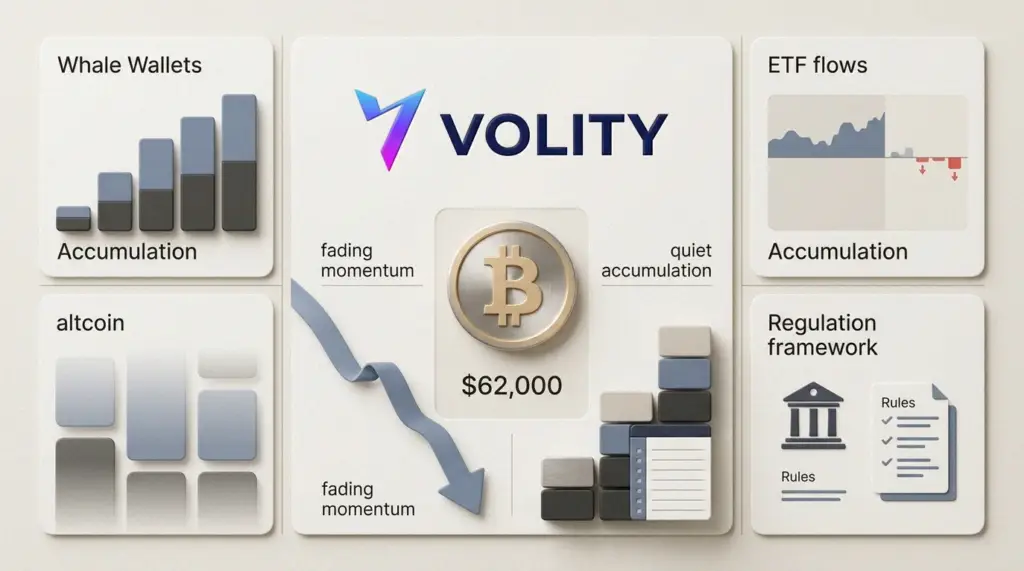
Bitcoin recently traded near the low-$62,000s, roughly half its October 2025 record above $126,000. That drawdown has put BTC back on every macro desk’s screen. It also leaves traders arguing over whether this is deep value or a bull trap.
Technically, momentum remains soft. Several desks are watching monthly moving averages for a possible bearish cross. If sellers keep control, the old $50,000 area from mid-2024 may return to the chart.
Yet the flow picture is less one-sided. Spot Bitcoin ETFs saw about $2.4 billion of net outflows in May, their weakest month of 2026. Meanwhile, large wallets reportedly accumulated roughly 270,000 BTC during the same period.
That is the core tension. Institutions using ETFs appear cautious. Whales, however, look willing to take the other side. Until one camp breaks, Bitcoin may remain stuck between value hunters and exhausted trend followers.
By the numbers
- 23% – approximate six-month fall in non-BTC, non-ETH crypto market value.
- 80% plus – share of top-100 tokens that fell in June.
- $62,000 – recent Bitcoin area, far below the 2025 peak.
- $2.4 billion – estimated spot Bitcoin ETF outflows in May.
- 270,000 BTC – reported accumulation by large wallets during ETF weakness.
Ethereum and xrp show the new split
Ethereum has hovered near support in the mid-$1,700s. However, resistance overhead has capped every serious recovery attempt. The asset remains essential to crypto infrastructure, but that does not guarantee a rising token price.
XRP has a different feel. Traders are watching breakout levels around $1.14 to $1.18. At the same time, the XRP Ledger reportedly processed about 1 million AI-linked payments through a Ripple-backed project.
That combination captures the market’s mood. Usage keeps appearing in payments, tokenisation and experimental AI finance. Still, token prices rarely reward activity immediately. Investors now demand proof that network use becomes durable value.
Risk plumbing returns to centre stage
This market is also forcing traders to relearn the boring parts. Multisig wallets, flash loans and liquidation engines are not background material anymore. They decide who survives a fast sell-off.
- Multisig wallets require several private keys to approve transactions. Treasuries, DAOs and exchanges use them to reduce single-key risk.
- Flash loans let traders borrow and repay funds inside one blockchain transaction. They support arbitrage, but also many protocol attacks.
- Liquidation systems sell collateral when leverage gets too high. They do not care about your thesis or your stop-loss plan.
For active traders, this is practical knowledge. A thin order book can become a liquidation spiral quickly. Meanwhile, one compromised signer can turn a treasury defence into an open door.
Wall street moves on chain
Away from spot crypto prices, tokenised real-world assets remain one of the stronger trends. Activity in tokenised equities has more than doubled in recent data. Banks and brokers now want blockchain rails without meme-coin chaos.
The product set is widening. Tokenised stocks offer on-chain exposure to conventional equities, often with fractional ownership and longer trading hours. RWA perpetuals go further, creating synthetic futures tied to stocks, bonds or commodities.
This is not only a retail experiment. Traditional finance wants faster settlement, programmable collateral and cheaper back-office systems. Crypto rails may keep winning business even while native tokens trade poorly.
Regulators fill the vacuum
Washington is also moving. July has been branded “Crypto Week” on Capitol Hill, with debate planned around the CLARITY Act, the Anti-CBDC Surveillance State Act and the GENIUS Act for stablecoins.
The CLARITY Act aims to define digital asset markets more cleanly. It also seeks protections for developers building decentralised systems. That distinction matters, because open-source coders are not the same as centralised issuers.
Meanwhile, Europe is rethinking parts of MiCA as stablecoins and exchanges become more competitive globally. The politics are not tidy. CBDC proposals face a growing backlash from voters worried about surveillance and wallet-level control.
For investors, regulation is moving from fog to rulebook. However, the transition will create winners and losers. Tokens with unclear issuer control, weak disclosures or thin compliance support may struggle for regulated capital.
Corporate adoption keeps arriving
The corporate feed tells a different story from the price chart. SWIFT is testing a blockchain ledger pilot with global banks for tokenised interbank settlement. That does not replace its messaging network yet, but it signals intent.
Sony Bank has secured conditional US approval to form a dollar stablecoin trust bank. Hyundai Card is testing intercompany remittances using USDT on Avalanche. Robinhood, meanwhile, keeps pushing deeper into crypto infrastructure after a strong run in HOOD.
The pattern is simple. Large companies like stablecoins, settlement rails and tokenised assets. They are much less eager to warehouse volatile coins. Adoption is becoming more practical, less theatrical.
Security and exchange risk bite again
The risk tape remains ugly. An INTERPOL operation targeting illicit crypto flows produced thousands of arrests and blocked transfers. Enforcement is catching up with cross-border on-chain activity, even if slowly.
Users are still the soft target. A sophisticated Ethereum phishing scam drained nearly $1 million from wallets. Separately, AscendEX said it would shut down and warned users they may not recover full balances.
That is a blunt reminder. Venue risk is position risk. Custody risk is strategy risk. In crypto, a profitable trade can still disappear through the wrong login page.
Macro still sets the ceiling
The broader backdrop remains hostile. Inflation has not vanished, economic activity has stayed resilient, and central banks have little room to cut. Higher real yields continue to weigh on long-duration risk assets.
The Federal Reserve has also flagged inflation risks linked to heavy AI investment. Meanwhile, geopolitical shocks, including renewed Iran-related tensions, have hit global risk appetite. Bitcoin still sells off when portfolios move into defence.
So crypto’s next leg may not come from a protocol upgrade or a conference slogan. It may come from bond yields, oil prices and rate expectations. Traders should watch the Treasury screen as closely as gas fees.
Key takeaways
- Respect the trend: rallies still look tactical until Bitcoin reclaims stronger momentum.
- Be selective: altcoins now need usage, liquidity and credible token economics.
- Check custody: exchange and wallet risk can overwhelm a good trading thesis.
- Follow regulation: CLARITY, GENIUS and MiCA changes may redraw investable markets.
- Separate rails from coins: adoption can rise even while token prices fall.
This is the awkward phase of a crypto cycle. The charts look worn down, but the infrastructure keeps advancing. For disciplined traders, that is uncomfortable. It is also where the next market map quietly gets drawn.
Related coverage on Volity
- How to Avoid Crypto Scams: A Beginner Safety Checklist
- How to Choose a Trading Platform: A 10-Point Checklist
- Demo vs Live Trading Account: A 7-Step Checklist Before You Go Live
- How to Size a Trade: Position Sizing and Risk Per Trade for Beginners
- Risk-Reward Ratio Explained: How to Set It and Why It Matters
- ETF vs Index Fund: The Difference and Which to Pick