Crypto morning brief: etf money, political fire and ethereum’s tug-of-war
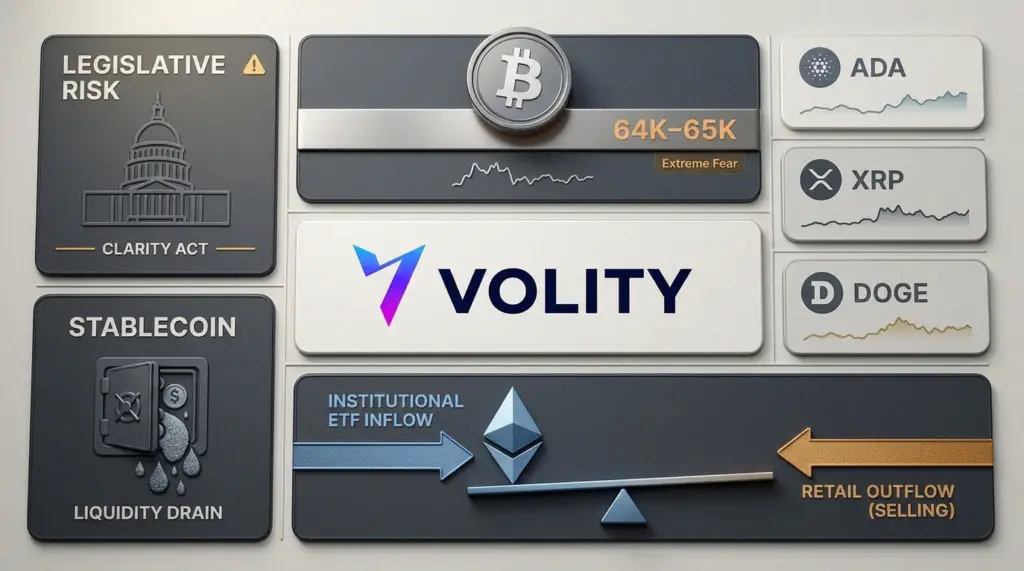
Crypto is green this morning, though nobody is throwing confetti. Bitcoin is holding the $64,000 to $65,000 band. Ethereum is caught between institutional buying and retail selling. Meanwhile, politics is doing what politics does best – turning a market story into a stress test.
The total crypto market value sits near $2.3 trillion, up about 1.7% over 24 hours. Trading volume is running close to $69 billion. That is healthy enough for traders, but not yet the sort of tape that forces sceptics back in.
Market pulse
Bitcoin has clawed back ground above $65,000 after finding buyers near $64,000. However, the rebound looks careful rather than forceful. Bulls want a clean move through $68,000. Bears want one failed bounce, then a test of $60,000.
For now, the chart is simple. Holding $64,000 to $65,000 keeps the short-term bullish case alive. A break below $60,000 would change the conversation quickly. The next few sessions may matter more than the modest daily gain suggests.
Sentiment gauges still point to extreme fear, despite bitcoin’s weekly bounce of roughly 5%. That tells traders something useful. The market has recovered price faster than confidence. In crypto, that can produce sharp rallies. It can also snap back without much warning.
By the numbers
- $2.3 trillion – approximate total crypto market value.
- $69 billion – 24-hour trading volume across major venues.
- $64,000 to $65,000 – bitcoin’s near-term support zone.
- $68,000 to $70,000 – next upside target area for bitcoin bulls.
- $2.3 billion – estimated stablecoin liquidity drain from leading exchanges.
Ethereum
Ethereum is the more interesting fight. ETF buyers and larger funds have turned net buyers after weeks of hesitation. Yet retail wallets continue to sell into rallies. Meanwhile, several US-based flows remain weak, keeping the price action heavy.
Derivatives desks have begun to lean the other way. Net taker volume on Binance has flipped positive for ETH for the first time since last summer. That points to renewed long interest in futures and perpetual contracts. However, spot buyers have not yet followed with conviction.
ETH remains below levels many longer-term valuation models treat as fair. It also sits near important technical zones. Traders are watching the $1,825 to $1,975 area on downside structures. Above that, attention shifts towards $2,400 to $2,800, where the next bigger battle begins.
Some long-range forecasts still talk about $5,000 to $9,000 ether. Still, the immediate chart is far more ordinary. Ethereum is chopping around major moving averages. Neither side owns the tape. The market feels more like accumulation than acceleration.
That matters because Ethereum often sets the mood for the rest of the risk curve. If ETH can reclaim the mid-$2,000s, altcoins may breathe. If it fails near current resistance, traders will probably keep favouring bitcoin and liquid large caps.
Altcoins
Outside bitcoin and ether, the action is choosy. Pi Coin is among the notable losers, trading near $0.0915, down about 4.5%. Its Protocol v25 story still has believers, but the chart needs a reclaim of $0.10 before momentum traders care.
Cardano, XRP and Dogecoin are all drawing attention. However, their stories differ sharply.
- Cardano trades just below $0.20. A rounded-bottom pattern has formed, while recent network changes have revived talk of a break through $0.19 to $0.20.
- XRP has gained around 4%, helped by ETF inflow chatter and a triangle breakout. Bulls are watching $1.35 as a possible target.
- Dogecoin is flashing technical buy signals. Still, a merge-mining debate and whale positioning near liquidation levels could stir intraday swings.
Solana is trying to hold below $80, even as fresh exploit headlines test patience with its ecosystem. That is becoming a familiar pattern. Traders will chase strong stories, but they now punish weak security and thin liquidity much faster.
Regulation
The liveliest catalyst may not be on a chart. The US CLARITY Act, a central digital-asset bill, has moved past a major ethics dispute. Negotiators have narrowed restrictions on federal officials profiting directly from digital assets. That removes one obstacle, though not the whole political mess.
Even so, the bill is moving into election-season weather. Donald Trump’s allies have used ethics arguments to slow Senate timing. Bernie Sanders, meanwhile, is promising to take on crypto as part of a broader attack on financial excess. Traders should expect headlines to matter.
Coinbase has backed tougher versions of the bill. That position is telling. Large US exchanges appear willing to accept stricter rules if those rules finally replace uncertainty. For public companies and ETF issuers, ambiguity is often more expensive than compliance.
Regulatory pressure is also spreading beyond Washington.
- Russia has passed a broad crypto market law covering cross-border trade and international digital-asset flows.
- India is seeing Maharashtra push the DELTA Act, a planned framework for tokenised property.
- Britain has opened a parliamentary inquiry into bank restrictions on crypto firms and fiat access.
- South Korea continues to draw stablecoin and tokenisation partnerships into mainstream payment channels.
Enforcement has not vanished either. Celsius co-founders are set to pay $6.5 million after fraud claims were closed. Meanwhile, US regulators continue to pursue alleged mining-related fraud. The clean-up from the last cycle remains unfinished business.
Stablecoins
Stablecoins remain the market’s less glamorous core. Recent estimates show a $2.3 billion drain of stablecoin liquidity from major exchanges, including Binance and Bybit. That matters because thinner on-exchange dollar liquidity can exaggerate moves when bitcoin loses momentum.
However, the broader stablecoin story is not bearish. One dollar-pegged coin has crossed $1 billion in supply while adding Chainlink infrastructure. In Asia, payment partnerships continue to frame stablecoins as settlement tools, not just trading chips.
Tokenisation is moving in the same direction. Base and Coinbase are nearing products that track tokenised stocks close to 1:1. Robinhood has been early in listing tokenised equity. Meanwhile, Hanwha has become the largest shareholder in Securitize, a direct bet on regulated tokenised securities.
Even the London Stock Exchange is studying overnight trading. That is a small sentence with a large meaning. Traditional markets are watching crypto’s 24-hour rhythm and wondering how much sleep they can still afford.
Key takeaways
- Bitcoin needs to hold $64,000 to $65,000. Losing that band would put $60,000 back in play quickly.
- Ethereum has a cleaner setup, but not a cleaner chart. Institutional demand is improving, while retail supply still caps rallies.
- Altcoin trades remain tactical. ADA, XRP and DOGE may move, but liquidity still rules the day.
- Regulation is now a market catalyst. The CLARITY Act could shape flows as much as any technical breakout.
- Stablecoin balances matter. Falling exchange liquidity can sharpen both breakouts and breakdowns.
The market has left panic behind, but it has not entered full recovery. For now, flows matter more than slogans. Watch ETF demand, stablecoin balances and political timing. The candles will follow the money.
Related coverage on Volity
- How to Avoid Crypto Scams: A Beginner Safety Checklist
- How to Choose a Trading Platform: A 10-Point Checklist
- Demo vs Live Trading Account: A 7-Step Checklist Before You Go Live
- How to Size a Trade: Position Sizing and Risk Per Trade for Beginners
- Risk-Reward Ratio Explained: How to Set It and Why It Matters
- ETF vs Index Fund: The Difference and Which to Pick