Crypto’s $80,000 crossroads: money pours in, confidence stays out
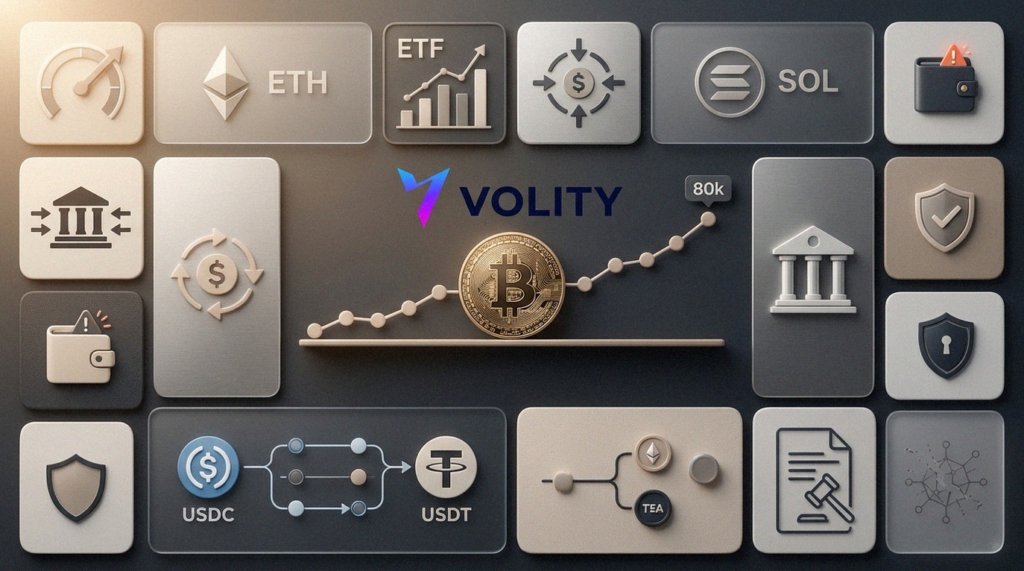
October 29, 2026 – Bitcoin has retaken $80,000, yet the move resembles a wary truce rather than a victory parade.
Stronger US growth data briefly revived risk appetite. However, a firm Federal Reserve, uneven ETF demand and new security failures kept buyers cautious.
Institutional capital has arrived in crypto. The harder question is whether it can overcome tighter liquidity, political uncertainty and operational risks.
Bitcoin finds buyers, but not a breakout
Bitcoin hovered near $80,000 after economic data showed stronger-than-expected US growth. Investors initially welcomed the numbers because recession fears eased.
That relief faded when the Federal Reserve held rates at 3.75% to 4%. Two officials reportedly preferred another increase.
Traders read the split as a warning. Inflation could still delay the rate cuts that normally support speculative assets.
Spot Bitcoin ETFs recorded about $137 million in net inflows during one recent session. Yet the buying has not delivered a sustained move above resistance.
Investors appear happy to buy dips. They remain less willing to chase Bitcoin after sharp intraday rallies.
The next personal consumption expenditures report may settle the argument. A softer reading could revive hopes for easier policy.
A hotter number would strengthen the Fed’s hand. In that case, Bitcoin’s $80,000 support may face another stern test.
Ethereum and Solana absorb the pressure
Ether has lagged Bitcoin as investors retreat from higher-beta tokens. ETF outflows have added to the strain.
Meanwhile, Ethereum client teams patched a flaw involving validator reward redirection. The episode stopped short of a network-wide failure.
Still, it exposed a persistent weakness in staking. Validators depend on software clients, signing systems and disciplined operational controls.
Any weak link can threaten rewards, custody or confidence. Yield in crypto rarely arrives without technical risk.
Solana’s decline has looked more direct. SOL fell below $100 after spot Solana ETFs recorded $24.8 million in combined outflows.
The token traded near $99.71 and had lost more than 15% over the month. A large holder also sold 1.02 million SOL.
That sale represented roughly $104 million over five days. Traders are watching $96 to $100 as the immediate support range.
A move above $104 to $105 would improve the short-term chart. Until then, sellers retain the advantage.
Stablecoins become the quieter success story
Token prices may wobble, but stablecoin payments continue to gain ground. Visa said settlement volume had surpassed $25 billion.
That figure was roughly ten times higher than a year earlier. Stablecoin-linked card programmes now exceed 225 across more than 50 countries.
Those programmes cover about five million cards. The appeal lies in mundane, useful plumbing rather than speculative excitement.
Businesses can prefund cross-border payments outside bank hours. Merchants can accept card payments without asking customers to understand blockchains.
Visa supports settlement across ten blockchains. Its supported assets include USDC, EURC, PayPal USD and other dollar-linked tokens.
The company has launched settlement services in markets including the US, Mexico, Switzerland and the UK. That expansion gives stablecoins a more tangible economic role.
Ripple’s RLUSD also reached Coinbase, with support across the XRP Ledger, Ethereum and Base. The listing widens access but raises familiar reserve questions.
Investors should examine backing assets, redemption speed and reporting standards. A stablecoin only looks stable when holders can leave easily.
Wall Street borrows crypto’s machinery
Traditional exchanges are moving closer to crypto’s trading model. Intercontinental Exchange has partnered with TradeXYZ on US perpetual futures.
Perpetual contracts have no fixed expiry date. They dominate crypto derivatives, partly because traders can maintain leveraged positions continuously.
A regulated US version could broaden access. It could also sharpen scrutiny of leverage, forced liquidations and retail losses.
Tokenisation is spreading beyond derivatives. DTCC has launched a tokenisation service involving 20 major companies.
Elsewhere, the London Metal Exchange is exploring tokenised metals in Hong Kong. The Cardano Foundation has joined a Swiss group focused on tokenised shares.
The sales pitch is simple: faster settlement, automated compliance and fractional ownership. The difficult questions concern legal ownership, custody and settlement finality.
Those details matter most when markets close or an intermediary fails. A token cannot solve a legal dispute by itself.
Security failures spoil the mood
The day’s most troubling report involved the CryptoBilis Ledger hack. Attackers reportedly stole about $95 million, while roughly $10 million was later frozen.
Singapore police separately reported $3.5 million in losses linked to tampered Ledger wallets. The cases again showed where crypto’s weakest points often sit.
Hardware devices, exchange accounts, signing tools and user interfaces can all fail. The blockchain itself need not break for investors to lose money.
Allium, a blockchain data provider used by Visa, Stripe and Coinbase, also suffered a breach. The incident disrupted services and prompted work around exposed API keys.
Such providers attract little attention during calm trading. Yet many payment, compliance and market-data systems depend on their reliability.
What traders are watching
- Bitcoin: Whether $80,000 holds without one-off ETF buying.
- US inflation: PCE data could shift expectations for Federal Reserve rate cuts.
- Ethereum: ETF flows and validator-security updates remain key.
- Solana: The $96 to $100 range now marks the nearest support test.
- Stablecoins: Reserve disclosures and redemption terms matter as much as volume.
Crypto has more institutional money, payment activity and financial engineering than before. Yet price action still reflects a market demanding proof.
Bitcoin’s $80,000 level sits between improving adoption and restrictive liquidity. Every rally now faces the Fed, regulators and the next security report.
Related coverage on Volity
- How to Avoid Crypto Scams: A Beginner Safety Checklist
- How to Choose a Trading Platform: A 10-Point Checklist
- Demo vs Live Trading Account: A 7-Step Checklist Before You Go Live
- How to Size a Trade: Position Sizing and Risk Per Trade for Beginners
- Risk-Reward Ratio Explained: How to Set It and Why It Matters
- ETF vs Index Fund: The Difference and Which to Pick