The crypto market started Friday with one eye on charts and the other on Washington. Bitcoin slipped below $65,000, ether steadied near $1,900, and traders found little reason to chase risk before the weekend.
However, the market did not look broken. ETF demand still provided a cushion, volumes stayed firm, and selective buying returned to smaller tokens. Even so, the delay of a key U.S. market-structure bill shifted the day’s mood from hope to hesitation.
Market pulse
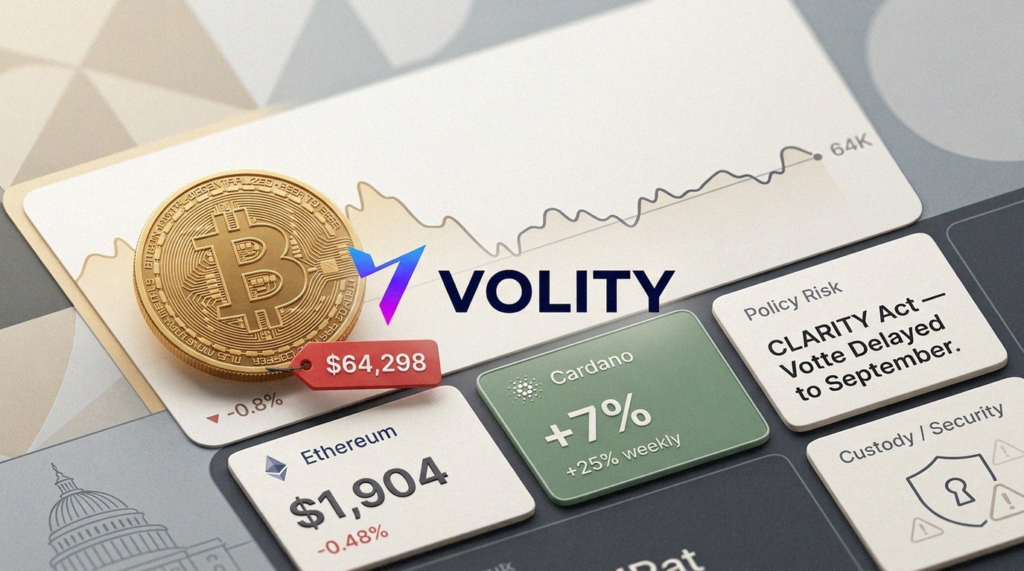
Bitcoin traded at $64,298.45, down 0.8% on the day, with turnover near $16.87 billion. The move followed U.S. jobs data and left BTC stuck in a narrow band below a psychologically important level.
Normally, steady ETF inflows would give bulls a cleaner story. This time, though, they looked more like insulation than rocket fuel. Institutional demand helped limit the damage, but it did not force a breakout.
Meanwhile, ether held a slightly firmer tone. ETH traded near $1,903.76, down 0.48%, after pushing through key moving averages in a run toward $2,000. That kept technical traders interested, even as momentum cooled.
The difference matters. Bitcoin still sets the market’s weather, but ether often shows whether risk appetite has depth. For now, ETH looks less tired than BTC, though neither asset is sprinting.
Cardano offered the livelier trade. ADA rose 7.12% to $0.2015, with volume around $1.02 billion. The token has gained roughly 25% this week, making it one of the clearer pockets of relative strength.
Still, traders should be careful with that kind of heat. A strong weekly move can pull in momentum money. However, it can also leave late buyers exposed if bitcoin loses the $64,000 area.
By the numbers
- Bitcoin: $64,298.45, down 0.8%, with $16.87 billion in turnover.
- Ether: $1,903.76, down 0.48%, after a technical push toward $2,000.
- Cardano: $0.2015, up 7.12%, with $1.02 billion in volume.
- Policy calendar: U.S. Senate vote on the CLARITY Act delayed until September.
- Security watch: More than 5,200 addresses linked to a Coldcard-related wallet issue.
Regulation risk
The day’s most important catalyst may sit in Congress, not on-chain. The U.S. Senate delayed its vote on the CLARITY Act until September, pushing the issue beyond the August recess.
That delay matters because the bill has become a shorthand for cleaner U.S. crypto rules. It could shape how exchanges, issuers and intermediaries operate. A postponement removes a neat bullish talking point from the tape.
Markets dislike uncertainty, but crypto particularly dislikes it. The industry has spent years asking whether a token is a commodity, a security, or something in between. The longer that answer drags, the harder it becomes to price U.S. regulatory risk.
Even so, the regulatory story is not purely American. In Europe, Stripe-owned Bridge joined the EU’s MiCA register as the 42nd authorised stablecoin issuer. That places it inside a framework that already functions as a commercial filter.
As a result, Europe is turning compliance into infrastructure. Firms that secure licences early may gain distribution advantages. Meanwhile, slower rivals face higher costs and narrower banking options.
Wintermute also gained U.S. broker status and is looking at tokenised stocks. That development points to a broader shift. The next crypto cycle may depend less on mascot coins and more on market plumbing.
Security pressure
Security remained a live concern, and not in a theoretical way. Bitcoin Telegram accounts were targeted by North Korean hackers, according to industry security reports. Coldcard also paused customer data deletion after a July exploit.
Separately, a five-year-old Coldcard firmware flaw enabled attackers to drain bitcoin from affected wallets starting July 30. More than 5,200 addresses were tied to the issue.
That detail should bother anyone who treats self-custody as a simple fix. Hardware wallets reduce certain risks, but they do not remove software flaws, phishing or poor operational habits. In crypto, cold storage can still produce hot losses.
Microsoft also flagged ClickFix malware that used BNB Chain to fetch attack instructions. That is a grim little twist. Public blockchains can move payments, verify assets and, apparently, help malware find its marching orders.
Meanwhile, crypto crime continues to move beyond online hacks. Investigators now track more offline pressure, hybrid schemes and social-engineering attacks. The security premium around trusted custody may keep rising.
Company moves
Miners delivered some of the rougher corporate news. CleanSpark reported a $239 million quarterly loss as revenue fell 30.5%, missing expectations. MARA said its bitcoin holdings fell 29% as its second-quarter loss reached $611 million.
Those figures show why mining equities can trade differently from bitcoin. Higher network difficulty, energy costs and balance-sheet choices all matter. So, a flat bitcoin price can still feel painful for weaker operators.
By contrast, Canaan tapped a $130 million crypto reserve for stock buybacks. That move may support its equity, at least near term. However, it also underlines how miners now manage treasuries like public-market companies, not garage pioneers.
On the product side, Kraken gave token holders voting rights in its xStocks initiative. If executed carefully, that could reduce a legal sore point in tokenised equities. Investors want economic exposure, but regulators care about governance rights too.
MetaMask unveiled an AI wallet with $10,000 of loss protection. The consumer pitch is clear: make crypto less hostile to ordinary users. Still, security guarantees will need proving in market stress, not in product demos.
Rarible also launched on Solana with Claynosaurz NFTs. That is not a systemic event, clearly. Yet it shows consumer crypto has not disappeared. It has merely become more selective, cheaper and a little quieter.
Global policy
Japan’s Financial Services Agency is pushing withdrawal delays after a rise in scams. Thailand is using a zero percent crypto tax to compete for capital. South Korea’s Upbit parent, Dunamu, will custody seized crypto for police.
These are not flashy headlines, but they matter. Governments are no longer only writing warnings and filing lawsuits. Increasingly, they are building the rails, setting custody rules and shaping where capital can move.
That changes the investment case. Crypto may still trade like a speculative asset class, especially on weekends. However, its infrastructure is becoming more formal, more regional and more tied to public policy.
Trading focus
- Bitcoin near $64,000: a sustained break lower could unwind Friday’s calm quickly.
- Ether near $1,900: follow-through above moving averages would improve short-term risk appetite.
- Cardano at $0.20: buyers need to defend the breakout area after a sharp weekly rally.
- U.S. regulation: the delayed September vote keeps market-structure uncertainty in place.
- Custody risk: wallet exploits and state-linked phishing remain immediate sentiment threats.
For now, crypto is pausing rather than panicking. Bitcoin needs a catalyst, ether needs confirmation, and altcoins need BTC to avoid another air pocket. Until then, Washington may move prices as much as any candlestick.
Related coverage on Volity
- How to Avoid Crypto Scams: A Beginner Safety Checklist
- How to Choose a Trading Platform: A 10-Point Checklist
- Demo vs Live Trading Account: A 7-Step Checklist Before You Go Live
- How to Size a Trade: Position Sizing and Risk Per Trade for Beginners
- Risk-Reward Ratio Explained: How to Set It and Why It Matters
- ETF vs Index Fund: The Difference and Which to Pick