Crypto week puts wall street onchain
Crypto starts the week with a split screen. Bitcoin is sagging below $65,000, while Wall Street keeps wiring itself to blockchains. Meanwhile, Washington has turned digital assets into campaign ammunition.
For traders, that mix is awkward. The tape looks tired, yet the plumbing keeps improving. Short-term price action and long-term market structure are now telling different stories.
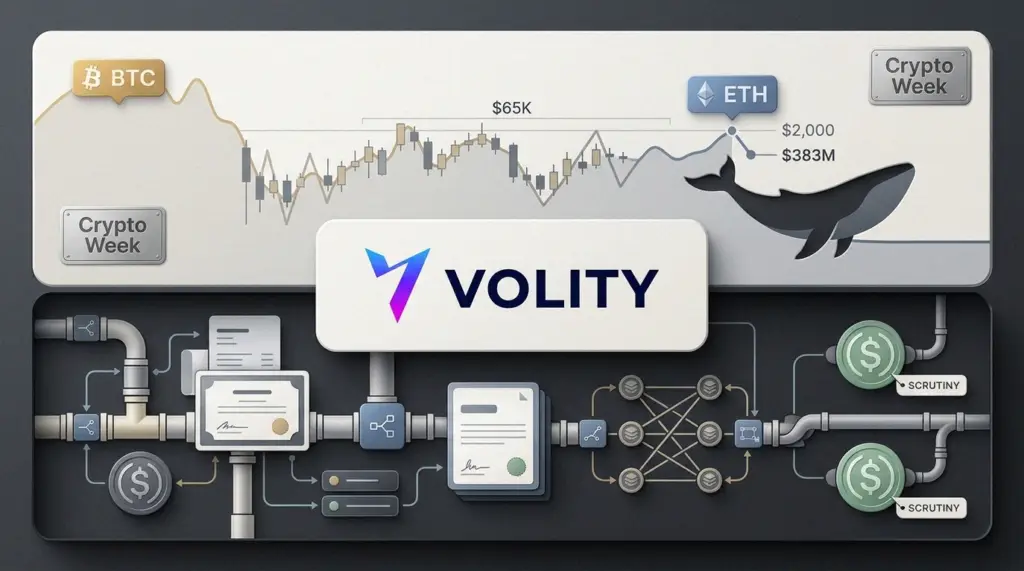
Bitcoin loses steam below $65,000
Bitcoin slipped under $65,000 after a brief rally on softer inflation data. However, the move looks more like profit-taking than panic.
Whales and long-term holders have been locking in gains after the latest push higher. Derivatives data also points to stretched positioning, with leverage doing more work than spot demand.
That matters because leverage can lift prices quickly, then vanish faster. Traders should treat sharp upside wicks with care until spot demand returns.
Still, the bull case has not disappeared. Veteran trader Peter Brandt has flagged a possible bottoming structure near current levels. If that read holds, this pause could become a base rather than a trapdoor.
Then came the week’s ghost story. A dormant wallet moved about $383 million in BTC after more than eight years of silence. Old coins rarely move quietly, and desks noticed.
For now, Bitcoin is stuck between profit-taking and patience. That usually means chop, false breaks and expensive confidence.
Ethereum keeps $2,000 in sight
Ethereum also rallied on the inflation print, then gave back ground. Once again, the $2,000 area is doing heavy work.
For options traders, that strike remains the battlefield. Meanwhile, spot investors are watching whether ETH can hold higher lows beneath it.
A clean break above $2,000 would improve sentiment quickly. However, another failed move could flush fresh leverage from the system.
Macro still has ETH on a short leash. Softer data can spark fast buying, but the market has little patience for unconfirmed breakouts.
AI tests bitcoin’s attention span
Artificial intelligence still pulls capital and attention from crypto. Even so, Binance founder Changpeng Zhao has sharpened the debate.
He argues that Bitcoin, not AI stocks, offers real protection against inflation. The point is simple. AI may deliver growth, but it still lives inside the fiat system.
That distinction matters for allocators. They must decide whether to chase earnings momentum or keep a hard-money anchor in BTC.
In practice, many will try both. However, crowded AI trades and weak crypto momentum make position sizing more important than slogans.
Stablecoins keep being marketed as digital dollars. Yet traders should remember that a peg is a promise, not a law.
A depeg happens when a token meant to trade at $1 moves materially above or below that level. Reserve doubts, market stress or regulatory shocks can all trigger it.
That sounds academic until liquidity thins. Then, what looked like cash can become a directional bet at precisely the wrong moment.
Reserve quality now matters as much as yield. So does the issuer’s jurisdiction, disclosure and banking access.
Tokenisation moves into the back office
The week’s biggest structural story is not on a candle chart. It is in Wall Street’s back office.
Cantor Fitzgerald and Securitize are working to bring IPO shares onchain. The move fits a broader push into tokenised stocks, Treasurys and fund interests.
Meanwhile, transfer agents are gaining new importance. They keep cap tables accurate, reconcile onchain and offchain records, and police compliant share movement.
BlackRock has joined DTCC’s $114 trillion tokenisation initiative for stocks and U.S. Treasurys. That signals something larger than a pilot scheme.
In Japan, SBI is using Solana for a tokenised domestic equity fund. If it works, others will copy the design quickly.
- Tokenisation is moving from experiment to market infrastructure.
- Transfer agents and custodians will matter more to crypto traders.
- Traditional assets are starting to use crypto-style settlement rails.
New rails bring new weak spots
Exchanges are racing to build products around tokenised equities. Bitget has added margin support for 100 tokenised U.S. stocks in one pool.
That gives traders equity exposure with crypto-style leverage and settlement. However, it also blends two risk systems that behave differently under stress.
DeFi had its own reminder this week. Morpho recovered after a suspected AWS CloudFront outage hit its app and API.
The lesson was blunt. Even decentralised finance can still lean on centralised web infrastructure.
Inside Morpho, Zama’s confidential USDC vault climbed to eighth place. Demand for private, yield-bearing stablecoin products is rising.
Elsewhere, Hyperion DeFi committed 500,000 HYPE tokens to support perpetual listings on Hyperliquid. Incentives remain the fuel under derivative growth.
Companies test crypto in the real world
Corporate experiments are getting less theoretical. Volvo Group is testing its own cryptocurrency for supplier payments.
If the trial works, supply chains could become live environments for programmable settlement. That would mean faster reconciliation and fewer payment frictions.
ORANGE JUICE, a roll-up vehicle, raised $40 million to buy real-world businesses and build a Bitcoin treasury. The idea echoes MicroStrategy, but with operating companies attached.
Visa is also preparing for an AI economy where cards and stablecoins work together. Payment giants seem determined to absorb crypto rails, not fight them from the outside.
Pi network shows whale risk
Pi Network jumped about 20% in one session, helped by aggressive dip buying from a large holder.
One wallet reportedly holds about 400 million PI. That can look like conviction, but it also creates concentration risk.
For traders, PI now behaves like a whale-shaped market. Technical levels matter, yet one large actor can shove them aside.
Politics turns louder in washington
In Washington, crypto has moved from committee rooms to campaign speeches. The CLARITY Act is heading toward a Senate fight.
The bill aims to define digital asset rules and block a U.S. central bank digital currency. Donald Trump has personally pressed senators to support it.
Supporters say it would strengthen America’s role in crypto and AI. Critics say it could protect Trump’s own digital asset interests.
Meanwhile, the House has branded this stretch “Crypto Week”. Lawmakers are pushing bills on stablecoins, market structure and CBDC limits.
For markets, policy risk is no longer vague. It is being drafted, traded and weaponised in real time.
Abroad, South Korea has raised rates, adding pressure to risk appetite. Young, leveraged traders absorbed much of a reported $1.45 billion wipeout.
In Latin America, Tether has put about $20 million into Argentine fintech Ualá. Dollar stablecoins keep burrowing deeper into emerging-market finance.
Security keeps making noise
Operational risk also stayed in view. Blockaid uncovered an $18 million exploit that forced Ostium to halt trading.
A Stanford study flagged a design flaw in Polymarket. Under certain structures, the flaw could reward attempted Bitcoin price manipulation.
Robinhood Chain launchpad Vlad.fun shut down abruptly over internal issues. That undercut the comforting myth of always-on retail platforms.
Hardware wallets also took heat. Onchain investigator ZachXBT criticised leading devices sharply, with Ledger receiving the harshest mention.
For investors holding serious size, custody is not a lifestyle choice. It is part of the trade.
Key takeaways
- Respect $65,000 Bitcoin. Profit-taking and possible bottoming signals can coexist. Trade smaller in noisy ranges.
- Watch ETH at $2,000. A clean hold improves momentum. Another rejection could reset leverage.
- Study tokenised securities. Transfer agents, custodians and settlement rails are becoming tradeable knowledge.
- Treat stablecoins as credit products. Pegs depend on reserves, liquidity and regulatory access.
- Price politics into risk. U.S. crypto bills can change liquidity, listings and institutional flows.
The week’s tape looks uncertain, but the direction of travel is clear. More assets are moving onchain, and more politicians want a hand on the switch.
Related coverage on Volity
- How to Avoid Crypto Scams: A Beginner Safety Checklist
- How to Choose a Trading Platform: A 10-Point Checklist
- Demo vs Live Trading Account: A 7-Step Checklist Before You Go Live
- How to Size a Trade: Position Sizing and Risk Per Trade for Beginners
- Risk-Reward Ratio Explained: How to Set It and Why It Matters
- ETF vs Index Fund: The Difference and Which to Pick