Crypto’s weekend split
Bitcoin slipped beneath $80,000 on Saturday, while regulated funds kept accumulating exposure.
Meanwhile, Robinhood Chain posted striking fee numbers, driven largely by speculative activity.
The contrast captures crypto’s current mood. Macro traders are cutting risk, yet longer-term capital has not left.
Bitcoin loses $80,000 after jobs surprise
Bitcoin traded near $79,600 after falling from above $81,000 earlier in the session.
At its intraday low, the token briefly touched the high-$78,000 range.
August payrolls reportedly rose by 162,000, beating expectations and challenging hopes for easier monetary policy.
Unemployment held at 4.1%, reinforcing the view that the labour market remains firm.
Rate futures raised the implied odds of a Federal Reserve increase at September’s meeting.
Those odds reportedly moved above 60%, from just over 50% before the data.
Bitcoin reacted like a high-beta macro asset. Higher yields can make non-income-producing assets less appealing.
However, the move looks more like a positioning reset than a broad withdrawal from crypto.
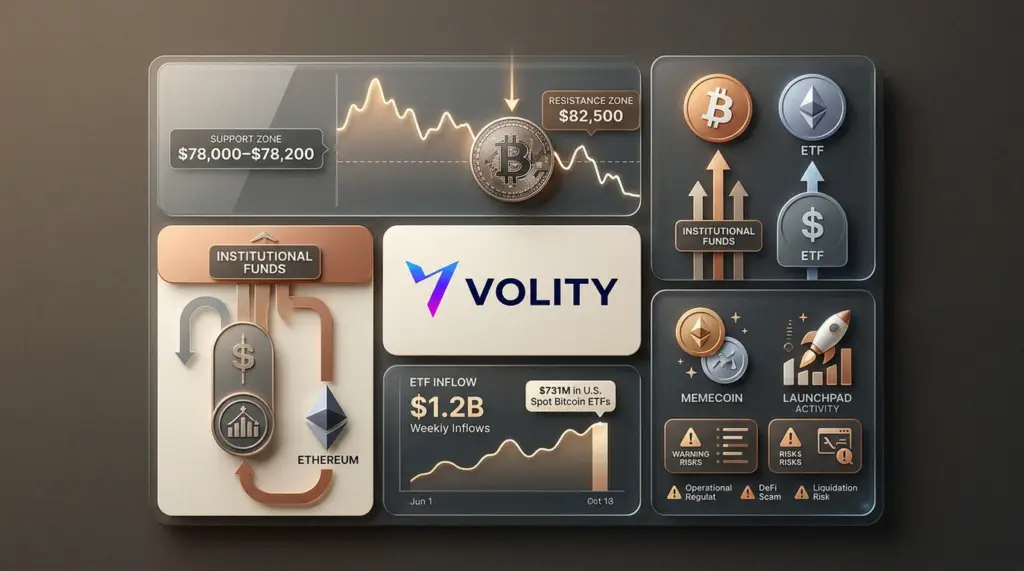
Traders now watch $78,000 to $78,200 as near-term support. Resistance sits around $82,500.
A sustained break below support could expose the mid-$76,000s, particularly if leveraged positions unwind.
Conversely, a recovery above $82,500 would signal that buyers absorbed the jobs-data shock.
ETF buyers take the other side
Spot prices weakened, but the ETF channel told a more constructive story.
Bitcoin and Ethereum exchange-traded funds attracted roughly $1.2 billion of net inflows during the past week.
U.S. spot Bitcoin ETFs alone took in about $731 million, their strongest weekly intake since January.
That matters because ETF buying tends to reflect slower-moving allocation decisions, rather than intraday sentiment.
The market has split into two camps.
Short-term traders are reacting to rates, liquidation levels and the $80,000 headline.
Meanwhile, wealth managers and institutional investors appear willing to buy macro-driven weakness.
Neither group guarantees Bitcoin’s next move. Still, the flows reduce the case for calling this a simple demand collapse.
- Bitcoin price: about $79,600 after losing $80,000
- Near-term support: $78,000 to $78,200
- Near-term resistance: about $82,500
- Weekly BTC and ETH ETF inflows: about $1.2 billion
- U.S. spot Bitcoin ETF inflows: about $731 million
Robinhood Chain’s fee burst comes with a warning
Elsewhere, Robinhood Chain has become one of the market’s liveliest experiments.
The network reportedly generated daily fees between $3.75 million and $6 million on its busiest days.
At times, that exceeded Solana, Ethereum and Base combined on the fee line.
For a chain only months into mainnet operations, those figures demand attention.
However, fee revenue alone does not prove a durable network economy.
Much of the activity has been described as “degen flow”, including memecoin trades and rapid-fire launchpad speculation.
That traffic can produce enormous fees during favourable conditions. It can also disappear with little warning.
Launchpads, including Pons, have already drawn users away from established venues such as Pump.fun.
Tokenised stock experiments have also started attracting unwanted attention from listed companies.
AMC’s chief executive publicly objected to a Robinhood-linked token, saying he had not authorised it.
The episode shows how quickly tokenisation can collide with corporate governance and securities-law questions.
Big daily-yield claims deserve small position sizes
Promotions promising $1,000 to $8,400 in daily income have also spread across XRP, Bitcoin and USDC communities.
Many wrap themselves in familiar language: automated strategies, institutional settlement and Federal Reserve signals.
Some also pair legitimate XRP chart analysis with extravagant income projections.
For example, recent XRP commentary cited rebounds of 6% to 9%, then pivoted towards daily-income pitches.
However, a plausible price target does not validate a yield product.
Investors should ask where returns originate, who holds assets, and what happens during a sharp market move.
They should also check whether leverage, token emissions, or new deposits fund the advertised payouts.
If a return resembles a lottery prize, its risks probably deserve more attention than its annual percentage yield.
Regulation advances unevenly
Policy developments remain fragmented, even as tokenisation pushes closer to mainstream finance.
- Poland: A third presidential veto stalled a proposed crypto regulatory framework.
- South Korea: Officials are targeting 2027 for a broader tokenised securities market.
- United States: The CLARITY Act may face less resistance after losing a prominent law-enforcement opponent.
- Stablecoins: A proposed “21-bank” stablecoin aims to challenge USDT and USDC.
Meanwhile, platforms including DefiLlama and Forgd are introducing institutional-style token grades.
An AAA label may help compare projects. It cannot make a volatile or illiquid token risk-free.
Ratings depend on assumptions, and crypto markets often test those assumptions at inconvenient moments.
Operational risks remain close
Connecticut authorities recently warned after a resident reportedly lost about $200,000 in a DeFi scheme.
Separately, FinCEN flagged roughly $12.7 billion linked to alleged Southeast Asian crypto investment scams.
Those cases often use polished websites, apparent trading dashboards and promises of dependable yield.
Infrastructure can fail too. A faulty Vesu oracle reportedly triggered about $3 million in liquidations.
A correct market view may still lose money when price feeds, smart contracts or liquidity fail.
What traders should watch
- Watch $78,000: Bitcoin’s first technical test sits below the weekend’s headline level.
- Track ETF flows: Continued inflows would support the case for institutional dip-buying.
- Treat chain fees carefully: Robinhood Chain’s revenue is impressive, but speculative volume can reverse abruptly.
- Interrogate yield claims: Demand clear answers on custody, leverage, counterparties and liquidation risks.
- Price regulation selectively: Tokenisation may create winners, but national rules will not move in lockstep.
Saturday’s market offers a familiar crypto contradiction: cautious prices, confident fund flows and increasingly aggressive speculation.
The winning trade may depend less on predicting the next candle than understanding which demand is built to last.
Related coverage on Volity
- How to Avoid Crypto Scams: A Beginner Safety Checklist
- How to Choose a Trading Platform: A 10-Point Checklist
- Demo vs Live Trading Account: A 7-Step Checklist Before You Go Live
- How to Size a Trade: Position Sizing and Risk Per Trade for Beginners
- Risk-Reward Ratio Explained: How to Set It and Why It Matters
- ETF vs Index Fund: The Difference and Which to Pick