Investing in financial products involves risk. Losses may exceed the value of your original investment.
Bitcoin geopolitical risk is a core topic for traders in 2026. The complete guide follows.
Crypto markets buckle as geopolitical tensions collide with macro uncertainty
Bitcoin slid below $71,000 on Monday as U.S.-Iran tensions spooked risk assets, while heavy liquidations and a fresh protocol scare deepened the sense of fragility across crypto.
The day fear took over
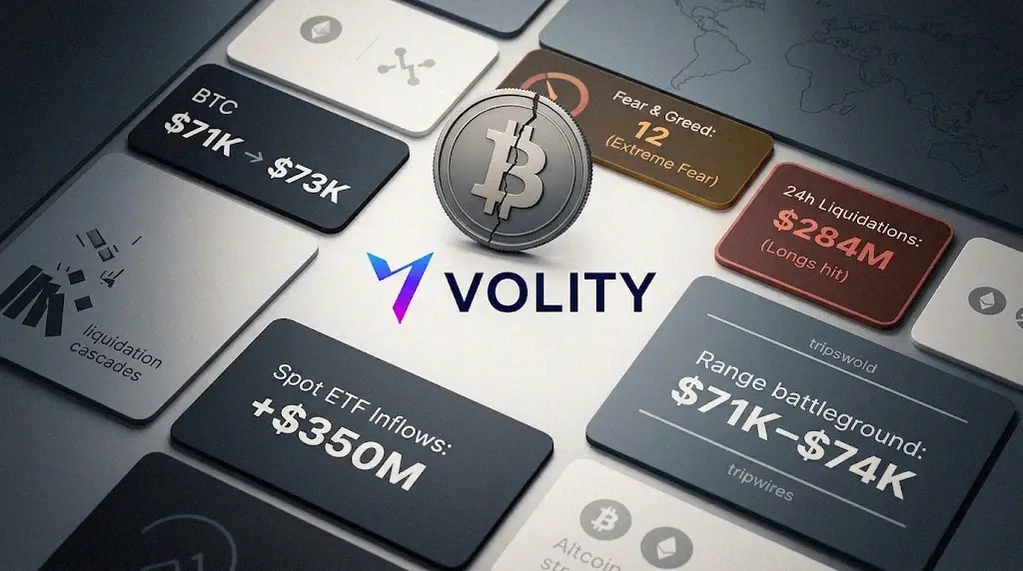
Early Monday brought a hard shift in tone. The Fear and Greed Index sank to 12, a level traders file under panic. Meanwhile, an escalation in U.S.-Iran brinkmanship jarred markets that were already jumpy about rates and growth.
Bitcoin fell to $70,623, then chopped violently. Oil jumped 9.5% to $105 a barrel, and crypto traded like a high-beta macro bet. However, the selling was not just spot. It came from leverage getting forced out.
Across 24 hours, total liquidations reached $284 million, with $203 million from long positions. The move had a mechanical feel, as stops tripped and margin calls snowballed. Bitcoin open interest dropped 6.41% to $51.337 billion, a sign traders cut exposure rather than “buy the dip” with leverage.
Yet the tape did not stay one-way. By Sunday evening, Bitcoin had bounced to $73,010, helped by $350 million of spot ETF inflows. Even so, the recovery looked tentative. Bitcoin remains below its 200-day moving average, and sellers keep leaning on the $74,000 area.
When protocols break, confidence cracks
Market stress rarely arrives alone. Polkadot became the day’s cautionary tale after an attacker minted 1 billion DOT and sold the lot in one transaction. The haul was only 108.2 ETH, around $237,000, which made the episode feel more like sabotage than profit-seeking.
That sort of exploit hits harder during a risk-off tape. Traders can tolerate bugs in bull markets. However, in drawdowns, a single security shock can turn “cheap” into “uninvestable” in minutes.
Meanwhile, Bittensor’s ecosystem showed strain after Covenant AI, a notable contributor, said it would step away. The group cited completion of a decentralised pre-training run, a 72-billion-parameter model it claimed outperformed LLaMA-2-70B. Investors asked the awkward question: how decentralised is “decentralised” when a few teams can reshape the roadmap?
Institutional rails expand, even as retail swerves
Even in a fearful market, the plumbing keeps getting built. CME Group launched regulated futures for Avalanche (AVAX) and Sui (SUI), pulling both further into the institutional orbit. These tokens now sit closer to the world of basis trades, hedges, and relative-value books, not just retail momentum.
Ethereum held up better than most, rising 2.01% to $2,230. Developers are also pointing ahead to 2026 upgrades. “Glamsterdam” in the first half targets Layer 2 scaling and gas optimisation, while “Hegotá” in the second half aims at transaction parallelisation. However, tech narratives rarely matter on days when geopolitics and CPI set the price.
Narrative trades keep flashing
Not every corner bled. RaveDAO (RAVE) spiked on a 480% volume jump after announcing a partnership with a mid-tier streaming platform. It read like classic story-first trading, fast and unforgiving.
Pudgy Penguins (PENGU) proved steadier than peers. Floor prices held around 8.2 ETH while rival NFT collections fell 15% to 20%. That relative strength suggested committed holders and faith in IP licensing, even as broader risk appetite thinned.
What traders are watching this week
Price is now orbiting a few obvious tripwires. Meanwhile, macro prints and headlines can still do the job of a liquidation engine.
- $71,000 to $74,000 in Bitcoin: the current battleground for trend control and positioning.
- Downside risk: below $67,769 sits an estimated $834 million in long liquidations.
- Upside squeeze risk: above $74,444 sits an estimated $1.099 billion in short liquidations.
- US CPI on April 13: consensus looks for 0.3% month-on-month.
- Geopolitics: tariff threats and Middle East volatility keep headline risk priced in.
Regulation tightens in volatile weather
Regulators are also moving while markets wobble. The European Central Bank backed a push to shift oversight of major crypto firms towards EU markets regulators. Meanwhile, the US Commodity Futures Trading Commission sought expanded control over prediction markets, a change that could reshape product design and compliance costs.
South Korea pushed for crypto circuit breakers after a Bithumb transfer error exposed operational risk. The more violent the tape gets, the more likely market structure changes arrive at speed.
Key takeaways
- Fade leverage first: the liquidation mix shows forced selling still drives intraday extremes.
- Respect the range: $71,000 to $74,000 is where positioning flips and squeezes start.
- Watch ETF flows: the $350 million inflow helped, but it did not restore broad risk appetite.
- Security risk is back: protocol exploits now carry extra penalty in a skittish market.
- Macro headlines matter more than narratives: CPI and geopolitics can drown out token-specific news.
Crypto began the week caught between institutional dip-buying and retail caution. However, until Bitcoin can reclaim and hold the mid-$74,000 area, the market will trade like it is one headline away from another flush.
For more on this topic see our deep-dives on Bitcoin and Crypto Crashes: How US Tariff Shocks Hit Markets, Crypto Equities Explained: MicroStrategy, ABTC and Bitcoin Proxies, and Bitcoin at $109K: ETF Flows, Regulation and Crypto Market Drivers.
What our analysts watch: Three signals separate noise from regime change during a crisis. Funding rates and perpetual open interest show whether the initial drop is a leverage flush (often bought back) or genuine unwind (which extends).
Stablecoin flows on regulated exchanges reveal whether sidelined dollars are stepping in to buy the dip. Country-specific premia (the spread between BTC priced on Turkish, Argentine, or Russian venues versus the global benchmark) measure whether real safe-haven demand is forming.
When premia widen and stablecoin inflows accelerate while leverage resets, the second-phase bid is real and durable.
Frequently asked questions
Why does Bitcoin sometimes drop during geopolitical shocks?
Initial geopolitical shocks tighten dollar liquidity and force margin calls across leveraged books. BTC, as the most liquid 24/7 asset, sells first because traders can actually exit it on a Saturday or in off-hours.
The selling pressure is mechanical rather than fundamental and typically reverses once leverage clears. The U.S.Federal Reserve tracks the dollar liquidity dynamics that drive these episodes.
Is Bitcoin actually a safe haven?
The data points to a partial answer. BTC has functioned as a safe haven within local currency crises (Turkey, Argentina, Lebanon, Nigeria) and as a hedge against capital controls. It has not consistently functioned as a global safe haven on the same axis as the dollar or gold during major risk-off episodes. The framework is regional and conditional rather than absolute. Investopedia explains the structural differences in detail.
How quickly does the safe-haven phase typically arrive?
Historically the rotation lags the initial shock by 24 to 72 hours. The first leg is leverage flushing on global venues; the second leg is capital from affected regions buying through local on-ramps. The Bank for International Settlements publishes cross-border flow data that supports this two-phase pattern.
How should retail traders position around a Middle East shock?
Reduce leverage materially before known event windows, hold core positions in segregated custody, and keep a portion of capital in stablecoins on a regulated exchange so dry powder is available to buy a clean leverage flush. Volity research uses an on-chain data overlay to size these decisions rather than trade headlines.
Related guides
- Bitcoin explained
- Cryptocurrency trading
- Crypto trading platforms
- Risk management
- Best crypto investments
Volity operates a trading platform and also publishes educational and analytical content about trading. The content on this page is for educational purposes only and should not be considered financial advice. Volity may benefit commercially when readers open trading accounts through links on this site.
Our content is produced and reviewed under documented editorial standards; see our comparison and review methodology.