Crypto crosswinds: bitcoin wobbles while Wall Street leans in
Crypto ends the week in an awkward split screen. Prices look tired, yet the institutional machinery keeps getting louder.
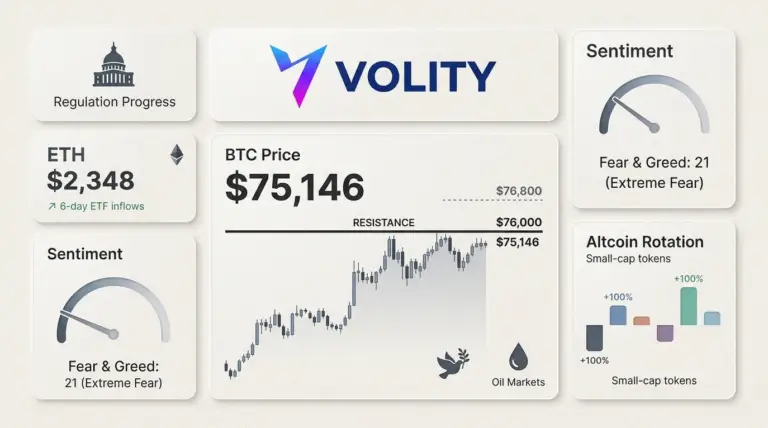
Bitcoin slipped below $63,000 late Friday, after briefly testing the mid-$64,000s earlier in the session. Meanwhile, ether struggled below $2,000, and solana gave back part of its sharp July run.
At the same time, brokerage platforms, card networks and regulated custodians are moving deeper into digital assets. That contrast matters. Traders are selling risk, but Wall Street is still building the rails.
Market snapshot
Bitcoin’s drop below $63,000 turned a cautious recovery into another test of nerves. Geopolitical tension also weighed on risk assets, as fresh US-Iran headlines unsettled traders across markets.
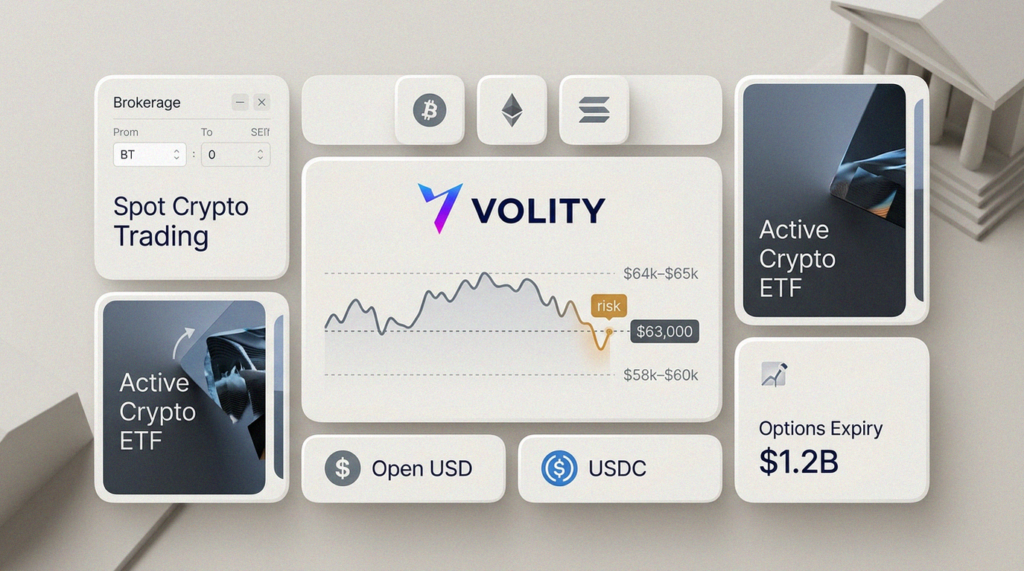
For now, BTC sits in a narrow but important zone. Bulls need a clean reclaim of $64,000 to $65,000. However, sellers will watch $58,000 to $60,000 as the deeper fault line.
Ether looks weaker near term. It failed to hold a push above $2,000, while traders wait for clearer signals from Washington. The CLARITY Act remains stuck in Congress, leaving the market with enthusiasm but little legal certainty.
Solana remains the livelier major. Even after the pullback, SOL still trades around the low-$70s after a strong run. Desks are treating $67 to $70 as a key support zone.
Total crypto market value remains above $2 trillion. Yet leadership has narrowed. Bitcoin holds dominance, ether is regaining institutional attention, and most altcoins are moving only when a specific catalyst appears.
By the numbers
- Bitcoin: below $63,000 late Friday, with resistance near $64,000 to $66,000.
- Ether: under $2,000, with support watched around $1,550 to $1,600.
- Solana: testing the low-$70s, with $67 to $70 viewed as support.
- Crypto market value: still above $2 trillion, despite weaker breadth.
- Bitcoin options: about $1.2 billion in expiries remains a short-term volatility risk.
Wall street
The week’s most important structural news came from the brokerage world. Morgan Stanley’s E*TRADE went live with spot crypto trading for eligible retail clients.
Clients can buy and sell bitcoin, ether and solana through infrastructure provider Zero Hash. That may sound technical. However, it removes a familiar hurdle for ordinary US investors.
Many investors still keep wealth inside traditional brokerage accounts. Now, some can add basic crypto exposure without wiring funds to a specialist exchange. That is not small.
Meanwhile, asset managers are testing more flexible crypto products. T. Rowe Price launched an actively managed crypto ETF, moving beyond the passive spot products that dominated the first wave.
Active mandates can rotate between BTC, ETH and selected altcoins. As a result, they may steer flows into DeFi, layer-2 networks or tokenised assets when market stories shift.
ETF flows have also turned less damaging. After a difficult June, spot bitcoin funds have seen renewed demand from larger issuers and steadier behaviour in smaller products.
That does not guarantee a rally. Still, it changes the tone. The market looks less like forced liquidation and more like a pause after excess leverage burned off.
Stablecoins
Beyond the charts, stablecoins may carry the bigger story. Visa unveiled its Open USD stablecoin platform for banks and fintechs.
The toolkit aims to support stablecoin payments, transfers and on-chain settlement inside existing financial systems. In practice, it pushes the idea of crypto in the back, fiat in the front.
That puts Visa closer to Circle’s USDC ecosystem. It also shows that payments firms now treat stablecoins as infrastructure, not a laboratory trick.
Circle is pushing back. It has rolled out USDC Gateway and global fiat payout tools on Fireblocks, a platform already used by many institutional trading desks.
For traders, this matters because liquidity needs fast settlement. If institutions can move between fiat and USDC more easily, exchanges, DeFi venues and tokenised assets all benefit.
Tokenisation is also spreading beyond US Treasuries. Japan’s SBI Group is working with Ondo Finance and a yen-denominated stablecoin to bring baskets of Japanese stocks on-chain.
Meanwhile, Brazil’s B3 exchange has expanded crypto-linked derivatives tied to Nasdaq indices. Slowly, “traditional assets on crypto rails” is moving from pitch deck to product shelf.
Regulation
Regulators are sending mixed signals, though not vague ones. Europe continues to turn MiCA into a practical licensing regime.
BitPay’s Dutch arm secured full authorisation under MiCA, allowing it to passport regulated crypto services across the European Union. Licensed firms gain a cleaner route to institutional clients.
In the US, the Securities and Exchange Commission is preparing rules that could permit compliant token sales under federal securities law from July. That would mark a sharp break from the old ICO grey zone.
However, enforcement remains aggressive. Taiwan handed the founder of BitShine a 22-year sentence over a $39 million crypto fraud scheme.
Argentina froze 25 wallets linked to an inquiry into the $LIBRA token. India’s Enforcement Directorate also seized crypto tied to online investment and work-from-home scams.
The message for professionals is simple. Cross-border opacity no longer protects weak counterparties. Compliance is becoming part of liquidity, not an optional extra.
Altcoins
The speculative edge of the market looks tired. Dogecoin has slipped towards a critical support zone, while demand around the listed DOGE ETF has cooled sharply.
That shift says something about appetite. Earlier in the cycle, memecoin access through regulated wrappers looked almost cheerful. Now it looks exposed to the first cut in risk budgets.
Pi Network’s PI token is trying to rebound after weeks of pressure. A network upgrade and fresh retail attention have helped, but it remains one of the cycle’s laggards.
Solana offers the more serious case. The Alpenglow consensus upgrade, expected as early as next quarter, aims to tackle performance bottlenecks.
If it delivers, SOL could regain a stronger growth narrative. But first, buyers need to defend the $67 to $70 area and push price back towards $80.
Elsewhere, infrastructure names keep getting busier. Bybit expanded in Indonesia by acquiring NOBI and listing more than 500 trading pairs under local oversight.
Injective is also seeking to become an SEC-registered transfer agent for on-chain records. The line between crypto firm and market utility keeps blurring.
Trading map
Short-term traders should watch the options board. About $1.2 billion in bitcoin options expires soon, giving dealers a reason to defend crowded strikes.
If spot pins near heavy open interest, volatility may fade. However, a clean break from the $62,000 to $64,000 band could trigger faster hedging flows.
Macro still matters, too. Fresh Middle East risk has reminded traders that bitcoin remains sensitive to global stress, especially when liquidity thins into the weekend.
Yet there is another side. Large strategy funds hold meaningful cash, and positive ETF flows could support bitcoin if macro data calms.
Key takeaways
- Respect the range: BTC needs $64,000 to $65,000 for momentum, while $58,000 to $60,000 is the danger zone.
- Watch ETH policy risk: ether needs legal clarity as much as chart strength.
- Follow the rails: E*TRADE, Visa and Circle are more important than most token headlines.
- Separate memes from infrastructure: DOGE looks fragile, while settlement and tokenisation projects keep attracting institutions.
- Treat regulation as tradable: MiCA licences and US token-sale rules can move liquidity quickly.
Crypto prices may look bruised. Still, the market’s foundations are getting less exotic and more financial. That tension will define the next trade.
Related coverage on Volity
- How to Avoid Crypto Scams: A Beginner Safety Checklist
- How to Choose a Trading Platform: A 10-Point Checklist
- Demo vs Live Trading Account: A 7-Step Checklist Before You Go Live
- How to Size a Trade: Position Sizing and Risk Per Trade for Beginners
- Risk-Reward Ratio Explained: How to Set It and Why It Matters
- ETF vs Index Fund: The Difference and Which to Pick