Crypto markets: miners capitulate, lawmakers circle, and traders hunt yield
Bitcoin is entering August with a limp, not a swagger.
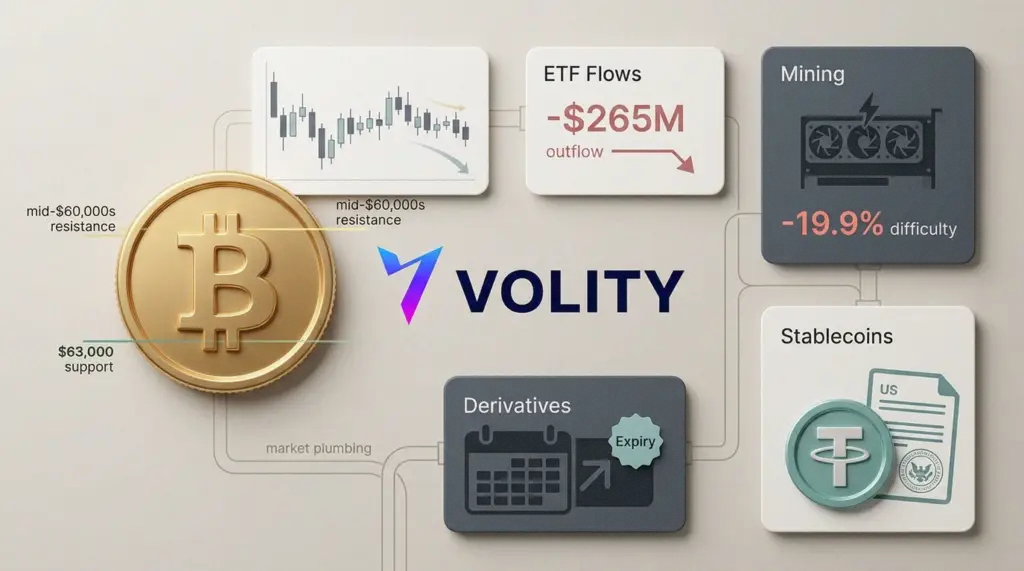
BTC is trading in the low-$60,000s, with buyers repeatedly defending the $63,000 area. However, demand looks thin whenever the market approaches the mid-$60,000s. Spot desks are fighting ETF redemptions, derivatives pressure and a twitchy macro tape.
US-listed Bitcoin ETFs have seen about $265 million in outflows. That marks a sharp turn from the post-halving bid. Traders are treating ETF flow data as a daily risk gauge, not background noise.
Meanwhile, the mining market is flashing stress. Network difficulty has fallen roughly 19.9%, one of the sharper drops of this cycle. Older rigs are going dark, while some listed miners are steering power contracts and sites towards AI data centre customers.
That pivot matters. Mining capitulation can eventually reduce forced BTC selling. First, though, it usually signals pain. Margins are squeezed, debt costs bite, and management teams start treating compute as more valuable than freshly minted coins.
Bitcoin pressure points
- BTC level: buyers keep circling $63,000, while resistance builds above the mid-$60,000s.
- ETF flows: about $265 million has left US spot Bitcoin funds.
- Mining stress: network difficulty is down about 19.9%.
- Options drag: a recent $9.6 billion notional expiry kept positioning heavy.
- Macro risk: Fed expectations and Middle East tension keep intraday moves jumpy.
For now, Bitcoin’s chart tells only half the story. The plumbing looks just as important. ETF flows, miner selling and options positioning are pinning the market in a narrow, uncomfortable range.
Yield returns, with strings attached
While Bitcoin stalls, exchanges are trying to make holding crypto feel less idle.
Bitget has introduced daily Bitcoin rewards for users of its BGBTC product. The offer is simple enough. Keep capital on the platform, trade or provide liquidity, then receive BTC rewards each day.
However, the maths deserves a hard look. This is not risk-free income. It is platform risk dressed as yield. Traders should ask who pays the reward, what happens in stress, and whether withdrawals stay smooth.
Elsewhere, XRP has built a quieter momentum. XRP ETF inflows have topped $1.5 billion, while income products pitch large daily rewards to wealthier accounts. Some strategies use lending. Others lean on staking-like structures or options exposure around XRP.
At the same time, XRP Ledger v3.3.0 has shipped five institutional features. The upgrade sharpens its appeal as tokenised finance plumbing. Japan’s SBI Group has also valued its Ripple stake at $41.2 billion, despite weakness in XRP itself.
That split is worth watching. Corporate equity in infrastructure can detach from token sentiment. XRP traders should not treat every Ripple headline as a clean read-through for the coin.
Stablecoins move closer to the centre
Stablecoins are becoming the market’s quiet heavyweights.
Circle, the issuer of USDC, has secured an OCC-approved national bank charter and a New York trust charter. That combination gives Circle a stronger pitch to institutions that want dollar exposure on-chain with clearer oversight.
Meanwhile, Tether remains the sector’s profit machine. The company posted about $1.5 billion in second-quarter profit. Yet its reserve buffer has reportedly halved, renewing questions about resilience if US Treasury yields fall or credit markets wobble.
Central banks are watching, too. In one test, stablecoin remittances accounted for about 9% of flows. That number is small enough to ignore at first glance. However, it is large enough to alarm banks that depend on cross-border payment fees.
The direction is clear. Dollar tokens are moving from trading desks into payments, treasury operations and remittances. Regulation is following, but not always at the same speed.
Washington advances, New York swings
In Washington, crypto lobbyists are focused on the CLARITY Act.
The bipartisan bill aims to define how digital assets are classified and supervised. It could reach a Senate vote before the August recess. Prediction markets place the odds of passage near 25%, so traders are not pricing in victory.
Still, even partial progress would matter. Coinbase, Grayscale and token issuers want less legal guesswork. Listed crypto firms also want a cleaner route for listings, custody and institutional products.
New York, however, is taking a harder line on prediction markets. State authorities have sued Kalshi, seeking penalties tied to event-based contracts. The case frames the platform as an illegal off-exchange futures venue.
Meanwhile, Google plans to ban prediction-market extensions from the Chrome Web Store from August 1. For traders, the lesson is blunt. Venue risk now includes app-store access, legal domicile and payment rails.
Listed crypto stocks show the split
Public crypto stocks are giving investors a rougher, more revealing mirror.
Coinbase reported a $359 million quarterly loss, missing revenue expectations for the third straight quarter. Shares fell about 12% after the print. Fee compression, thinner retail activity and weaker spot volumes all hurt.
Yet Coinbase also gained conditional approval for a national trust charter. So the market faces a familiar tension. The business is cyclical, but regulators increasingly treat it as permanent infrastructure.
Robinhood tells a different story. Its shares have recovered as analysts highlight tokenisation, crypto brokerage growth and its Rothera expansion. Bernstein has assigned a $160 target, implying roughly 80% upside.
Then there is Strategy, ticker MSTR, still the market’s favourite Bitcoin proxy. The company posted an $8.2 billion loss as BTC slipped below its cost basis. Shares weakened further after Michael Saylor signalled a pause in additional Bitcoin purchases.
Some brokers still call Strategy the premier listed Bitcoin vehicle. However, investors should treat it as more than leveraged BTC. It adds debt, governance choices and balance-sheet timing to the Bitcoin bet.
Asia cools, but experiments continue
Asia remains a split screen.
South Korea’s crypto trading volume fell nearly 55% in the first half. Tougher enforcement, tired retail traders and weaker momentum all played a part. Seoul has also confirmed a 22% tax on crypto gains from 2027.
Even so, the market has not gone quiet. Payments group KSNet has joined the Solana Foundation to test Solana Pay for Korean merchants. If it works, it could show that regulation slows speculation without killing useful payment trials.
AI money keeps crossing into crypto
The strangest capital flow in crypto now runs through AI.
Miners and treasury companies are funding AI data centres, using sites, power access and equity proceeds for compute. The logic is practical. AI customers pay rich rates, while Bitcoin mining margins remain volatile.
NEAR is testing another model. Users can pay for AI services by staking tokens, tying token economics to computing demand rather than simple emissions. It is early, but more interesting than another branded chatbot.
Research is changing as well. Investors want tools that join on-chain flows, governance votes, wallet clusters and cross-chain activity. AI agents that clean and connect data may prove more useful than louder trading bots.
Risk reminders from the darker tape
The week also brought the usual warnings from crypto’s rough edges.
A reported build error in Coldcard firmware drained about $38 million in Bitcoin in roughly 25 minutes. Separately, Swan Treasury lost around $625,000 after a signer key leak affected its STY product.
Retail losses remain brutal. A Hong Kong romance scam cost one woman about $3.3 million. In another case, the chief executive of Moneyflip was charged over a $40,000 murder-for-hire plot allegedly paid in crypto.
Geopolitics adds another layer. Investigators mapped a $4 billion Iran sanctions-evasion network using crypto rails. Other reports linked digital assets to Russian and Iranian drone-financing channels. Expect those cases to feed the next sanctions debate.
Key takeaways
- Watch ETF flows daily: they are now a near-term driver for BTC, not a side issue.
- Treat miner capitulation carefully: it can mark stress before it marks recovery.
- Price yield as risk: daily rewards and lending products depend on platforms, contracts and liquidity.
- Track legal catalysts: CLARITY, Kalshi and Circle’s charters can move venues and valuations.
- Do not confuse proxies with coins: COIN, HOOD and MSTR carry company-specific risks.
Related coverage on Volity
- How to Avoid Crypto Scams: A Beginner Safety Checklist
- How to Choose a Trading Platform: A 10-Point Checklist
- Demo vs Live Trading Account: A 7-Step Checklist Before You Go Live
- How to Size a Trade: Position Sizing and Risk Per Trade for Beginners
- Risk-Reward Ratio Explained: How to Set It and Why It Matters
- ETF vs Index Fund: The Difference and Which to Pick