Crypto’s cold front: Bitcoin slips below $60,000 as regulation and balance sheets take centre stage
November 25, 2026 – Bitcoin slipped below $60,000 again, trading near $59,100 after giving back most of Monday’s rebound.
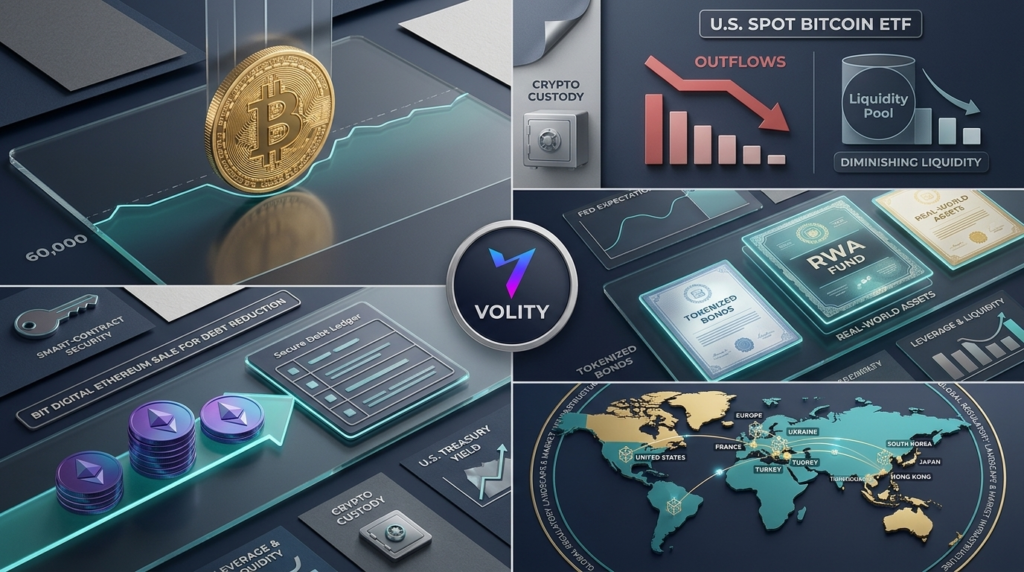
The move arrived alongside a fifth consecutive day of withdrawals from US spot Bitcoin exchange-traded funds. Monday’s outflows reached about $569.7 million, led by BlackRock’s iShares Bitcoin Trust.
BlackRock’s fund accounted for roughly $509.3 million of that total. November withdrawals have now approached $4.7 billion, the weakest month yet for the products.
ETF flows have become Bitcoin’s loudest short-term signal. The funds once represented a dependable new buyer with deep pockets.
Now they are operating more like a pressure valve. When investors cut exposure, sizeable Bitcoin volumes can reach the market quickly.
Traders are asking a less comfortable question. It is not whether Bitcoin looks oversold, but whether institutional buyers are still waiting below.
Debt forces an Ethereum sale
Bit Digital offered a sharp example of balance-sheet stress. The Nasdaq-listed Ethereum treasury company sold 29,825 ETH between November 15 and 23.
The sales raised about $50 million at an average price near $1,676 per Ether. Bit Digital used all proceeds to repay secured borrowing from Galaxy Digital.
That payment cut the Galaxy loan from $100 million to $50 million. Yet the transaction showed how swiftly leverage can reshape a digital-asset strategy.
Companies can describe token holdings as long-term reserves. Still, secured lenders often require action long before management wants to sell.
Bit Digital retains Ethereum for treasury and staking operations. However, its sale shows that debt can turn conviction into a liquidity exercise.
That matters across the growing field of crypto-treasury stocks. Asset values attract attention, while borrowing terms determine how much patience a company actually has.
Europe examines DeFi’s stablecoin machinery
The European Banking Authority has warned that stablecoins used in decentralised finance can create risks for consumers and issuers.
Its review examined lending, borrowing, trading and collateral arrangements involving stablecoins and e-money tokens. The authority flagged poor disclosures, leveraged positions and failed repayments.
It also focused on operational weaknesses at services connecting users with DeFi protocols. Those weak points may include interfaces, custodians and other identifiable gateways.
European officials worry that DeFi structures could sidestep parts of the Markets in Crypto-Assets framework. The concern includes rules on token offerings, trading admission and interest payments.
The debate is not simply about banning decentralised finance. Regulators instead want responsibility to follow the economic activity, rather than the marketing label.
The EBA has urged the European Commission to consider extra obligations for crypto firms facilitating access to DeFi. That could eventually affect wallets, exchanges and stablecoin distribution channels.
Infrastructure advances during the sell-off
Prices are weakening, but institutional infrastructure continues to expand. Hong Kong has launched a blockchain-based settlement platform for tokenised bonds.
BlackRock’s Hong Kong cash-fund structure also points towards a different stablecoin role. Stablecoins could become a route into regulated fund shares, rather than merely a dollar substitute.
Japan is moving further into on-chain finance. SBI and Sumitomo Mitsui Financial Group have joined a Solana-based venture.
The groups behind that effort manage combined assets of roughly $2.3 trillion. Meanwhile, Ripple is working with Turkey’s Yapı Kredi on crypto custody services.
Circle is also exploring wider USDC distribution with Paribu. None of those developments guarantee token prices will recover.
Yet they show where the industry’s commercial energy is moving. Settlement, custody and tokenised cash products may prove more durable than another retail token frenzy.
Regulation becomes a tradable risk
South Korea will hold a December 3 hearing on a major digital-asset bill. The proposals could reshape ownership and control of local exchanges.
A possible 20% ownership cap has drawn attention to Dunamu and its reported $11.2 billion transaction with Naver. The details matter for exchange valuations across Asia.
Ukraine is also advancing work on crypto taxation and licensing, although its legislative timetable has shifted. France’s Senate, by contrast, rejected a tougher wallet-disclosure proposal.
That French measure would have covered crypto wallets holding €100,000 or more. Its failure suggests political support for stricter reporting rules remains uneven.
In Washington, an SEC staff no-action letter for Molecule’s research tokens offered a narrower signal. Such letters address specific facts and structures, not whole token categories.
Builders may welcome the opening. But they should not mistake a limited compliance route for a blanket regulatory green light.
Security reaches the trading screen
Bithumb has confirmed that a data breach exposed more information than first feared. The compromised data included identification details, bank-account information and crypto wallet addresses.
That combination can make phishing and impersonation attacks far more convincing. It can also connect blockchain activity with real-world identities.
Ethereum Foundation researchers are recommending Keccak-256 within work on future cryptographic resilience. Solana developers, meanwhile, are proposing ways to reduce wasted validator computing work.
Sequent has raised $2.2 million for AI-powered smart-contract security tools. These projects may sound distant from a Bitcoin sell-off, but the market increasingly treats security as investable infrastructure.
What traders are watching
- ETF flows: Whether Bitcoin withdrawals extend beyond the current five-session streak.
- Corporate sales: Whether indebted crypto-treasury companies sell tokens to reduce secured borrowing.
- Macro markets: Treasury yields, US data and changing expectations for Federal Reserve policy.
- Stablecoin rules: How Europe assigns responsibility when DeFi platforms use regulated tokens.
- Institutional rails: Whether tokenised bonds, funds and custody products keep advancing during weaker prices.
Bitcoin is trading like a risk asset facing a liquidity squeeze. Banks, regulators and infrastructure providers are still building the market’s less visible foundations.