Crypto markets juggle regulation, prediction mania and a fragile rebound
Crypto begins the week with a familiar unease. Prices look steady, yet the ground beneath them keeps shifting.
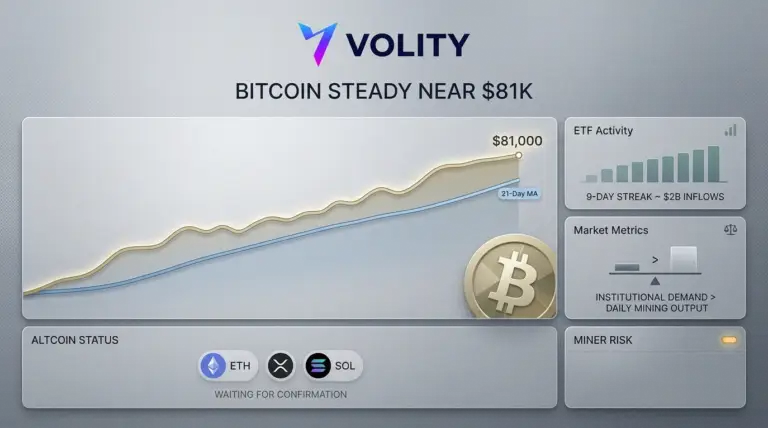
Bitcoin is holding near the mid-$62,000s, while traders keep one eye on Washington and another on leverage. Meanwhile, prediction markets are moving from crypto side streets into regulated finance. Stablecoins are gaining payment licences. Token treasuries are becoming balance-sheet weapons.
So, the tape is not quiet. It is merely speaking in a lower voice.
Bitcoin holds, but the comfort is thin
Bitcoin, trading under BTC, has settled just above the $62,000 area after June’s bruising liquidation wave. That sell-off flushed out hundreds of millions of dollars in leveraged longs and briefly dragged price towards recent lows.
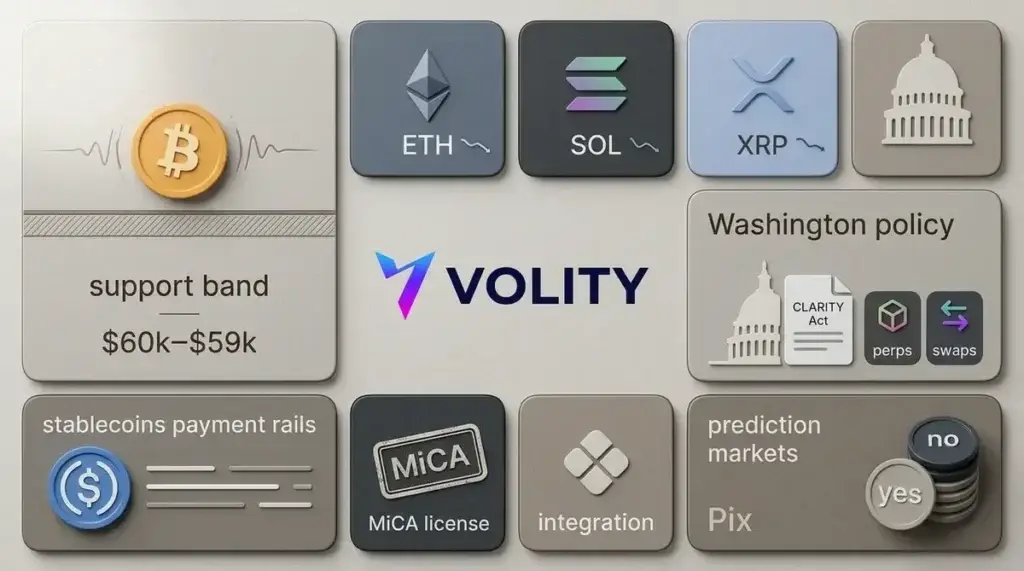
However, the market has not recovered its old swagger. Sentiment gauges still sit near “fear”, and traders keep circling the same support band. The $60,000 to $59,000 zone now matters more than any sunny conference-panel remark.
If that floor breaks, systematic sellers could reappear quickly. Many desks are treating $60,000 as both a technical level and a crowd psychology test.
BlackRock’s message also captures the mood. The firm has helped turn spot Bitcoin ETFs into a mainstream product, yet it still frames Bitcoin as a small allocation. Its suggested range of 1% to 2% in diversified portfolios is hardly a victory parade.
Still, that number matters. Bitcoin is being invited into serious portfolios, but only through the side door. For allocators, BTC now sits somewhere between macro hedge, tech beta and speculative insurance.
Altcoins show weaker footing
Beyond Bitcoin, the picture looks less sturdy. Ethereum, or ETH, is trading in the mid-$1,600s, pressured by ETF outflows and softer derivatives interest.
That combination rarely points to a confident market. Capital is leaving some regulated ETH products, while leverage has not rushed back. As a result, the old beta trade looks paused.
Meanwhile, Solana, or SOL, trades near the high-$60s after a strong longer-run performance. Yet the chart has started to trouble technicians. A possible double top leaves the low-$60s exposed if sellers push through the neckline.
Solana’s core story has not vanished. The chain still attracts fast-moving DeFi projects, consumer apps and high-volume trading flows. However, momentum traders do not pay for long-term architecture when stops start firing.
XRP offers another lesson. Ripple keeps adding enterprise wins and continues to discuss a possible public listing. Even so, the token remains stuck near the low-$1 range.
That gap is important. A company can win clients while its token fails to rerate. In crypto, owning the story and owning the cash flow are often different trades.
Regulation puts perps in the crosshairs
The biggest story for derivatives traders is not on a chart. It is sitting inside the proposed CLARITY Act.
The bill aims to define digital assets and divide oversight between regulators. However, its treatment of perpetual futures and swaps could reshape the market’s favourite engine. Perps still drive much of crypto’s price discovery, especially offshore.
Critics are focused on Section 604. They argue that enforcement changes could create new jurisdictional gaps, even while lawmakers claim to be adding clarity. Lawyers are also examining how the bill might affect Bitcoin-backed treasury structures and yield strategies.
At the same time, Cboe and other derivatives venues are preparing for a more formal market. If regulators bless crypto perps, liquidity could deepen in the United States. If they fence them in, leverage may migrate again.
For traders, the issue is practical. Tighter rules may reduce tail risk, but they may also compress funding trades. The next volatility regime could be written in committee rooms before it appears on screens.
Stablecoins advance as CBDCs split the map
Public digital money is becoming a political dividing line. In the United States, opposition to a central bank digital currency remains fierce. Anti-CBDC language has advanced through Congress, reflecting deep worries about privacy and state control.
Europe is moving differently. The European Central Bank continues to push the digital euro, treating it as an upgrade to payment rails rather than a threat to civil liberty.
That split matters for payment firms. They may soon serve a world where the euro has a public digital twin, while the dollar relies more heavily on private stablecoins.
Meanwhile, stablecoin adoption keeps gathering pace. OpenPayd’s MiCA licence in Europe gives it clearer room to expand compliant services. In Brazil, Tether-linked projects are working to connect USDT with Pix, the country’s dominant instant-payments network.
Yet Brazil has also blocked crypto campaign donations before its 2026 vote. So the message is selective. Crypto is welcome in payments and settlement, but politics remains a harder border.
Prediction markets leave the fringe
Prediction markets may be the week’s most interesting side plot. They are no longer just crypto’s clever parlour game.
Cboe has launched S&P 500 prediction contracts through Cboe Predicts. That move signals a deeper shift. Traditional finance now sees value in markets that trade forecasts, not just assets.
However, regulators are still arguing over where these products belong. Kentucky’s resistance to platforms such as Polymarket and Kalshi has drawn federal scrutiny. The fight is really about event futures, retail access and who gets to police the line between trading and betting.
Tech companies are circling too. Meta has been working on points-based prediction products and game-like market formats. For crypto-native platforms, that is both flattery and threat.
The interface may end up in Big Tech’s hands. However, settlement and risk engines could still run on public chains. That split would not be new. Finance often lets someone else build the pipes, then fights to own the customer.
By the numbers
- $62,000: Bitcoin’s current neighbourhood, with $60,000 to $59,000 as key support.
- 1% to 2%: BlackRock’s cautious Bitcoin allocation range for diversified portfolios.
- Mid-$1,600s: Ethereum’s trading area after ETF outflows and softer open interest.
- High-$60s: Solana’s price zone, with chart risk building near the low-$60s.
- 2026: Brazil’s election year, with crypto donations already facing restrictions.
Treasuries become the new battlefield
Under the daily price action sits a slower ownership fight. Bitcoin treasury companies are turning BTC into a balance-sheet strategy for equity buyers.
These vehicles often trade on modified net asset value, discounts and premiums to holdings. As a result, corporate buying and selling can amplify moves in the spot market.
Ethereum faces a related squeeze. Some firms want meaningful percentages of total ETH supply. If treasuries, funds and stakers lock up enough coins, the free float could tighten.
However, scarcity is not automatic. Investors still need to track unlocks, vesting dates, treasury wallets and fully diluted valuations. A token can look cheap on price and expensive on supply.
In this market, tokenomics is no longer spreadsheet homework for specialists. It is trading hygiene.
Key takeaways
- Respect the floor: BTC below $60,000 would likely change risk appetite fast.
- Do not confuse news with value: Ripple’s corporate progress has not unlocked XRP.
- Watch perps: Any CLARITY Act shift could alter leverage, funding and liquidity.
- Track stablecoin rails: MiCA and Pix integrations point to real payment adoption.
- Use prediction markets carefully: They may become early signals for policy and macro shocks.
For now, crypto prices are stable enough to tempt complacency. Yet regulation, payments and market structure are changing quickly. The next large move may start as a legal clause, a licence, or a product launch – not a candle.