Investing in financial products involves risk. Losses may exceed the value of your original investment.
Occidental oxy options is a core topic for traders in 2026. The complete guide follows.
Oil traders came in expecting sparks. Instead, the fuse fizzled. Crude eased, and the energy tape lost its swagger, which matters because Occidental Petroleum (OXY) has stopped trading like a headline hedge.
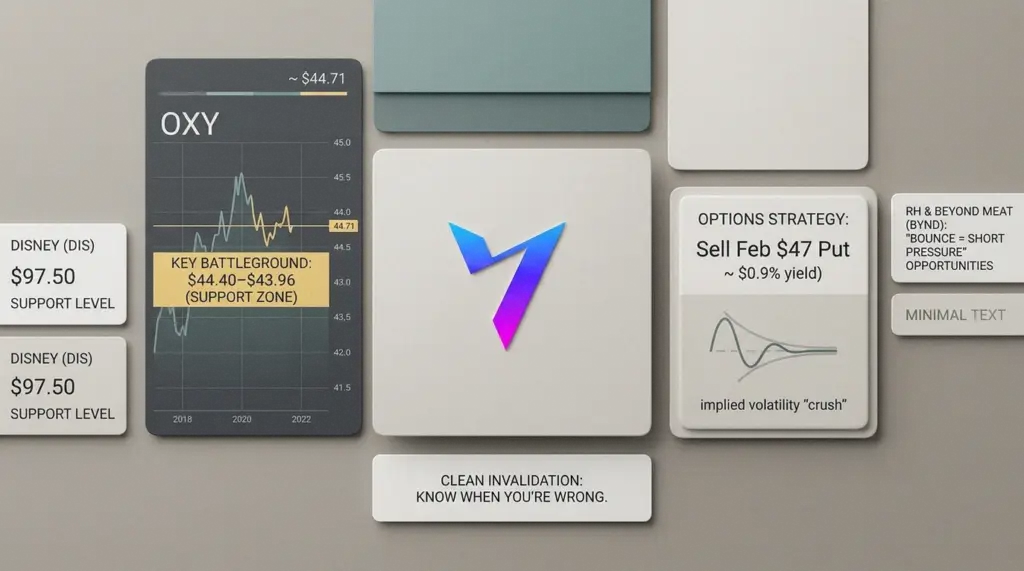
OXY just reported a Q4 beat, printing $0.31 in EPS against a $0.19 expectation. However, the stock still sagged to about $44.71, as softer crude pulled the whole complex down. Therefore the post-earnings story shifted from fundamentals to positioning. Options desks saw put interest climb, and premium sellers moved in for the familiar play: let volatility collapse after the event.
One widely discussed setup sells the Feb $47 put for about $0.97 in premium, which is roughly 2.1% of the strike if OXY holds above $47 into expiry. Meanwhile, chart watchers have a tight line in the sand around $44.40 to $43.96. If that shelf holds, short sellers may need patience. If it breaks, momentum traders will push for acceleration lower, and rallies become selling opportunities, not relief.
Elsewhere, the tape offers the opposite sort of tension. Disney (DIS) is sitting on a level traders recognise even if they avoid the stock: $97.50 as make-or-break support.
The shares have chopped between roughly $92 and $104 lately. However, the analyst community still talks like a recovery is inevitable, with average price targets clustering around $129 to $133.
The spread is wide, with lows near $77 and highs up to $168, which tells you confidence is not the same thing as agreement.
If DIS holds $97.50, the path of least resistance points back toward recent highs. Conversely, a clean crack risks an ugly gap-fill trade, where buyers step away and sellers smell open air. Volume is the tell, and there has been no neat three-day confirmation yet. Still, the Street’s bias remains upward, which can matter in a market that hunts stops before it picks a direction.
Earnings hangovers, meanwhile, continue to do the heavy lifting for day traders. RH’s miss and softer FY26 tone put “dead-cat bounce” firmly back on the menu. Therefore any sharp intraday rebound becomes a potential short entry for those who trade broken leaders. Beyond Meat (BYND) landed in the same bucket after a weak Q4 and cautious Q1 outlook, with premarket selling encouraging short-side volume.
Nike (NKE) is messier, which is often where the money is. The company beat, yet talk of Q4 softness and price-target trims kept the tape twitchy. Therefore the setup turns on whether the gap fills and stabilises or whether sellers press through support. Watch volume rather than headlines, because headline traders are often the first to get squeezed.
Not everything is breaking down. Eli Lilly (LLY) is acting like a textbook trend stock, turning old resistance into support and inviting a bounce attempt back toward highs. nCino (NCNO) caught a bid after an upbeat quarter and raised tone. Boeing (BA) kept momentum alive as “recovery” chatter pushed it above recent peaks, and Visa (V) drifted into what value-focused technicians call a buy zone, setting up a potential rebound if the market stays risk-on.
By the numbers
- OXY: Q4 EPS $0.31 vs $0.19 expected; shares near $44.71.
- OXY options: sell Feb $47 put for about $0.97 premium, around 2.1% of strike.
- OXY support: $44.40 to $43.96 as the near-term shelf.
- DIS pivot: $97.50 support; recent range roughly $92 to $104.
- DIS targets: cluster near $129 to $133, with a wider band from $77 to $168.
Heat on the tape
AI chip positioning remains jumpy as memory pricing signals clash with weaker smartphone demand, keeping names like Micron (MU), Nvidia (NVDA), Marvell (MRVL) and Arm (ARM) sensitive to any supply-chain datapoint. Meanwhile, selective healthcare shorts are cooling from overbought readings, which invites fast, rules-based trades rather than conviction bets.
Rocket Lab (RKLB) continues to trade on space optimism, including Artemis-linked buzz, while dividend-minded flows drift toward defensives and industrial yield stories such as ABM Industries (ABM), Booz Allen Hamilton (BAH) and Pitney Bowes (PBI). In autos, the Tesla (TSLA) versus BYD divergence remains a popular relative-value conversation, especially when supply chain headlines hit.
Key takeaways
- If OXY loses $44, downside momentum may accelerate, and bounces can become sell setups.
- If DIS holds $97.50 with improving volume, mean reversion can target the top of the recent range.
- RH and BYND remain “hangover” stocks, where rallies often face immediate supply.
- NKE is a volume story first, narrative story second.
- Strength names like LLY, NCNO and BA can work, but only while indices hold their ground.
In short, this is a market of fast levels and faster mood swings. Therefore the cleanest trades are the ones with obvious invalidation: support that must hold, and resistance that must break.
For more on this topic see our deep-dives on AI Stocks Rally as Oil Surges: Where Traders Are Looking Now, Short Squeezes and AI Chips: How Risk-On Stocks Move, and Intel Stock and Defensive Rotation: How Investors Position Pre-Earnings.
What our analysts watch: Three reads turn the OXY options framework into an executable position. Implied volatility rank against the 52-week distribution defines whether the premium collected is fair compensation for assignment risk; selling puts at sub-30 IV rank is structurally bad value, while sub-30 IV rank with a clean technical floor is the rare spot where the trade has real edge.
The crude oil curve (WTI front month plus six-month deferred) is the second read, since OXY equity beta to crude is reliable enough that the options trade is implicitly a crude-direction position; sellers of OXY puts are short volatility and long crude on a delta basis. And the put-call open-interest skew at the strike sold defines crowding; heavy retail short-put positioning at $47 means the trade is consensus and the risk-reward is compressed.
The ESMA investor protection 10-Q filings publish the production guidance and capex assumptions that drive Occidental fundamentals, the CME Group WTI futures complex provides the canonical crude reference and curve structure, and the ECB Economic Bulletin reference on cash-secured put strategies covers the position mechanics and assignment scenarios.
Volity offers US equity, options, and CFD execution under CySEC oversight via UBK Markets (licence 186/12).
Frequently asked questions
Why does selling a put work better after an earnings beat than before?
Implied volatility collapses post-earnings as event risk resolves, which is exactly the mechanic short-premium positions monetise. Selling a put before earnings means paying for the IV crush as a buyer; selling after the event means collecting the residual premium while the underlying stabilises. The trade is structurally a post-event play, and traders who run it pre-event without an explicit volatility view are on the wrong side of the volatility carry.
What invalidates the cash-secured put on OXY?
The $44.40 to $43.96 support shelf failing on a closing basis, ideally combined with WTI front-month breaking through its own structural support. The combination signals a regime change in the crude complex, which converts the local-equity options trade into a directional bet against the energy sector. Closing the put short and rolling to a wider strike is the standard response; doubling down at lower strikes without confirming a stabilisation pattern is the most common path to assignment loss.
How does the OXY-Berkshire holding influence the options chain?
Berkshire Hathaway is a structural holder, which dampens both upside skew (large holders sell into rallies) and downside cascade (large holders rarely panic-sell). The chain typically prices a tighter realised-volatility distribution than comparable energy peers, which means the premium on OXY puts is structurally compressed and the trade has slightly less theoretical edge than the analogous trade on a less institutionally-anchored ticker.When is a covered call better than a cash-secured put on the same underlying?
The two trades have identical payoff diagrams in cash equivalent terms, so the choice is purely capital-efficiency and tax-treatment. If the trader already holds OXY long, a covered call avoids tying up additional cash and produces income against existing exposure. If the trader is flat OXY but wants to enter at a discount, a cash-secured put is the cleaner expression because the assignment outcome leaves the trader long at a target price minus collected premium.
Volity operates a trading platform and also publishes educational and analytical content about trading. The content on this page is for educational purposes only and should not be considered financial advice. Volity may benefit commercially when readers open trading accounts through links on this site.
Our content is produced and reviewed under documented editorial standards; see our comparison and review methodology.