Every time you spend, send or invest across a currency border, someone quietly takes a cut. You rarely see it, because most of the cost is not a line item; it sits baked into the exchange rate you are handed. The fix has nothing to do with luck or loyalty points. Learn to see both costs in seconds, then pick a structure that strips them out. This guide walks you through it, with a checklist you can run before any conversion.
TL;DR / Quick insight: A currency conversion has two costs – a named fee you can see, and a hidden markup buried in the rate (the spread). To pay less: always pay in the local currency (decline DCC), skip airport and hotel exchange desks, check the offered rate against the mid-market rate, and hold the currencies you use in a multi-currency wallet. On a Volity account the FX fee is free and internal conversion is a flat, transparent 1%, with same-currency transfers free.
Currency conversion fees are the easiest money to lose without noticing, and the mechanics turn simple once someone names them. This guide speaks to anyone with a financial life: shoppers on foreign sites, people paid in another currency, anyone funding a trading account.
Where currency conversion fees hide
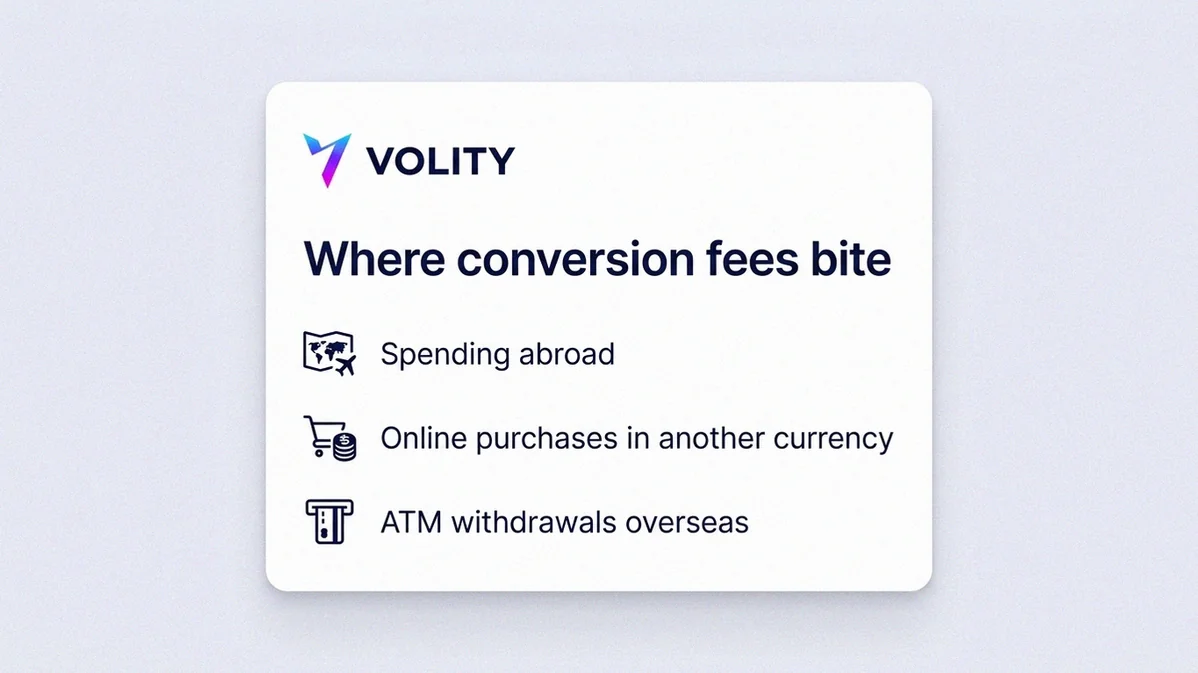
Your first job is to find every place a conversion touches your money. People assume it only happens on holiday. It happens far more often, and quietly.
- Card payments abroad. Tapping your card converts at a rate your bank or network sets.
- ATM withdrawals abroad. The machine may offer to convert for you, and that offer is rarely cheaper.
- Online purchases in another currency, on a foreign store, marketplace or subscription.
- International transfers, sending money to family, freelancers or your own account abroad.
- Funding a trading account, depositing in one currency to trade assets priced in another.
Try this. Write down your conversion touchpoints from the last three months. Most people find three or four they had forgotten, and that tells you which fixes matter most.
The two costs: the fee and the marked-up rate
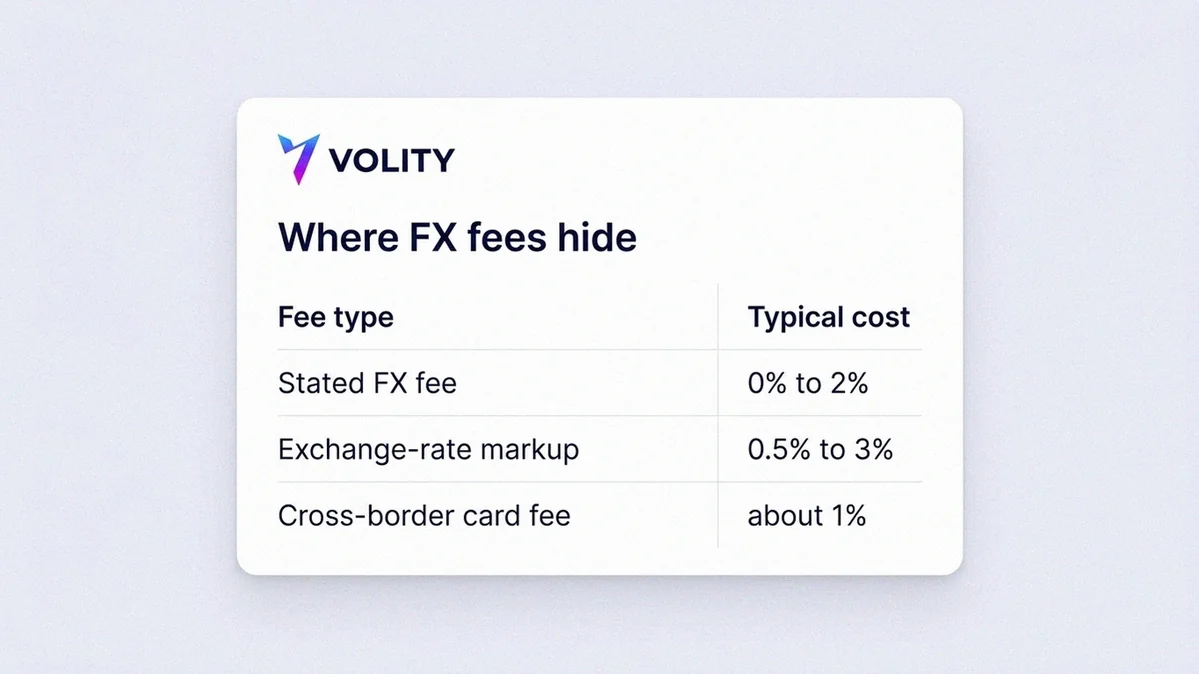
Every conversion carries two separate costs. The first is the named fee, a stated line item labelled “currency conversion fee” or “foreign transaction fee”. You can see it, and it stays honest because it is written down.
The second is the marked-up rate, or spread: a margin slipped silently into the exchange rate, so you get a worse rate and the provider keeps the difference. This is the cost people miss, and often the bigger one.
Your benchmark is the mid-market rate, also called the interbank rate. It is the real midpoint before anyone adds a margin, the honest “wholesale” price. Every rate you are quoted is that number plus a cut.
How the two costs stack up:
Mid-market rate (the honest price) → + hidden markup in the rate (the spread) → + any named fee = what you actually pay
Try this. Split the two apart: the stated fee, then how far the rate sits from the real one.
How to spot the real cost in seconds
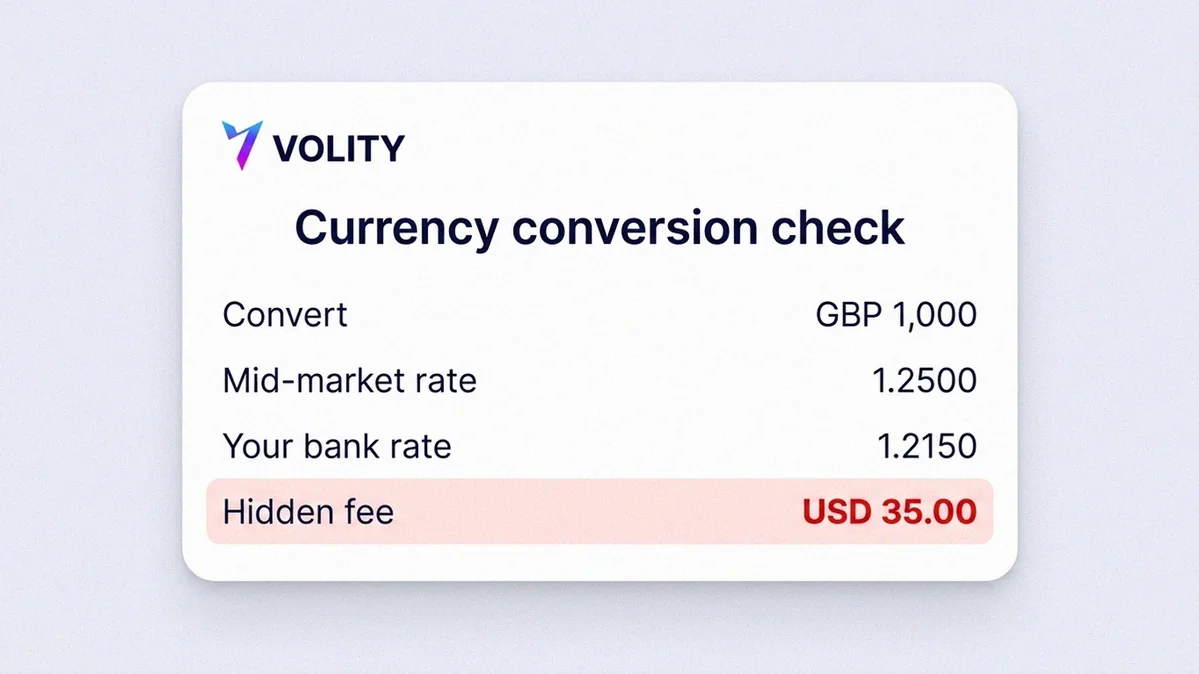
You do not need a spreadsheet, just a ten-second check before you confirm any conversion. This one skill puts you ahead of most people.
- Look up the mid-market rate for your two currencies. A quick search for the pair gives the honest midpoint.
- Compare it to the rate offered. The gap is the hidden markup. A small gap is fine; a wide gap is a warning sign.
- Add any named fee on top, so you see the full cost at once.
- Decide. If the gap is wide or the fee is steep, use a different method, or hold the currency you need instead.
Try this. Run the check before you tap “confirm” at an ATM, checkout or transfer screen. Soon it becomes automatic.
Six ways to cut conversion fees
These are the moves that actually shift the number. Pick the ones that match how you spend.
- Always pay in the local currency, never your home currency. When a terminal, ATM or hotel asks “pay in your home currency?”, that is Dynamic Currency Conversion (DCC), and it lets the operator set the markup. Choose the local currency and your own bank or card handles it, usually cheaper. This is the highest-value, zero-cost habit on the list.
- Avoid airport kiosks, hotel desks and ATM-operator conversion. These are the worst-value places to change money. Plan ahead so they never corner you.
- Use a card or account with no FX fee. A fee-free option removes one of the two costs outright.
- Hold the currency you need in a multi-currency wallet. If you already hold it, there is nothing to convert. More on this structural fix below.
- Convert in one larger move rather than many small ones. Each conversion is a chance to be charged, so one beats a drip of small ones.
- Check the rate against mid-market first. The ten-second check, turned into a habit.
Avoid this. Never accept the “pay in your home currency” offer for convenience. It is the most common, most expensive trap, and declining it costs you nothing.
How a multi-currency wallet removes most of them
Tips fight the problem one transaction at a time. The structural fix is to stop converting at the moment of spending. A multi-currency wallet is an account that holds several currencies side by side, like labelled envelopes of cash. When you already hold the currency you are about to spend, there is no conversion and no markup. You convert once, on your terms, then spend freely.
Volity gives you a $0 multi-currency wallet as part of one all-in-one account, with same-currency internal transfers free. This is “one account, every life-stage” in practice: the default for anyone who touches more than one currency, never a premium add-on. See it on the Volity payments hub.
Try this. Set up a $0 wallet and pre-hold the one or two currencies you use most, so common spends and transfers skip conversion entirely.
FX fees and the 1% conversion rule on a trading account
If you also fund a trading account, conversion cost shows up again, often hidden inside an opaque card conversion. On a Volity account the FX fee is free, so funding across currencies does not carry the silent markup you eat elsewhere. When you convert inside the account, you pay a flat, transparent 1%, a single number you can plan around rather than a moving spread, and same-currency internal transfers are free. Read it on the Volity FX conversion page.
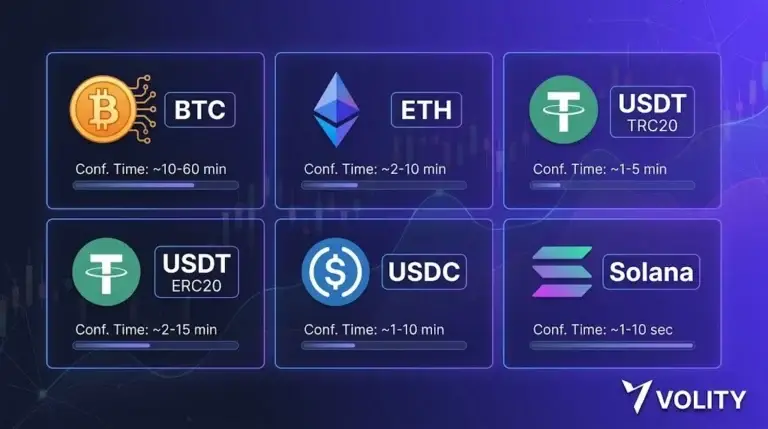
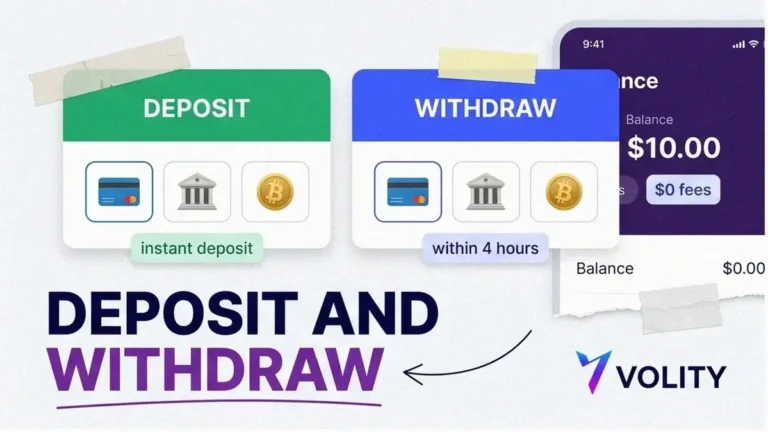
Funding stays clean too: deposits and withdrawals via BTC, ETH, USDT, VISA and Mastercard are free and instant, 24/7, with withdrawals generally within 4 hours and a EUR 10 minimum.
| Where the cost lives | Typical card or kiosk | Volity account |
|---|---|---|
| FX fee | Often charged, sometimes hidden | Free |
| Internal currency conversion | Variable, baked into the rate | Flat, transparent 1% |
| Same-currency transfer | May still carry a fee | Free |
| Deposit / withdrawal | Fees and delays common | Instant 24/7; free on crypto, 2.99% on card deposits |
Convert only occasionally? The habits above are enough. Move or invest across currencies often? A $0 wallet plus an account where the FX fee is free and conversion sits at a clear 1% removes the guesswork.
Try this. Choose a funding path with a known cost rather than an opaque card conversion. You can open a Volity account in minutes, or test it risk-free with a free demo account first.
Your checklist to keep more on every conversion
Save this and run it before each conversion.
- Pay in the local currency, and decline DCC every time.
- Skip airport kiosks, hotel desks and ATM-operator conversion.
- Run the ten-second check: mid-market rate against the rate offered, plus any named fee.
- Use a card or account with no FX fee when you spend abroad.
- Hold the currency you need in a multi-currency wallet so common spends skip conversion.
- Convert in one deliberate move rather than many small ones.
- For investing, prefer a transparent fee (free FX, flat 1%) over a hidden markup.
What to do next: name your conversion touchpoints, set up a $0 wallet and pre-hold your main currencies, then run the ten-second check until it becomes a reflex. Compare the full picture on the Volity fees and account types page.
Reviewed by: A. Bennett, Volity editorial desk.
Data accuracy: all Volity figures (free FX fee, flat 1% internal conversion, $0 wallet, free instant crypto deposits and withdrawals, 2.99% on card deposits, EUR 10 minimum) are verified against the Volity fee documentation, current as of June 2026. General conversion mechanics are stated qualitatively.
Related Volity guides
- Fixed vs floating spread
- How to choose a trading platform
- How to calculate profit and loss on a trade
A withdrawal from a trading venue adds one more conversion to watch, because the funds leave the venue as a dollar stablecoin. Our walkthrough of how to withdraw from an external trading platform explains the difference between an available balance and money the venue has committed to your open positions.
Frequently asked questions
What is a fair currency conversion fee?
There is no single “fair” percentage, because the real cost depends on both the named fee and the hidden markup. The honest benchmark is the mid-market rate: the closer your offered rate sits to it, and the smaller any stated fee, the fairer the deal.
How do banks hide FX fees?
Most of the cost is not a separate charge. A margin gets added quietly into the exchange rate (the spread), so you get a slightly worse rate and the difference is kept. With no line item, many people never realise they paid it.
Is a multi-currency account cheaper?
It usually is, when you hold the currency you actually spend. If the money already sits in the right currency, there is nothing to convert, so no markup. Volity offers a $0 multi-currency wallet with same-currency transfers free.
Does Volity charge FX fees?
The FX fee on the Volity trading account is free. When you convert between currencies inside the account, you pay a flat, transparent 1%, and same-currency internal transfers are free. Confirm it on the Volity FX conversion page.
What is DCC, and should I ever accept it?
DCC is when a terminal, ATM or hotel offers to charge you in your home currency instead of the local one. It lets the operator set the markup, usually worse for you. The rule stays simple: always choose the local currency and let your own bank or card convert.
Sources
This guide draws on the following public sources.
- Bank for International Settlements – CPMI report on cross-border payment costs
- FCA – FCA guidance on avoiding investment scams and clone firms
- IOSCO – IOSCO investor protection and cross-border resources
- European Commission – Single Euro Payments Area rules for euro transfers
- BIS – CPMI on correspondent banking and cross-border cost
- FCA – How to check a firm's authorisation on the FCA register
- CySEC – CySEC public register of Cyprus investment firms
- ESMA – ESMA register of EU investment firms and passporting
- European Commission – EU payment services rules including SEPA and transparency