Investing in financial products involves risk. Losses may exceed the value of your original investment.
The Crypto Trading Starter Kit
A plain-English PDF: what to check before you trade, how orders and risk really work, and the mistakes to skip. Get it free.
Quick answer
HFT crypto trading uses microsecond execution, colocated servers near exchange matching engines, and proprietary market-data feeds. The economics require fixed infrastructure costs of $100,000+ monthly and continuous quant development. Retail traders running Python on home internet cannot compete on latency; what’s actually possible at retail is mid-frequency strategies (1-second to 1-minute holds) using REST APIs and standard exchange feeds.
High-frequency crypto trading is a latency game, not a chart game. Firms co-locate servers in the same data centre as the matching engine, run custom network stacks, and earn fractions of a basis point on each trade across millions of trades per day. The edge is microseconds and rebate tiers, not directional opinion. If you are reading this from a residential connection on a retail account, the realistic conclusion is that you cannot compete with HFT on its terms. The useful question is what to do instead.
What HFT actually is
The Bank for International Settlements characterises HFT as algorithmic trading with very short holding periods, high order-to-trade ratios and co-location to minimise latency. In crypto, three families dominate:
- Market making. Posting two-sided quotes, capturing the spread, earning maker rebates. Inventory-neutral by design.
- Latency arbitrage. Detecting price gaps between venues or between spot and perp faster than competitors and crossing them.
- Statistical arbitrage. Mean-reversion and pairs strategies on baskets of correlated coins, holding seconds to minutes.
The cost stack
Five line items separate professional HFT from retail discretionary:
- Co-location. A rack inside the exchange’s data centre. $5,000 to $20,000 per month per venue.
- Cross-connects. Direct fibre to the matching engine. Microseconds matter; a single switch hop is a rounding error in retail and a deal-breaker in HFT.
- Market data feeds. Raw websocket plus FIX with full order book depth. Some venues charge $10,000+ per month for the fastest tier.
- Fee tier. Top-tier maker rebates of -0.005% to -0.01% versus retail taker fees of 0.05% to 0.10%. The 5-10x asymmetry is structural.
- Engineering headcount. Two to five quant developers and one ops engineer, minimum. $1m+ annual run rate before bonuses.
Why retail latency cannot close the gap
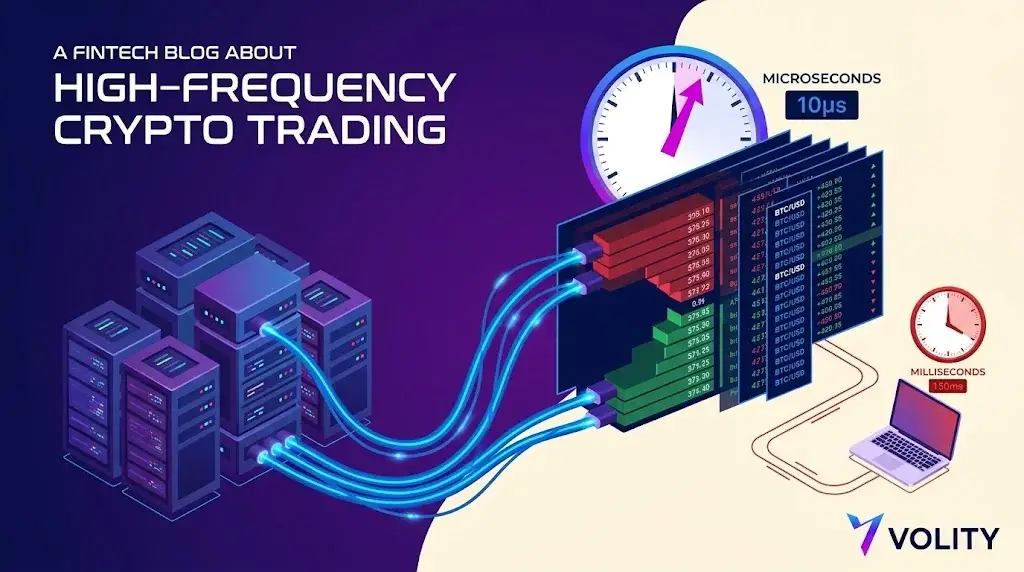
A retail trader on a residential fibre connection in Frankfurt sees a price tick from a Tokyo-based exchange roughly 250 to 300 milliseconds after it prints. A co-located HFT server sees the same tick in 50 to 200 microseconds. That is a 1,000x to 6,000x speed advantage. By the time the retail screen refreshes, the HFT firm has already evaluated the tick, sent an order, received an acknowledgement, and started hedging.
This is not a software upgrade away. The speed of light over fibre between Frankfurt and Tokyo is roughly 50 milliseconds one-way. Physics caps you.
What HFT does to the order book you see
Three observable effects, useful to understand even if you never compete:
- Spreads compress in normal conditions. Aggressive market making narrows the bid-ask gap on liquid pairs to 1-3 basis points.
- Spreads blow out in stress. Market makers pull quotes when uncertainty spikes. The May 2021 BTC flash crash and the November 2022 FTX implosion both saw spreads widen by orders of magnitude for minutes at a time.
- Apparent liquidity is partly mirage. Layers of resting orders cancel before you can hit them. The CFTC has flagged spoofing and layering in multiple actions; legitimate market making is constant order revision, which looks similar from outside.
Where retail edge actually lives
If HFT owns microseconds, retail can still own the timeframes that algorithms are not optimised for. Three honest options:
- Hours-to-weeks horizons. Swing trading and position trading on daily and weekly closes. Latency irrelevant. Discipline is the edge.
- Macro-driven directional. Reading Fed policy, ETF flows, and regulatory developments and positioning ahead of the institutional rotation. Slow but durable.
- Funding-rate cash-and-carry. Spot long plus perpetual short. Mechanical, capital-intensive, indifferent to latency. The position earns the funding rate while staying market-neutral.
What about retail bots?
Retail-grade bots running on cloud VPS or home hardware are not HFT. They are automated retail. The distinction matters because the cost structure is different: a retail bot pays taker fees, not maker rebates, and runs at residential latency. A profitable retail bot exists because it captures patterns at slower frequencies, not because it competes with co-located firms. If a strategy claims to scalp single-tick moves on a retail account, the math does not work.
Regulation watch
The European Securities and Markets Authority (ESMA) regulates HFT under MiFID II Article 17, requiring firms to maintain effective systems and risk controls and to test algorithms. The CFTC has pursued spoofing cases under Dodd-Frank Section 747. Crypto-native venues are slowly aligning. Expect more pre-trade risk controls and audit-trail requirements over the next 24 months as MiCA implementation matures.
The honest framing
HFT is a fascinating market structure phenomenon and a poor strategy choice for retail traders. The right reaction is not to mimic HFT on a smaller budget; it is to choose a timeframe where execution speed is not the binding constraint and discipline is. Volity supports CFD exposure to 20+ cryptocurrencies on a regulated venue, with retail leverage capped at 1:2 under ESMA product-intervention measures and negative balance protection on retail accounts. Execution is by UBK Markets Ltd (CySEC 186/12). Eligible retail clients are covered by the Cyprus Investor Compensation Fund up to EUR 20,000 per client per firm.
Volity operates a trading platform and also publishes educational and analytical content about trading. The content on this page is for educational purposes only and should not be considered financial advice. Volity may benefit commercially when readers open trading accounts through links on this site.
Our content is produced and reviewed under documented editorial standards; see our comparison and review methodology.
Frequently asked questions
What infrastructure does HFT actually require?
Co-located servers next to the exchange matching engine, direct market data feeds, and software measured in microseconds. The cost of that stack is why the field is dominated by firms rather than individuals.
Is there any speed-based edge left for an individual?
Not against genuine HFT. The realistic response is to compete on a different axis: longer holding periods, where a few milliseconds are irrelevant and judgement about direction matters more than latency.
Does high-frequency activity affect ordinary retail orders?
For most retail trade sizes, market making by fast participants tends to narrow the spread. The disadvantage appears mainly in stressed conditions, when that liquidity can withdraw quickly and spreads widen sharply.