Investing in financial products involves risk. Losses may exceed the value of your original investment.
The Crypto Trading Starter Kit
A plain-English PDF: what to check before you trade, how orders and risk really work, and the mistakes to skip. Get it free.
Quick answer
A crypto trading fund token is a tokenized share in an on-chain or hybrid trading fund. Holders gain pro-rata exposure to the fund’s PnL via on-chain redemption or NAV tracking. They sit in a regulatory grey zone: most jurisdictions classify them as securities requiring fund licensing. Examples include Enzyme, dHEDGE, and Set Protocol vault tokens.
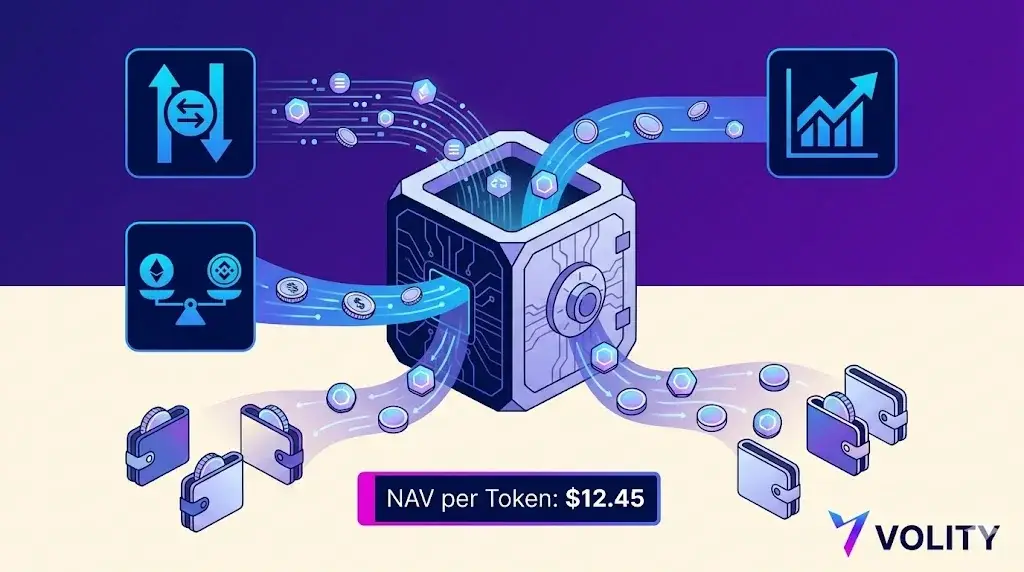
A crypto trading fund token represents a share in a tokenised investment vehicle that runs trading strategies on the holder’s behalf. You buy the token; the protocol or off-chain fund manager runs market making, arbitrage, directional, or yield strategies; the token’s price tracks the net asset value of the underlying portfolio. The structure mimics a traditional hedge fund or ETF, ported onto a blockchain wrapper. The promise is access. The risks are operational, custodial, and regulatory, and most of them are not obvious from the marketing page.
The structural pattern
Three component layers sit behind almost every crypto trading fund token:
- The vehicle. A legal entity (often a Cayman or BVI fund) or an on-chain vault that holds capital.
- The strategy. Off-chain trading desk, on-chain algorithm, or hybrid. Could be market making, statistical arbitrage, options vol selling, or directional macro.
- The token wrapper. An ERC-20 (or equivalent) that represents a fractional claim on the vehicle’s NAV. Mintable on deposit, redeemable on withdrawal, sometimes tradable on a secondary market.
How NAV is calculated
The token’s value should equal: (total fund assets in USD – liabilities) / tokens outstanding. In practice, calculation depends on:
- Pricing source. Which oracle or index is used for the underlying. Mismatched oracles can cause NAV drift versus market reality.
- Frequency. Real-time on-chain vs end-of-day off-chain. The faster the update, the lower the gap between token price and NAV.
- Fees. Management fee (typically 1-2% annual) and performance fee (typically 10-25% above a hurdle), accrued continuously and netted against NAV.
The four risk categories
Standard fund risks plus crypto-specific layers:
- Strategy risk. The trading strategy can lose money. A market-making vault can be picked off by toxic flow; a directional strategy can be on the wrong side of a regime change. Past performance is not predictive, especially in crypto where backtests rarely include 2018, 2022, or 2024 stress windows.
- Custodial risk. Where does the fund hold its assets? Self-custody (smart-contract vault), institutional custodian (e.g., a regulated qualified custodian), or exchange wallet. Each has different failure modes. The 2022 FTX collapse zeroed out funds that held assets there.
- Smart-contract risk. On-chain vaults can be exploited. Audits reduce but do not eliminate this. The Securities and Exchange Commission has flagged smart-contract risk in multiple enforcement actions against tokenised funds.
- Regulatory risk. The SEC’s position is that most tokenised investment vehicles offered to US persons are securities and require registration or exemption. Enforcement has accelerated since 2023. EU’s MiCA regulation, fully applicable from December 2024, sets clearer rules for crypto-asset service providers but does not exempt tokenised funds from existing collective-investment-scheme directives.
Token redemption and liquidity
Two redemption models dominate:
- Primary redemption. Burn the token in exchange for the proportional share of underlying assets. Often subject to lockups, gating, and notice periods (30-90 days is common).
- Secondary market. Sell the token on a DEX or exchange listing. Fast but can trade at a discount to NAV during stress.
The Grayscale Bitcoin Trust (GBTC, traditional, not on-chain) traded at a 49% discount to NAV at its 2022 wide. Tokenised funds with similar redemption frictions exhibit the same dynamic.
Why these tokens exist
- Access. Hedge-fund minimums (often $1m+) are out of reach for most investors. Tokenisation lowers the entry to a single token.
- Composability. The token can be used as collateral in DeFi lending or LP’d into a pool. Useful for sophisticated holders.
- Transparency. On-chain holdings can be inspected at any time, reducing some traditional fund opacity.
- 24/7 liquidity. Unlike traditional funds with weekly or monthly NAV strikes, tokens can be transferred any time.
What to scrutinise before buying
- Manager track record. Pre-token strategy performance, ideally audited and across at least one full bull-bear cycle.
- Custodial setup. Named custodian, segregated account, insurance disclosure.
- Audit reports. Smart-contract audits by recognised firms; financial audits of off-chain operations.
- Redemption terms. Lockup, gating, notice period, suspension clauses.
- Regulatory status. Where is the fund domiciled? Who can buy? US persons restricted? MiCA compliant for EU offering?
- Fee structure. All-in cost including management, performance, custody, and gas/network fees on entry and exit.
How this fits a portfolio
A trading-fund token is a complement, not a substitute, for direct crypto exposure. Direct spot or CFD exposure gives you clean directional control and predictable cost structure. A fund token gives you exposure to a manager’s skill (or lack of it) and a strategy’s correlation profile. Allocate accordingly: spot or contracts as the core, fund tokens as a satellite if at all, with sizing that reflects the layered risks.
Direct crypto exposure at Volity
Volity offers spot-reference and contract exposure to 20+ cryptocurrencies on a regulated venue. Trading is executed by UBK Markets Ltd, a Cyprus Investment Firm authorised by CySEC under licence 186/12. Retail leverage is capped at 1:2 under ESMA product-intervention measures. Negative balance protection applies. Eligible retail clients are covered by the Cyprus Investor Compensation Fund up to EUR 20,000 per client per firm.
Volity operates a trading platform and also publishes educational and analytical content about trading. The content on this page is for educational purposes only and should not be considered financial advice. Volity may benefit commercially when readers open trading accounts through links on this site.
Our content is produced and reviewed under documented editorial standards; see our comparison and review methodology.
Frequently asked questions
What is a crypto trading fund token?
A token that represents a claim on a pooled trading strategy rather than on a network or protocol. Holders gain exposure to the fund's performance without managing positions themselves, and the token can usually be traded.
Why do these tokens exist at all?
They solve a distribution problem: tokenising a fund makes a stake transferable and divisible without the paperwork of traditional fund units. That convenience is the main appeal, and also the main source of regulatory ambiguity.
What should I check before holding one?
Who manages the strategy, whether performance is independently verified, how redemptions work, and what happens if the token trades below the value of the assets behind it. Liquidity of the token is a separate question from performance of the strategy.