Crypto digest: Bitcoin presses $81,000 as altcoins wait for their cue
Bitcoin is doing what bulls wanted most: staying boring at higher levels.
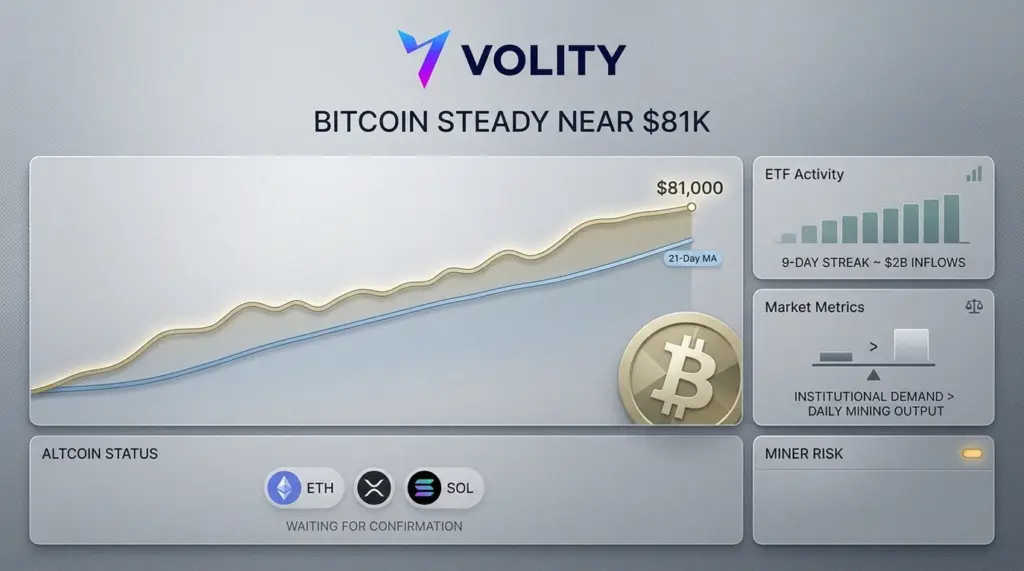
After touching $79,449 in late April, its best mark in 11 weeks, BTC is now probing $81,000. More importantly, it continues to trade above its 21-day moving average. That keeps short-term momentum alive, even as geopolitical headlines try to pull risk appetite off course.
However, the real story sits away from the candle chart. Institutional demand keeps eating supply. U.S. spot Bitcoin ETFs have logged a nine-day inflow streak through April 24, pulling in about $2 billion. Meanwhile, Michael Saylor’s MicroStrategy, ticker MSTR, bought another 34,164 BTC for $2.54 billion.
That lifts the company’s stack to 815,061 coins, or nearly 4 per cent of Bitcoin’s fixed supply. It is a remarkable hoard, even by crypto’s theatrical standards. It also removes coins from the liquid market faster than miners can replace them.
The current range carries more weight than a normal chop zone. A clean daily close above $80,000 would strengthen the case for a move toward six figures by late spring. Still, traders should not mistake calm for certainty. Post-halving economics are tightening, and miners face a harder margin game.
Why May matters
May arrives with sentiment no longer in the basement. The Crypto Fear & Greed Index has climbed to 47, its highest reading in three months. Last month, it sat near 12, a level usually associated with forced selling and dead phones.
That shift matters because Bitcoin is rising without looking technically stretched. Relative Strength Index readings do not yet scream overbought. Meanwhile, institutional bids are estimated at roughly nine times daily mining output. When that continues, even modest demand can push prices sharply.
Still, one warning deserves attention. Avalanche founder Emin Gün Sirer has cautioned that mining rewards remain under pressure after the halving. Higher power costs, lower block rewards and tougher competition could force weaker miners to sell more aggressively.
For now, though, the tape favours dip buyers. Bitcoin has outperformed gold by about 36 per cent since the latest Iran-related tensions entered the market conversation. Traders are treating BTC less like a fragile tech proxy and more like a scarce macro asset.
By the numbers
- Bitcoin: testing the $80,000 to $81,000 zone after an 11-week high.
- ETF flows: about $2 billion over nine sessions through April 24.
- MicroStrategy: 815,061 BTC after a $2.54 billion purchase.
- Sentiment: Fear & Greed Index at 47, up from 12 last month.
- Key level: a daily close above $80,000 could invite momentum accounts.
Altcoins: XRP, ETH and SOL line up catalysts
While Bitcoin sets the weather, altcoins are looking for their own spark.
XRP has moved back into focus as developers push lending tools and programmable escrows on the XRP Ledger. The political backdrop also helps. A markup of the CLARITY Act is expected by May 21, and traders see it as a possible step toward cleaner U.S. crypto rules.
Meanwhile, Senate Banking activity could arrive sooner. Stablecoin provisions remain contested, with banks pushing back and Coinbase lobbying hard. The market impact is straightforward. If lawmakers reduce uncertainty, some trading activity may drift back towards U.S. venues.
XRP technicians are watching the $0.93 to $1.45 area as a possible base. A firmer May tape could bring $1.85 back into view. However, the chart still needs confirmation. Regulatory optimism can lift prices quickly, but it can fade just as fast.
Ethereum looks less dramatic, although that may be the point. ETH remains pinned between $2,100 and $2,400. ETF inflows have improved, and attention is building ahead of the Glamsterdam upgrade. Still, the market needs a close above $2,400 before calling a real reversal.
Solana, meanwhile, continues to court institutional infrastructure money. Its pitch is familiar: speed, liquidity, developer activity and lower transaction costs. That story has worked before. Yet SOL still trades like a high-beta proxy for crypto risk, not a quiet compounder.
Chainlink has also drawn interest after whales removed 2.8 million LINK, worth about $26 million, from exchanges. Reduced exchange balances can signal longer holding periods. However, unlocks remain a supply risk, so traders should avoid treating outflows as a guarantee.
Market map
- XRP: support watched near $1.40, with $1.85 as a bullish May target.
- ETH: range-bound near $2,300, but stronger above $2,400.
- SOL: institutional narrative improving, with $180-plus in bullish scenarios.
- ADA: weaker setup near $0.24 to $0.26, with higher risk attached.
Presales: IONIX Chain gets the retail microphone
Presale markets are warming again, which usually says something about animal spirits.
IONIX CHAIN says its Stage 18 presale has raised $6.7 million, with tokens priced at $0.025. The project markets itself as an AI-native layer one, built around a “Quantum AI Consensus” model. It is targeting mainnet in the second quarter, followed by exchange listings.
That pitch will sound familiar to anyone who has watched crypto fundraising cycles. Fast chains, low fees and hungry retail buyers make a potent mix. However, presales carry different risks from listed tokens. Liquidity can be thin, timelines can slip, and early valuations often rely on marketing more than usage.
BlockchainFX is also drawing chatter as a challenger to exchange-linked tokens such as BNB and CRO. That corner of the market can move quickly when users believe fee discounts, revenue sharing or platform growth will accrue to token holders. Execution still matters more than branding once deposits arrive.
Macro: risk appetite helps, but it cuts both ways
The broader backdrop remains friendly. The S&P 500 sitting near record territory signals that investors still want risk. That has helped crypto, especially as rate-cut hopes and liquidity expectations return to the conversation.
Yet macro support can vanish in a hurry. Europe is still talking about inflation risk. Middle East tensions continue to flicker through oil markets. Crypto traders should watch energy prices as closely as funding rates. A sudden crude spike could pressure inflation expectations and hurt speculative assets.
There is also a growing overlap between crypto plumbing and artificial intelligence spending. Amazon’s use of Coinbase’s x402 system for AI bot USDC payments puts stablecoins inside a practical commercial workflow. Meanwhile, TeraWulf’s high-performance computing revenue is starting to compete with Bitcoin mining economics.
That shift is important. Some miners may become data-centre companies with Bitcoin exposure, rather than pure mining bets. Investors should value them differently when that transition becomes visible in revenue mix.
What traders should watch
- Bitcoin: hold $80,000 and momentum funds may add exposure.
- Miners: post-halving costs could force selling from weaker operators.
- ETFs: another inflow streak would tighten available supply further.
- XRP: CLARITY Act progress could revive U.S. trading interest.
- ETH: $2,400 remains the level that changes the chart.
For now, Bitcoin has the cleanest setup. It has price strength, institutional demand and a supply story that traders understand. Altcoins have catalysts, but they still need Bitcoin’s permission. If BTC loses $80,000, the market will turn pickier fast. If it holds, May could get noisy in a much more profitable way.
This momentum followed the earlier reset captured in our coverage of Bitcoin at $95,000 alongside the E*Trade fee cut, and continued the next day when Bitcoin held $82,000 as US Clarity Act odds jumped. For traders trying to position around these moves, our eight trading strategies for the 2026 market covers the playbooks that fit different time horizons.