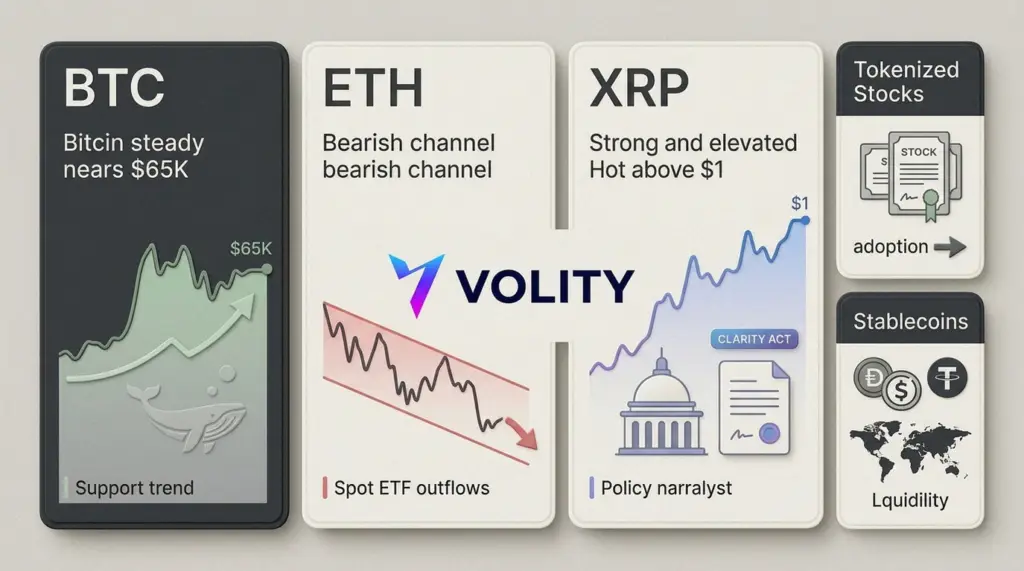
Crypto began the week with a calm face and a busy engine. Bitcoin traded around the mid-$60,000s. Ether remained trapped in a weak technical pattern. Meanwhile, XRP, tokenised equities and stablecoin payment rails drew fresh attention from institutions.
That mix matters. The broad tape looks quiet, yet liquidity is moving under the surface. For traders, the week is less about a single breakout. It is about positioning before regulation, ETF flows and Washington headlines start shifting prices.
Bitcoin: Whales Buy, the Chart Waits
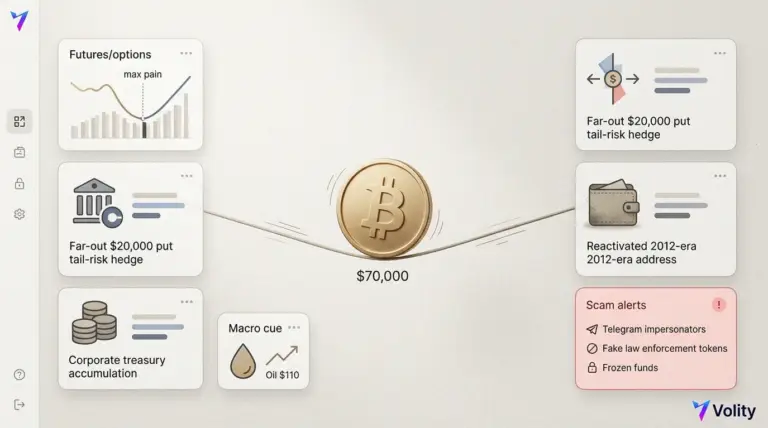
Large Bitcoin holders are accumulating again after the pullback from the $70,000 area. That usually gives bulls comfort. However, the chart has not yet confirmed a clean leg higher.
Bitcoin regained the $65,000 level after a U.S.-Iran peace deal eased oil worries. Risk assets also caught a bid as crude slipped to a two-month low. Still, the move looked more like relief than a full reset.
Peter Brandt, the veteran trader, has argued that buyers should avoid chasing this bounce. His point is simple. Accumulation helps the medium-term case, but price still needs proof.
- Whale buying supports the market below recent highs.
- A close above local resistance would matter more than another intraday spike.
- Volume remains the tell, especially around macro and regulatory headlines.
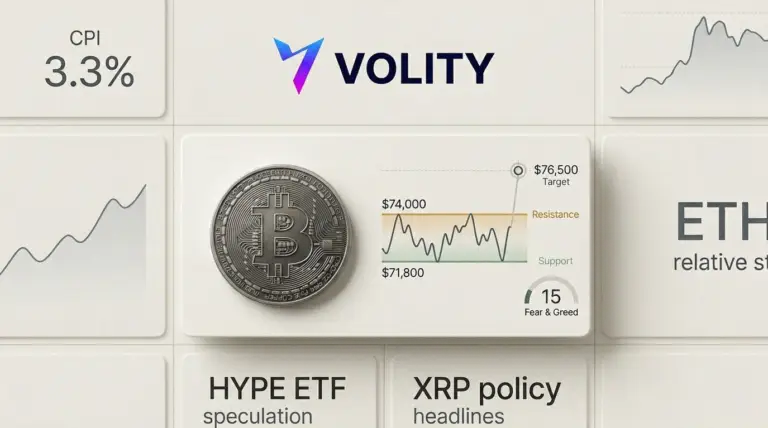
Bitcoin is not a clean momentum trade yet. It is a range trade with bullish sponsorship.
Ethereum: Cheap, Weaker and Still Watched
Ethereum has the opposite problem. The long-term believers are still there. However, the tape keeps punishing late buyers.
Ether remains inside a bearish flag after a drawdown quoted at about 66% from its peak. Large addresses have been adding exposure, but U.S. spot Ethereum ETFs continue to bleed money. Daily net outflows in the millions show that traditional investors are not rushing back.
That leaves ETH in a familiar bind. Fundamentally, the network keeps improving. Technically, the market still distrusts the chart.
One small but useful development comes from security research. Proposed post-quantum upgrades for Ethereum accounts have been pitched at roughly $0.07 per user. That is not a trading catalyst by itself. Still, it reminds investors that Ethereum is not standing still.
For now, ETH needs two things. First, it needs a break above flag resistance. Second, it needs ETF flows to stop acting like a slow leak.
Xrp: Policy Risk Turns Into Policy Upside
XRP is suddenly behaving like a policy asset, not just an old courtroom trade.
The token has held above $1, while U.S. ETF-style products tied to XRP have reportedly drawn stronger demand than Bitcoin and Ether equivalents for five straight weeks. That is a sharp change in market hierarchy.
Meanwhile, XRP’s older infrastructure is getting a second look. A former Ripple developer noted that the XRP Ledger had order-book decentralised exchange functions long before Solana’s current DEX boom. Traders may not care about bragging rights. They do care about settlement history and functioning liquidity.
The bigger catalyst is the CLARITY Act. If the bill advances in a usable form, XRP could benefit from cleaner token classification. That would reduce legal drag and widen the pool of institutions allowed to own it.
So, XRP is no longer trading only on past litigation. It is trading on future permission.
Washington: Crypto Week Becomes a Volatility Event
The week of July 14 is set to carry the “Crypto Week” label in the U.S. House. Lawmakers plan to consider the CLARITY Act, the Anti-CBDC Surveillance State Act and the GENIUS Act.
The political pitch is grand. Supporters want the U.S. to become the crypto capital of the world. However, the market cares less about slogans than line edits.
Critics have pushed amendments covering surveillance, stablecoins and regulatory turf. Some traders call these poison pills. The practical risk is clear. A clean bill could compress regulatory risk premiums. A messy bill could extend uncertainty into the summer.
Prominent crypto investors, including Anthony Scaramucci and Mike Novogratz, have argued that clearer rules could help Bitcoin retest the $70,000 region. Still, traders should expect headline whiplash before any durable repricing.
Institutions: Treasury Buying Meets Etf Outflows
Corporate Bitcoin buying has not disappeared. Michael Saylor’s company has authorised another $100 million Bitcoin purchase. The firm is still treating BTC as a treasury reserve, not a trading position.
At the same time, the ETF channel looks less one-way than it did during the spring rush. U.S. spot Bitcoin ETFs posted about $1.67 billion of outflows in a recent week. Across three weeks, withdrawals exceeded $4 billion.
That matters because ETF flows can both lift and bruise the market. Inflows flatten dips and pull in conservative money. Outflows, however, can turn profit-taking into a mechanical drag.
Meanwhile, product menus are widening. A T. Rowe Price crypto ETF has gained approval with exposure to Bitcoin, Ether and XRP. Multi-asset funds make crypto easier to place inside model portfolios and retirement accounts.
They also change the market’s plumbing. More capital can enter, but it may rotate without warning.
Tokenised Markets: Equities Move Onto Crypto Rails
The sharpest structural change may be outside the major tokens.
Tokenised stocks are narrowing the liquidity gap with spot crypto. Binance’s bStocks recorded a $143 million debut in tokenised equity trading. Meanwhile, Gate is offering access to Hong Kong shares through USDT-funded accounts.
That is not a side show. It suggests stablecoins are becoming a margin currency for global equities. It also means crypto venues increasingly compete with brokers, not just exchanges.
Prediction markets are following the same path. Bernstein expects the World Cup to fuel betting and prediction-market activity, including Robinhood’s newer products. However, regulators are drawing sharper borders. Japan’s Bitbank has warned clients that Polymarket-linked transactions could risk account suspension.
The message is blunt. Liquidity is global. Compliance remains local.
Stablecoins: Payments Chase Real Use
Stablecoins kept moving from trading desks into payments.
Zelle has chosen India for its first cross-border remittance launch and introduced ZLUSD as a settlement asset. That puts bank-linked stablecoin transfers directly against older remittance networks.
Meanwhile, Plume and Bybit are pushing tokenised real-world asset yield to stablecoin users. The pitch is simple. USDT holders can seek off-chain income without leaving an exchange interface.
Cyrus Finance and similar platforms are leaning into the same demand. However, higher advertised yield always deserves a harder counterparty check. Stable returns still need stable plumbing.
Europe: Mica Starts to Bite
Europe’s MiCA regime is moving from theory to market impact.
Industry estimates suggest as many as 75% of EU-based crypto firms could lose their licences on July 1 if they miss the new requirements. That could disrupt euro pairs and push volume toward better-capitalised venues.
Elsewhere, regulators are also tightening. The Philippines central bank is increasing scrutiny of crypto tokens. India has issued more than 44,000 crypto tax notices and identified over $100 million in undeclared income.
The old offshore convenience trade is getting harder. Traders may soon pay more for clean access and reliable settlement.
Altcoins: Ai Buzz and Gaming Stress
The altcoin market is selective rather than euphoric.
- Worldcoin, ticker WLD, rose about 20% on OpenAI IPO chatter and Eightco buying.
- HYPE gained roughly 9% on the week before a key technical zone.
- Uncharted is closing with its game Fishing Frenzy, adding pressure to GameFi sentiment.
That mix says plenty. AI-linked tokens can still move fast on outside technology stories. However, weaker gaming projects are running out of time and capital.
Related coverage on Volity
- Bitcoin Price Falls as Crypto Week, XRP ETF Buzz and Tokenised Stocks Heat Up
- Fed Rate Cuts, AI Chip Stocks and Energy Policy: What to Buy Now
- RZLV Buyback, AMD AI Lead: Top Stocks to Watch Today
- AI Earnings Test: Adobe (ADBE) and Oracle (ORCL) in Focus
- Bitcoin Price Wobbles as Tokenisation Goes Mainstream
By the Numbers
- $65,000: Bitcoin’s key relief level after calmer oil markets.
- $1.67 billion: recent weekly outflows from U.S. spot Bitcoin ETFs.
- $143 million: Binance bStocks debut volume in tokenised equities.
- 75%: estimated share of EU crypto firms at risk under MiCA deadlines.
- 44,000: crypto tax notices issued in India.
Trading Lens
- Respect the range: Bitcoin has whale support, but not breakout confirmation.
- Watch ETF flows: outflows can overpower good narratives in thin conditions.
- Track Washington: the CLARITY Act may move XRP, BTC and exchange tokens.
- Follow stablecoin rails: tokenised stocks and remittances are becoming real liquidity channels.
- Check venue risk: MiCA and local rules may reshape where volume actually trades.
This is not a sleepy crypto week. It is a positioning week. The best trades may come from seeing where liquidity moves before the price screen catches up.