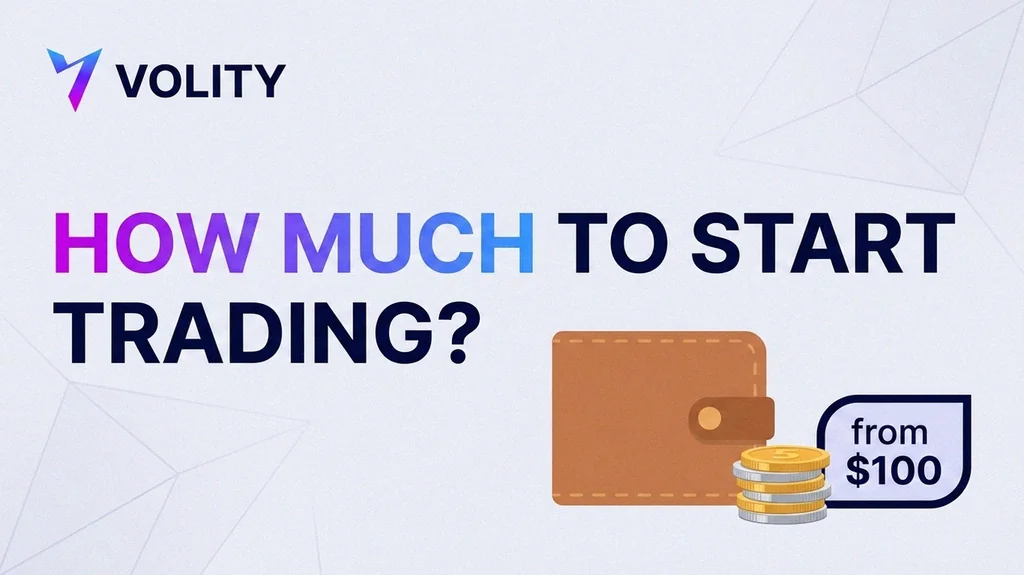
The honest answer to “how much money do you need to start trading” is not one magic number, and anyone who gives you one is selling something. You really need two numbers: what your broker requires to open an account, and the working capital that keeps your style alive through its first losses. With Volity you open a Markets account from $1, commission-free. This guide gives you both, plus the method to size your own.
TL;DR / Quick insight: There is no universal minimum. Separate two figures: the account minimum (Volity Markets opens from $1, commission-free, EUR 10 funding floor) and your sensible starting capital, which depends on your market, style and risk per trade. Start small on a real account, use fractional shares to scale in, practise on a free demo first, and never confuse leverage with “needing less money”.
Most pages blur these numbers and hand you a vague “a few hundred to a few thousand”. That range is useless without the reason behind it: position sizing. Volity’s view is calmer – anyone with a financial life can start small and real, then grow.
1. The honest answer: your minimum depends on three things
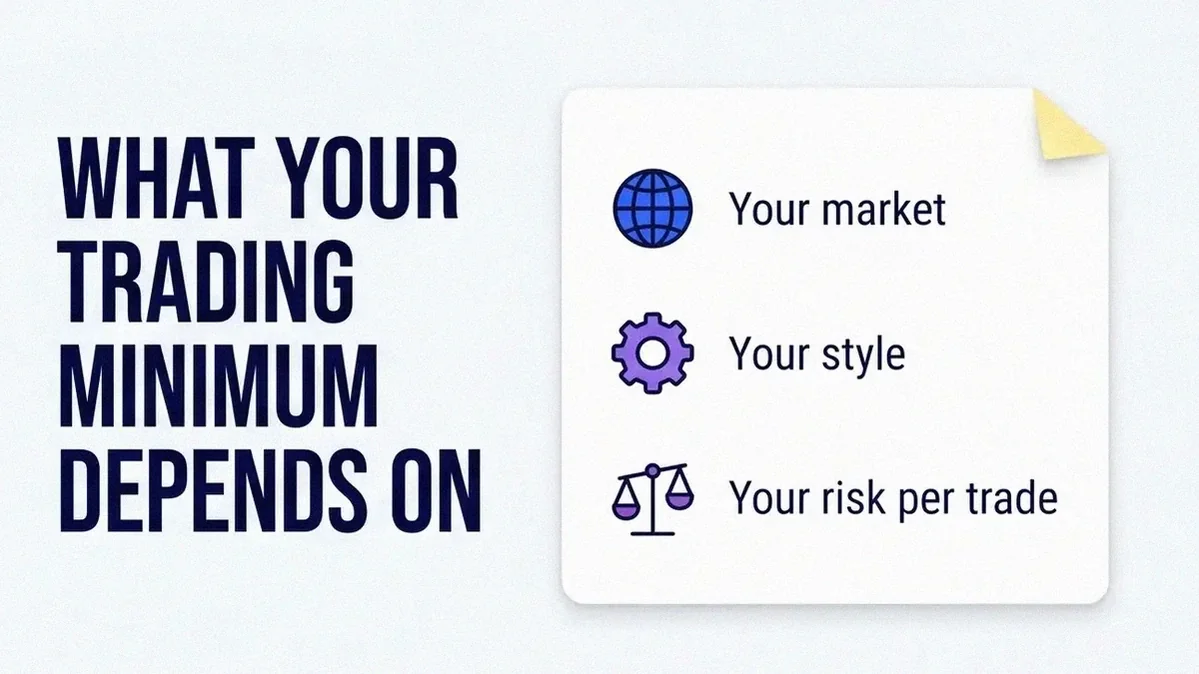
Your starting number is decided by three inputs. Skip one and you pick a figure too small to work or too large to risk.
- The market. Stocks let you buy a fraction of a share, so you can start with very little. Forex trades in lots, so size and the spread matter more. Crypto moves fast, so the same dollar carries more risk.
- Your style. “Style” just means how long you hold a trade. Scalping and day trading need tighter sizing than swing or position trading – more discipline, not more money.
- Your risk per trade. The fixed percent of your account you are willing to lose on one trade. This is the lever the hype pages never mention, and it lets a small account take many tries.
Do this now: write down one market and one style – not three, one. The guide turns that single choice into a single number.
2. Account minimum vs sensible starting capital
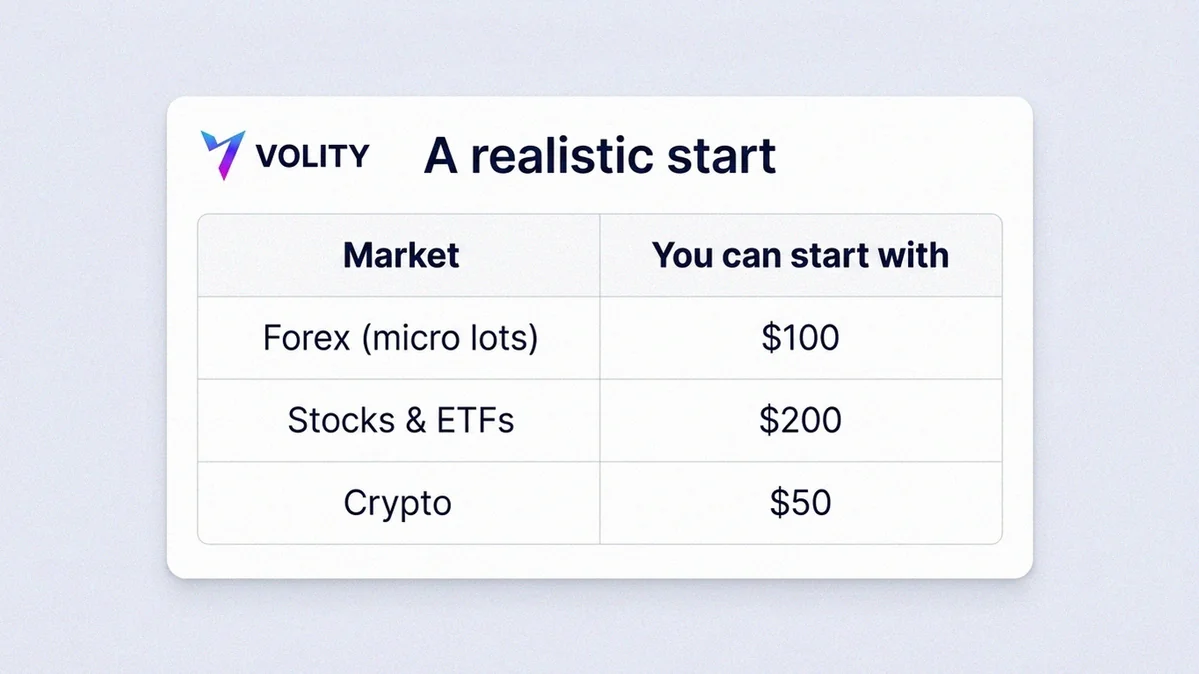
The account minimum is what the broker requires to open and fund. The sensible starting capital is what makes your style workable. They are rarely the same number, so keep them in separate boxes. On Volity the entry anchor is clear: the Markets account opens from $1, and trading is commission-free, so no per-trade fee quietly eats a tiny balance. Separately, the minimum deposit and withdrawal are EUR 10 – the funding floor for moving money in and out. EUR 10 is the smallest top-up, $1 is the Markets tier minimum; do not conflate them. Volity also offers PRO (from $500) and VIP (from $10,000), but Markets is the realistic on-ramp.
Verdict: Note your broker’s account minimum (Volity Markets: from $1, commission-free) in one box, and “working capital, to be calculated” in another. The minimum is the easy part.
3. How position sizing decides your real minimum
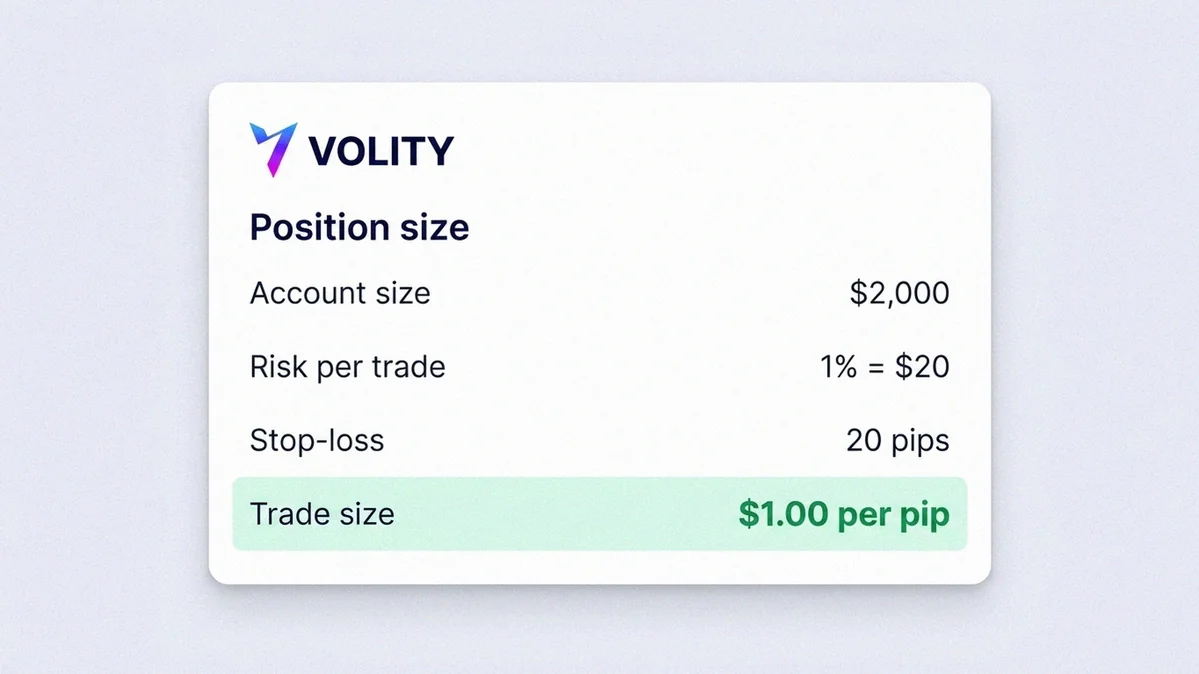
This is the mechanism the hype pages skip. Position sizing means making each trade small enough that a loss only costs a fixed, small percent of your account. Your real minimum is the smallest balance that places one valid position under that rule.
The position-sizing chain (illustration only):
Balance → pick a fixed risk percent → risk in money → divide by stop distance → position size.
Example, to show the arithmetic: on a $500 account, risking 1% means accepting a $5 loss. If your stop (the point where you admit the trade is wrong) sits 50 price units away, your size is whatever makes those 50 units equal $5. Change any input and the answer changes – no figure is a promise.
Read it backwards: your minimum is the smallest account that still places one real position at your chosen risk. If your market and stop force a position too tiny to place, the account is too small for that style. Do this now: pick your risk percent and work backward to that number.
4. A starter budget for forex, stocks and crypto (illustrative)
Apply the method to each market. The table illustrates the math – not recommended amounts.
| Market | Why the math differs | How to start small (illustrative) |
|---|---|---|
| Stocks | Shares can be pricey, but you need not buy a whole one. | Use fractional shares to buy a slice, so a tiny balance places a real position. Scale in over time. |
| Forex | Forex trades in lots; you pay the spread (gap between buy and sell price) on entry. | Use the smallest size your rule allows; treat the spread as a real cost. |
| Crypto | More volatile, so the same dollar carries more risk. | Size down so a hard swing still respects your fixed risk percent. |
Volity makes “start small” practical: you trade real shares, fractional shares, crypto and CFDs from one account, with a $0 multi-currency wallet behind it. Fractional shares are the quiet hero – they let a beginner own a slice of an expensive company, so your stock budget can be honestly small (the Volity stocks hub covers this in depth). Do this now: scale in rather than deploying the whole balance at once.
5. What a small account can and cannot do (the leverage trap)
The loudest corner of this topic is the “$50 controls $100,000” crowd. The plain truth: leverage amplifies losses as much as gains; it does not mean you “need less money”. A small move against you can wipe the account – leverage is borrowed exposure, not free buying power. Volity does offer leverage (up to 1:500 on PRO and VIP, up to 1:50 on crypto), but treat it as a risk dial: the higher the leverage, the smaller the move needed to hurt you. A small account survives on disciplined size, not leverage.
Verdict: Cap your leverage and per-trade risk before your first live trade, and never fund money you cannot afford to lose. Survival comes from size that lets you be wrong repeatedly.
6. What not to do with a small account
Most small accounts are killed by avoidable mistakes, not the market. Avoid these.
- Over-trading. Trading out of boredom or to “make it back” burns capital and breaks your sizing rules.
- Skipping the demo. Going live before your rules hold up pays tuition a free demo would have saved.
- Ignoring costs. Spreads and overnight financing matter more on a small balance, so factor them in.
- Funding then abandoning. Volity charges a $25/month inactivity fee only when both are true: no trades for 12+ months and no deposit in 90 days. Easy to avoid – just do not fund-and-forget.
- Confusing leverage with capital. Leverage is no substitute for an adequately sized account.
Do this now: run your plan on a FREE VOLITY DEMO first – every tier includes one – and go live only once your sizing survives a realistic run.
7. Checklist: are you funded and ready to start?
Tick every box honestly and you are funded, sized and ready.
- Market and style chosen. One market, one style, on paper.
- Risk-per-trade percent set. A small, fixed percent you will not break.
- Position size validated. Your account can place one correctly-sized position.
- Costs understood. You know the spread and overnight conditions for your market.
- Demo passed. Your plan held up on a free demo across a realistic run.
- KYC ready. You are 18+ with ID, proof of address and source-of-funds details.
- Only risk capital funded. The deposit is money you can afford to lose.
Do this now: complete the checklist, check the costs for your market on the SEE FEES AND ACCOUNT TYPES page, then OPEN A VOLITY ACCOUNT on the Markets tier (from $1, commission-free, fractional shares) and place your first correctly-sized trade. Keep learning at the Volity trader hub. The number you start with is smaller than the hype claims; the discipline you bring matters more.
Reviewed for accuracy: A. Bennett, Markets Editor, Volity.
Data integrity: all Volity product facts (Markets from $1, commission-free, EUR 10 funding floor, free demo, fractional shares, leverage and inactivity-fee terms) are verified against the Volity fee schedule as of June 2026. All starting-capital amounts and the risk example are universal illustrations of position-sizing math, not Volity figures or promises.
Related Volity guides
Related coverage on Volity
- Fractional Shares Explained: How to Start Investing With $50
- Demo vs Live Trading Account: A 7-Step Checklist Before You Go Live
- How to Size a Trade: Position Sizing and Risk Per Trade for Beginners
- How to Start Stock Trading: A 2026 Beginner Guide
- Forex Risk Management: A Position-Sizing Framework for Pairs
Frequently asked questions
Can you start trading with 50 dollars?
Yes. On Volity you open a Markets account from $1, commission-free, so per-trade fees do not drain a small balance. The caveat: $1 is the account minimum, not a magic working budget for every style. Fractional shares let you place a real stock position from a small balance; faster styles like forex day trading may need more.
How much money do you need to start forex trading?
There is no fixed figure. Your forex minimum is whatever lets you place one valid position while risking only a small fixed percent of your account. Work backward from your risk percent and stop distance to find your own number.
Is 100 dollars enough to trade?
It can be enough to start and learn, especially with commission-free trading and fractional shares. Whether it suits a style depends on your sizing math. Treat $100 as a starting point for practice, not a base for over-leveraged bets.
What is the minimum deposit to open an account?
On Volity, the Markets account opens from $1, and the minimum deposit and withdrawal are EUR 10. These are two different things: $1 is the Markets tier minimum, while EUR 10 is the smallest amount you can move in or out. Deposits via BTC, ETH, USDT, VISA and Mastercard are free and instant.
Should I use a demo account before funding real money?
Yes, and Volity includes a free demo on every tier for exactly this. It lets you test your sizing rules, your market and your costs with zero risk. Move to live only once your plan survives a realistic run of demo trades.
Sources
This guide draws on the following public sources.
- IOSCO – IOSCO on retail distribution and digital engagement practices
- Nobel Prize – Kahneman's Nobel work on judgement under uncertainty
- Bank for International Settlements – BIS working paper on retail trading behaviour
- ESMA – ESMA warning on speculative retail trading risk
- CFA Institute – CFA Institute Research Foundation on investor behaviour
- Bank of England – Bank of England explainers on markets and risk
- IOSCO – IOSCO report on retail market conduct and online marketing
- Nobel Prize – Thaler's Nobel work on behavioural economics
- Bank of England – Bank of England explainer on interest rates and risk