You want to start investing, but one question freezes most beginners: “what if I buy at the worst possible moment?” Dollar-cost averaging (DCA) is the simple answer: you invest a fixed amount on a fixed schedule, no matter what the price is doing. No guessing the perfect day, no staring at charts. This guide gives you the exact method, a worked example you can copy, and an honest call on when DCA actually fits you.
TL;DR / Quick insight: Dollar-cost averaging means investing the same fixed dollar amount on a regular schedule (say $100 every month), regardless of price. Because that fixed amount buys more units when prices are low and fewer when high, it smooths your average entry price and removes the stress of timing the market. It does not guarantee a profit or remove risk: lump-sum has historically come out ahead more often, but DCA wins on discipline and is the natural way to invest from a paycheck. To run it cleanly you need fractional shares and commission-free trades, so small buys are not eaten by fees.
Most beginners are not investing a giant windfall – they put aside a slice of each paycheck, which is exactly what DCA was built for. The hard part is not the idea, it is the setup, so frictions like whole-share prices and per-trade fees do not quietly break the plan.
What dollar-cost averaging is, and why it lowers timing stress
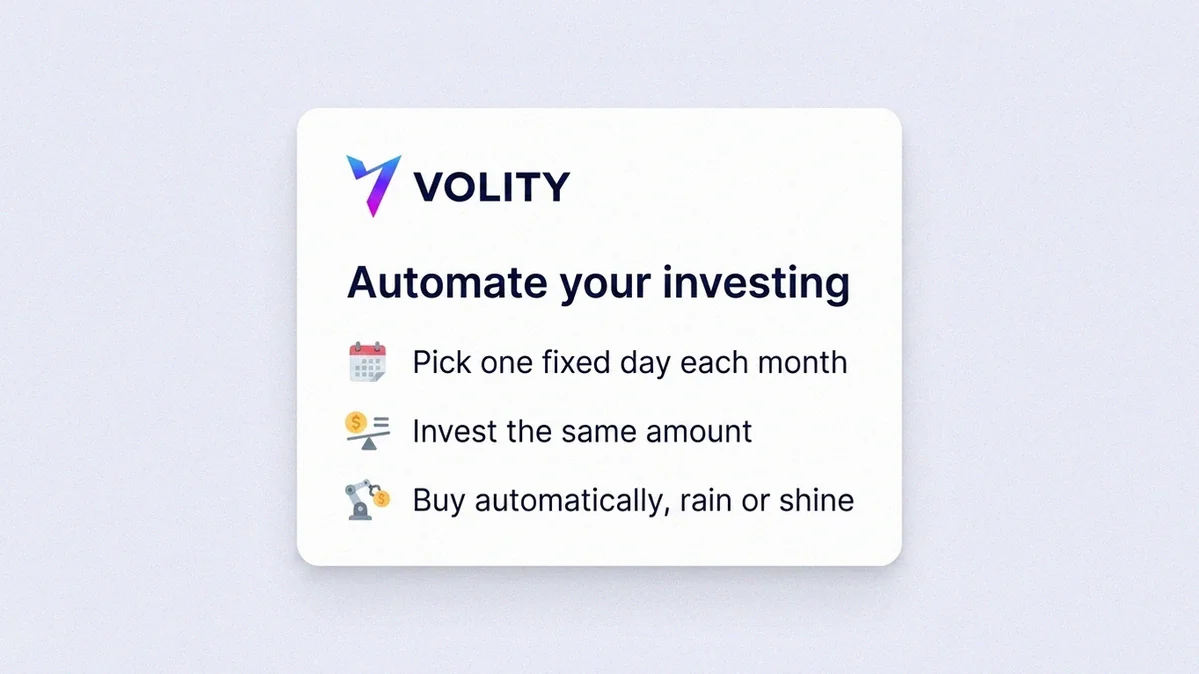
Dollar-cost averaging is investing a fixed dollar amount on a fixed schedule, regardless of the price that day. You decide the amount (say $100), the cadence (how often you buy, such as monthly), and the asset (a stock, an ETF, crypto), then buy on schedule. A fractional share is a slice of one share: if a share costs $180 and you have $100, you buy 0.55 of it instead of needing a whole one.
Here is the quiet magic. When the price drops, your fixed $100 automatically buys more units; when it climbs, the same $100 buys fewer. You buy more when things are cheap and less when expensive, without ever deciding to, so you never have to call the bottom. Timing the market is hard even for professionals; a fixed schedule removes the decision. Match the cadence to your income – paid monthly, buy monthly on payday.
Do this now: Write your one-line rule: “I will invest [amount] in [asset] every [cadence].” For example, “I will invest $100 in a broad market ETF every month.”
How DCA works, step by step (a worked, illustrative example)
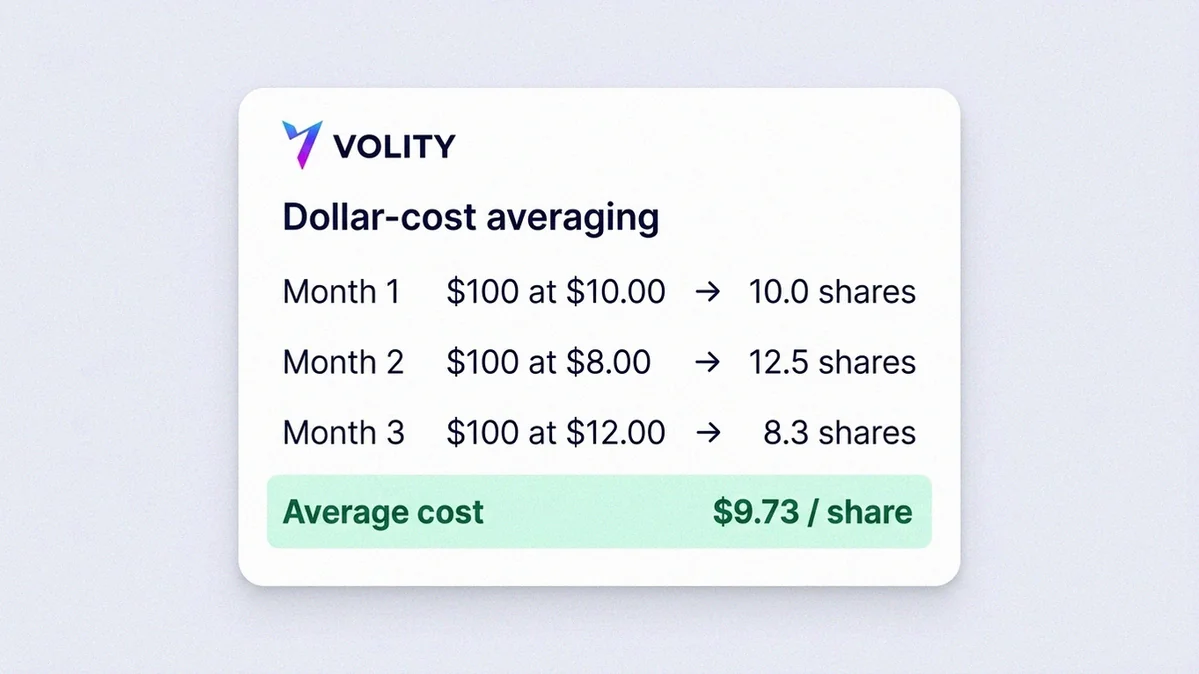
The table below is illustrative only – made-up teaching prices, not real prices, a forecast, or a Volity result. We invest a fixed $100 each month into an imaginary asset.
| Month | Fixed amount | Price (illustrative) | Units bought |
|---|---|---|---|
| 1 | $100 | $20 | 5.00 |
| 2 | $100 | $10 | 10.00 |
| 3 | $100 | $25 | 4.00 |
| 4 | $100 | $20 | 5.00 |
Add it up. We invested $400 total and collected 24 units, so your average cost is $400 / 24 = about $16.67 per unit – lower than the $18.75 simple average of the four prices, because your fixed $100 bought the most units in month 2, when the price was cheapest. One caveat: it only helps when prices recover, so a diversified asset matters.
Do this now: Copy four inputs into a note – amount, asset, cadence, start date. That is the whole setup.
Set up your plan in 5 steps
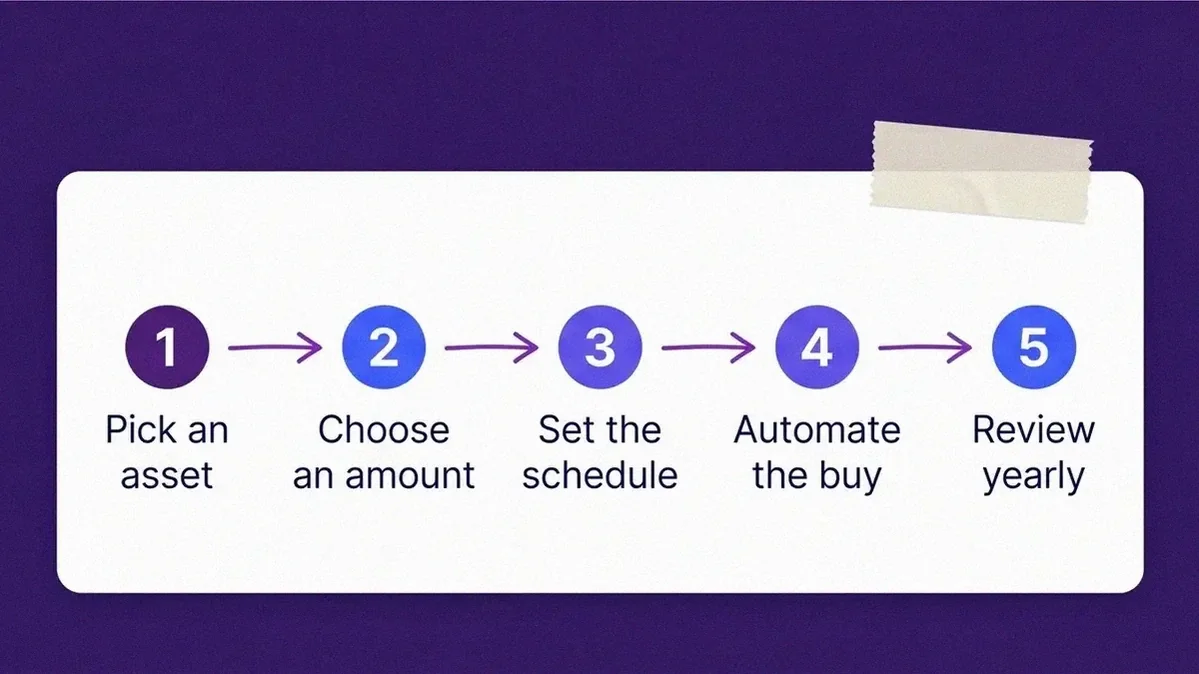
Work through all five before you fund anything.
- Step 1: Choose the asset. For most beginners a broad market ETF (one fund holding many companies, so you are not betting on a single stock) is the calmest start. A stock or crypto works too, but carries higher risk.
- Step 2: Set a sustainable amount. Pick a figure you can keep investing in a bad month. $50 monthly for years beats $300 for two months and quitting.
- Step 3: Choose your cadence. Weekly or monthly, on a specific day – monthly on payday is simplest.
- Step 4: Automate or calendar the buy. Use a recurring buy if your platform supports it, otherwise a recurring reminder. The goal is no fresh decision each cycle.
- Step 5: Set a review interval, then leave it alone. Quarterly or twice a year is plenty; otherwise, do nothing.
Do this now: Complete all five fields before you deposit a cent. A plan with a blank breaks under pressure.
A fixed-dollar plan only works cleanly if two things are true: you can buy a partial share, and you are not charged a fee on every small buy. If your rule is “$50 a month” but a share costs $180, without fractional shares you cannot follow your plan; and a commission on a $1 buy eats a painful slice every month.
That is why the Volity Markets account works the way it does. Trading on Markets is commission-free, so small recurring buys are not eaten by fees, and fractional shares let a fixed amount cleanly buy a partial share. The entry minimum is just $1, a $0 multi-currency wallet funds the account, and a free demo account on Volity’s own platform, Volity MT, lets you rehearse.
Do this now: OPEN A FREE DEMO ACCOUNT and place one practice buy at your planned size before risking real money. Full pricing is on the CHARGES AND FEES page.
DCA vs lump-sum: the honest trade-off
Anyone searching “is dollar-cost averaging worth it” deserves a straight answer. The alternative to DCA is lump-sum investing – all your money in at once. Historically, lump-sum has come out ahead more often, because markets tend to rise over time, so the sooner money is in, the longer it grows. DCA still matters for two reasons: discipline (watching a large one-off investment drop next week is brutal, and that fear keeps people in cash), and the fact that it is how you invest from regular income.
Verdict: Single large sum and a long horizon? Lump-sum has the historical edge, do not be scared out of it. Investing from a paycheck, or would a lump sum freeze you in cash? DCA is the right choice. To be clear, DCA does not guarantee a profit or remove risk and is not a way to “beat” lump-sum – it is a way to invest consistently and sleep at night.
Common mistakes that quietly break a DCA plan
DCA fails for behavioural reasons far more than financial ones. The worst is stopping during a dip – a falling price is exactly when your fixed amount buys the most units, so a downturn is the disciplined moment to buy the dip, the plan working, not failing. Close behind: changing the amount on emotion reintroduces the guesswork you adopted DCA to avoid; an unsustainable cadence you abandon in two months; and ignoring fees and whole-share limits. The cure is to decide your behaviour in advance, while calm. Our trader education hub covers the routine.
Do this now: Write one sentence for a downturn before one happens: “If the market falls, I keep buying on schedule and do not check the balance until my next review.”
Checklist: start your first plan
Tick every box, then begin on the demo, then a small real buy.
- Asset chosen – a broad ETF, a stock, or crypto, and you understand its risk.
- Amount set – a fixed figure you can sustain through a bad month.
- Cadence set – weekly or monthly, on a day tied to payday.
- Automation or reminder set, so no fresh decision is needed.
- Fees confirmed – commission-free buys and fractional shares.
- Demo rehearsed, downturn rule written.
Every box ticked? Then start; the hard work in DCA is the setup. When you are ready for a real plan, you can OPEN A VOLITY ACCOUNT with a $1 minimum, commission-free buys and fractional shares built in. For more, see our stocks hub.
Reviewed for accuracy: A. Bennett, Volity editorial desk.
Data integrity: all product facts (commission-free Markets trading, fractional shares, $1 entry minimum, $0 wallet, free demo, Volity MT platform) are verified against Volity’s documentation as of June 2026. The DCA mechanics and worked example are universal and illustrative only – teaching figures, not real prices, forecasts, or Volity performance.
Related Volity guides
- Fractional shares: start investing with $50
- Position sizing and risk per trade
- Risk-reward ratio explained
Related coverage on Volity
- Fractional Shares Explained: How to Start Investing With $50
- How to Start Stock Trading: A 2026 Beginner Guide
- How to Avoid Common Stock Trading Mistakes
- Demo vs Live Trading Account: A 7-Step Checklist Before You Go Live
- Fundamental Analysis in Stock Trading: A Working Definition
- Charlie Munger: mental models and investing legacy
You can apply the same drip-buying discipline to a single stock; see how to buy Barclays shares for the practical steps.
Frequently asked questions
What is dollar-cost averaging in simple terms?
It is investing the same fixed amount on a regular schedule – for example $100 every month – no matter what the price is that day. Because your fixed amount buys more units when prices are low and fewer when high, it smooths your average entry price and removes the need to guess the perfect moment to buy.
Is dollar-cost averaging worth it for beginners?
For most beginners, yes – because beginners typically invest from a regular paycheck, and DCA is the natural way to do that. It builds an automatic habit and removes the timing stress that keeps people in cash. It does not guarantee a profit, but it makes investing something you can keep up.
Does DCA beat lump-sum investing?
Not as a rule. Historically, investing a lump sum all at once has come out ahead more often, because markets tend to rise over time. With a large sum and a long horizon, lump-sum has the edge; if you invest from income, you are dollar-cost averaging anyway, and it wins on discipline.
How do I dollar-cost average with a small amount like $50?
You need fractional shares, so $50 can buy a partial share when a full share costs more, and commission-free trades, so a fee does not eat into a small buy. On a Volity Markets account both are built in, with a $1 entry minimum, so a small fixed amount fits cleanly every cycle.
What is the biggest mistake people make with DCA?
Stopping during a market dip. A falling price is exactly when your fixed amount buys the most units, so a downturn is the plan working, not failing. The fix is to write down, while calm, that you will keep buying on schedule no matter what.
Sources
This guide draws on the following public sources.
- BIS – BIS Quarterly Review on the growth of passive investing
- European Central Bank – ECB Economic Bulletin on markets and household investment
- ESMA – ESMA investor corner on funds, ETFs and costs
- London Stock Exchange – London Stock Exchange listing and market structure
- CFA Institute – CFA Institute Research and Policy Center publications
- Bank of England – Why inflation erodes the real value of returns
- Bank of England – How interest rates and inflation interact
- Bank of England – The 2% inflation target and why it matters to savers
- ESMA – MiFID II rules on costs, charges and disclosure